
TL;DR:
- Centralizing food operations consolidates prep, production, and admin to reduce costs and improve consistency. It lowers labor and space expenses while enhancing quality control and data management, supporting scalable growth. However, underutilization and management complexities pose challenges that require careful planning.
Centralizing food business operations means consolidating prep, production, procurement, and admin into a single hub to cut costs and build consistency. Food entrepreneurs who understand why centralise food business operations matters gain a direct edge: lower labor bills, smaller site footprints, and quality that holds across every location. The industry term for this model is the commissary or central production unit. Whether you run weekly meal plans, a catering operation, or sell digital recipes, the case for centralized management is clear, and the numbers back it up.
Why centralise food business operations: the core case
Centralizing food operations is defined as moving prep, production, and administrative control away from individual sites into one coordinated hub. This shift produces measurable gains across labor, space, and supply chain management. Operators adopting commissary kitchens report labor cost savings of 15–20% by moving prep off-site to specialized teams. That figure reflects a structural change, not a one-time fix. When prep work leaves the individual site, the remaining team focuses on service and assembly, which requires less culinary skill and less pay.
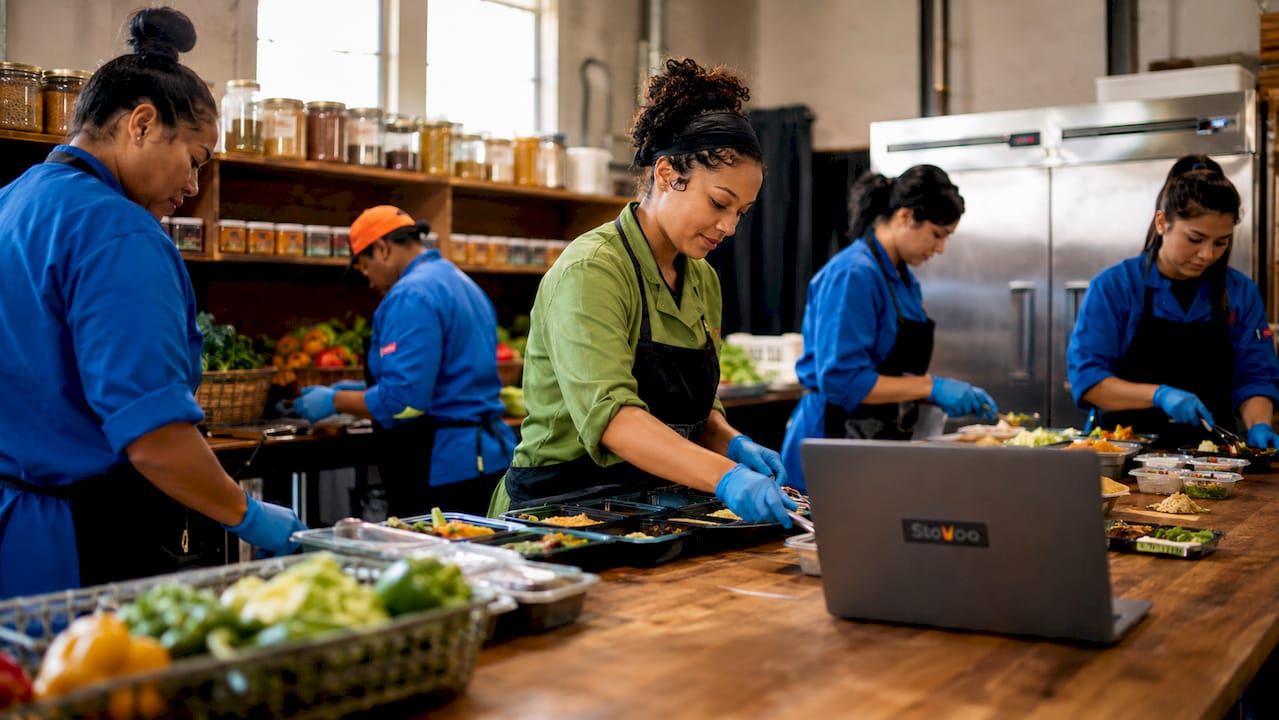
The benefits of centralizing food operations also extend to purchasing power. Centralized prep enables bulk purchasing, specialized equipment use, and tighter inventory control across multiple locations. A single purchasing team negotiating with suppliers beats five separate site managers buying the same ingredients at retail prices. For food entrepreneurs scaling from one location to several, this purchasing leverage protects margins at exactly the moment they are most at risk.
How does centralizing reduce labor costs and site footprint?
Labor and rent are the two largest cost lines in any food business. Centralization attacks both at once.
On the labor side, moving prep to a central kitchen changes who you hire. Sites shift from employing skilled chefs for prep to hiring assembly staff focused on speed and quality compliance. That transition lowers average hourly wages and reduces training time. The 15–20% labor savings reported by commissary kitchen operators come directly from this shift in labor profiles.
On the space side, the gains are equally concrete. Restaurant operators reduce individual site footprints by 30–40% when prep moves off-site. That freed back-of-house space converts into customer seating, storage, or additional revenue-generating use. For a food entrepreneur paying premium rent in a city center, reclaiming even 20% of the kitchen floor plan pays for itself quickly.
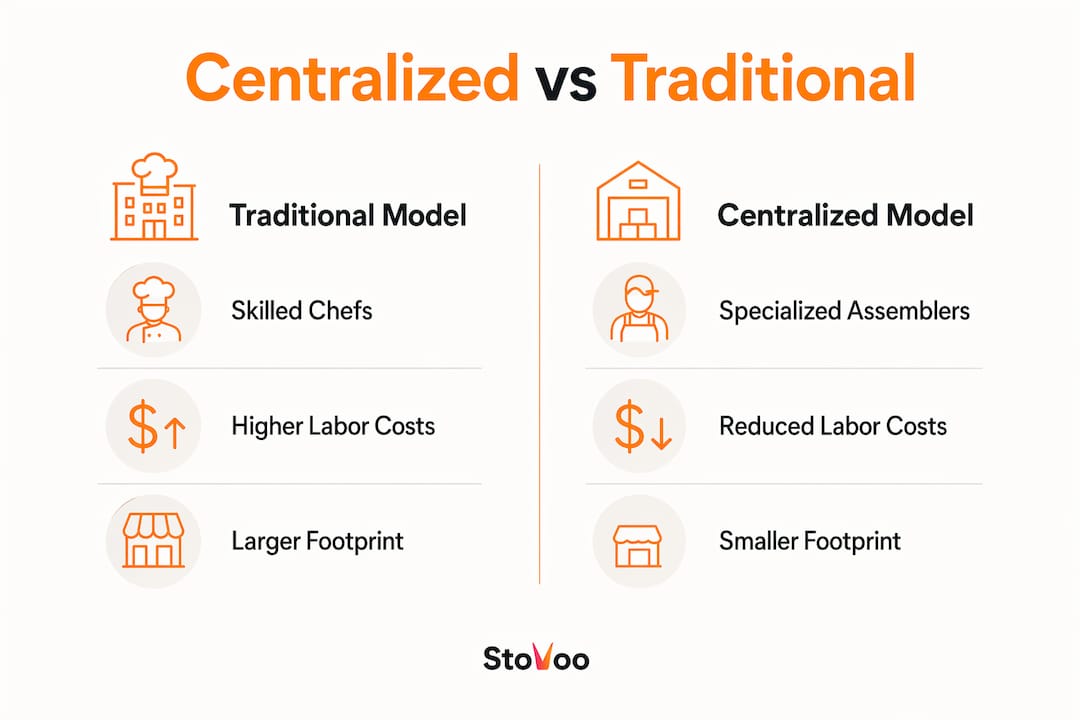
| Factor | Traditional model | Centralized model |
|---|---|---|
| Labor profile | Skilled chefs at every site | Assembly staff on-site, specialists centrally |
| Labor cost | Higher per site | 15–20% lower overall |
| Back-of-house space | 40–50% of total floor plan | 10–20% of total floor plan |
| Purchasing | Site-by-site at market rates | Bulk purchasing with negotiated rates |
| Training burden | High, repeated across sites | Concentrated at central kitchen |
Pro Tip: When hiring for a central kitchen, recruit for assembly speed and quality compliance first. Culinary creativity belongs in your recipe development team, not on the production line.
You can find more on reallocating kitchen space for growth in this guide to meal prep operations.
How does centralization improve food quality and consistency?
Quality control is where centralization delivers its most visible customer-facing benefit. When one team produces all food to a single standard, recipe variability drops to near zero. A sauce made in a central kitchen tastes identical whether it ends up in a Lagos catering order or a London meal plan delivery. That consistency builds customer trust and drives repeat spend.
Central production units improve guest satisfaction and repeat spend by combining labor rationalization with tighter quality control. The mechanism is straightforward: fewer hands touch the food, fewer points of variation exist, and brand standards apply uniformly. For multi-site food businesses, this is the difference between a reputation that scales and one that erodes as you grow.
Quality control measures that centralization makes possible include:
- Standardized recipes enforced at a single production point, eliminating site-level improvisation
- Batch testing before distribution, catching quality issues before they reach customers
- Centralized allergen management with one team responsible for labeling and compliance
- Faster menu rollouts because new dishes are developed and tested once, then distributed
- Consistent portioning using calibrated equipment at the central kitchen
For food entrepreneurs managing catering bookings alongside meal subscriptions, consistent quality across both product lines protects the brand. A customer who orders a weekly meal plan and then books catering expects the same standard. Centralized production delivers that.
How does centralized reporting improve supply chain decisions?
Data fragmentation is a silent profit killer in food businesses. When each site tracks its own inventory, labor hours, and supplier invoices separately, no one has a complete picture. Decisions get made on gut feel rather than numbers.
Decentralized mid-market operations waste 30–40% of analyst time on manual data reconciliation. That time goes to chasing numbers across spreadsheets and WhatsApp threads instead of acting on them. Centralized operational reporting eliminates that waste by creating a single source of truth for inventory, labor costs, and supplier performance.
Establishing a single source of truth prevents siloed decisions and supports sustainable growth for scaling food businesses. The practical result is smarter purchasing. When you can see exactly how much of each ingredient every location uses each week, you negotiate better supplier terms and reduce waste.
| Data area | Decentralized approach | Centralized approach |
|---|---|---|
| Inventory tracking | Per-site spreadsheets, often outdated | Real-time dashboard across all locations |
| Supplier management | Multiple contacts, inconsistent terms | Single supplier dashboard, negotiated rates |
| Labor cost visibility | Monthly payroll reports per site | Weekly labor cost by location and role |
| Financial reporting | Manual consolidation, 30–40% time wasted | Automated consolidation, instant margin view |
| Decision speed | Slow, based on incomplete data | Fast, based on current numbers |
Food business digitalization is the practical path to this kind of reporting. A guide to food business digitalization covers the tools that make centralized data management achievable without a large tech team.
What are the challenges of adopting a centralized food business model?
Centralization is not a guaranteed win. The model carries real risks, and understanding them before committing saves money and stress.
The biggest risk is underutilization. Central kitchens become costly fixed-cost anchors when minimum volume thresholds are not met. A central kitchen built for ten locations running at three locations bleeds money. The upfront capital investment in equipment, space, and setup only pays off when throughput is high enough to spread those fixed costs across sufficient output.
The second challenge is management structure. Separating creative culinary development from technical bulk production requires distinct labor profiles and management approaches. A head chef who excels at creating new dishes may struggle to manage a production line focused on speed and compliance. These are genuinely different jobs, and treating them as the same role is a common mistake.
Hybrid models solve both problems for many food entrepreneurs. Hybrid approaches combine centralized production for high-volume prep with on-site preparation for signature or heritage dishes. This protects brand identity while capturing the cost benefits of scale. A catering business might centralize its base sauces, stocks, and portioned proteins while finishing signature dishes on-site for each event.
The third challenge is customer service. Centralizing capital, brand standards, and senior talent while decentralizing daily customer service decisions produces better results than centralizing everything. Customers want to feel that their local food business knows them. Production can be central. Relationships should stay local.
Pro Tip: Keep your customer-facing team empowered to make small service decisions independently. Centralize what goes into the box. Let your people decide how it gets delivered with care.
For a broader look at how these decisions affect long-term growth, the guide to food business scalability covers the structural choices that separate businesses that scale from those that stall.
Reducing production costs is also a practical concern during the transition. Resources on reducing production costs effectively can help food entrepreneurs plan the financial side of moving to a centralized model.
Key Takeaways
Centralizing food business operations delivers measurable gains in labor cost, space efficiency, quality consistency, and data-driven decision-making, but only when volume thresholds and management structures are planned in advance.
| Point | Details |
|---|---|
| Labor cost reduction | Commissary models cut labor costs by 15–20% by shifting prep to specialized central teams. |
| Site footprint savings | Moving prep off-site reduces back-of-house space needs by 30–40%, freeing revenue-generating area. |
| Quality and consistency | Single-point production enforces brand standards and eliminates recipe variability across locations. |
| Reporting efficiency | Centralized data eliminates 30–40% of time wasted on manual reconciliation, enabling faster decisions. |
| Hybrid model balance | Combining central production with on-site finishing protects brand identity while capturing scale benefits. |
The part most food entrepreneurs get wrong about centralization
Centralization is not about control. That is the misconception I see most often. Food entrepreneurs hear "centralized operations" and picture a rigid system that kills creativity and makes every location feel the same. The reality is the opposite when it is done well.
The businesses I have watched succeed with centralization treat it as a resource allocation decision. They centralize the things that benefit from scale: purchasing, production, data, and brand standards. They decentralize the things that benefit from local knowledge: customer relationships, service style, and community presence. That split is where the real advantage lives.
The other mistake is waiting too long. Entrepreneurs often think centralization is something you do after you have ten locations. The food businesses that grow fastest start building centralized systems at two or three locations, before the chaos of scattered spreadsheets and inconsistent quality becomes a crisis. Getting your data, your production, and your customer management into one place early is what makes the jump from three locations to ten feel manageable rather than terrifying.
The creative tension between culinary identity and operational efficiency is real, and it does not go away. But the food entrepreneurs who thrive are the ones who stop treating that tension as a problem and start treating it as a design challenge. Build the system that lets your best chef focus on creating great food, while your production team delivers it at scale.
— freeman
How Stovoo supports centralized food business management
Food entrepreneurs building toward centralized operations need one place to manage orders, customers, and revenue. Scattered messaging apps and manual billing slow everything down at exactly the moment you need to move fast.
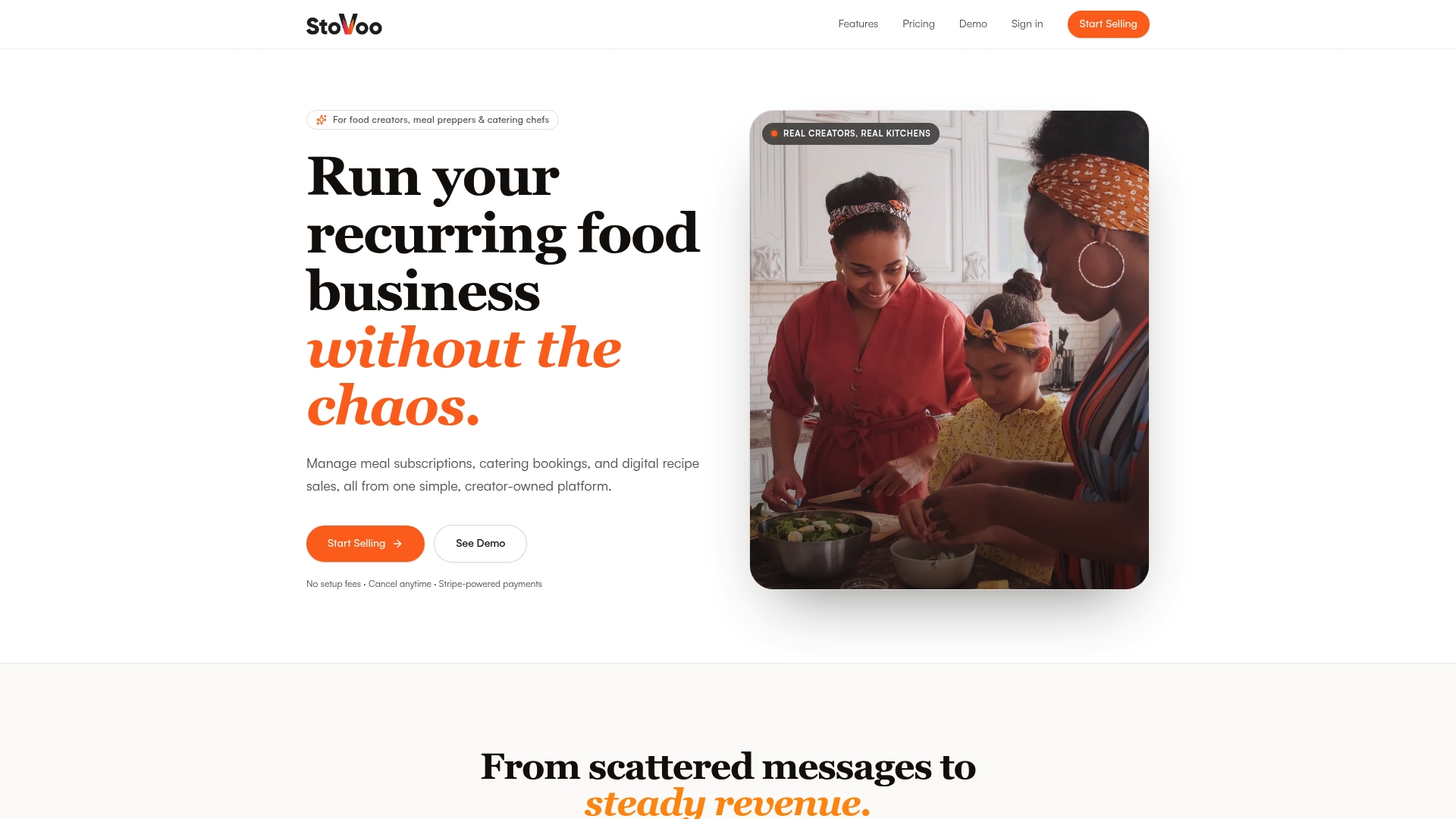
Stovoo gives food creators a centralized dashboard to manage meal subscription plans, catering bookings, and digital recipe sales in one place. Automated billing, customer records, and a mobile-first shopfront replace the WhatsApp threads and spreadsheets that hold growing food businesses back. You can set up your Stovoo shopfront in minutes, share the link across your channels, and start accepting recurring orders immediately. Businesses like Courtside Kitchen in Nairobi and Combochow Enterprise in Lagos already use Stovoo to run centralized food operations with less admin and more growth.
FAQ
What does centralizing food business operations mean?
Centralizing food business operations means consolidating prep, production, procurement, and admin into a single hub rather than managing each function separately at every location. The industry term for this model is a commissary kitchen or central production unit.
How much can centralization reduce labor costs?
Operators adopting commissary kitchen models report labor cost savings of 15–20% by moving prep off-site to specialized teams. Those savings come from hiring assembly staff rather than skilled chefs at every site.
What is the biggest risk of centralizing food operations?
The biggest risk is underutilization. Central kitchens become costly fixed-cost anchors when volume thresholds are not met, so the model only works when throughput is high enough to justify the upfront investment.
Should food entrepreneurs centralize customer service too?
No. The most effective approach centralizes capital, brand standards, and production while keeping daily customer service decisions local. Customers respond better when the people serving them have the authority to make small service calls independently.
When should a food business start centralizing operations?
Food businesses benefit most from building centralized systems at two or three locations, before scattered data and inconsistent quality become a crisis. Starting early makes scaling to ten or more locations far more manageable.