
TL;DR:
- A recipe ebook is a carefully structured digital product designed to deliver consistent value and foster customer trust. Success depends on intentional organization, professional design, and targeted niche positioning that appeals to a specific audience. Building a cohesive, marketable product with strategic curation and branding helps creators generate recurring income and build customer relationships.
If you think a recipe ebook is just a PDF with a list of dishes, you're leaving serious money on the table. The most successful food creators in the digital space understand that a recipe ebook is a carefully structured, marketable product built to deliver real value to buyers and generate consistent income for sellers. The difference between a file someone downloads and forgets versus one they share and buy again comes down to structure, curation, and positioning. This guide breaks down exactly what a recipe ebook is, what it should contain, and how to build one that sells.
Table of Contents
- Defining a recipe ebook: More than digital recipes
- Core components of a recipe ebook
- Formats and packaging: How recipe ebooks are delivered
- Standing out: Curating and marketing your recipe ebook
- Why most recipe ebooks miss the mark: Author's perspective
- Build and sell your recipe ebook with StoVoo
- Frequently asked questions
Key Takeaways
| Point | Details |
|---|---|
| Recipe ebook definition | A recipe ebook is a marketable, standardized digital product, not simply a collection of recipes. |
| Core components | Include clear recipe blocks with names, servings, times, ingredients, and step-by-step instructions for professional results. |
| Format choices matter | Choosing PDF or EPUB impacts your ebook's layout, usability, and sales appeal. |
| Curated content wins | Focused, niche collections of tested recipes provide more value and engagement than large, unfocused lists. |
| Marketing is essential | Strategic packaging and clear cover design help your recipe ebook connect with buyers and drive sales. |
Defining a recipe ebook: More than digital recipes
A recipe ebook is a digital product, not just a collection of recipes dumped into a document. That distinction matters enormously when you're trying to build a food business that generates real, recurring revenue. Think of it the same way you'd think about a physical cookbook from a professional publisher: every element is deliberate, consistent, and designed to serve the reader.
What separates a true recipe ebook from a basic digital recipe list is standardization and intentional structure. Each recipe follows a uniform format so the reader always knows where to look. The experience feels professional. Buyers trust it. And that trust is exactly what converts a one-time customer into a repeat buyer.
A recipe ebook is a marketable digital product built around curated, structured recipes that are easy to follow, professionally presented, and delivered as a single downloadable item.
The recipe ebook structure you choose will directly shape how customers perceive your brand. A well-organized ebook says "this creator knows what they're doing." A messy one says the opposite, no matter how brilliant the recipes are.
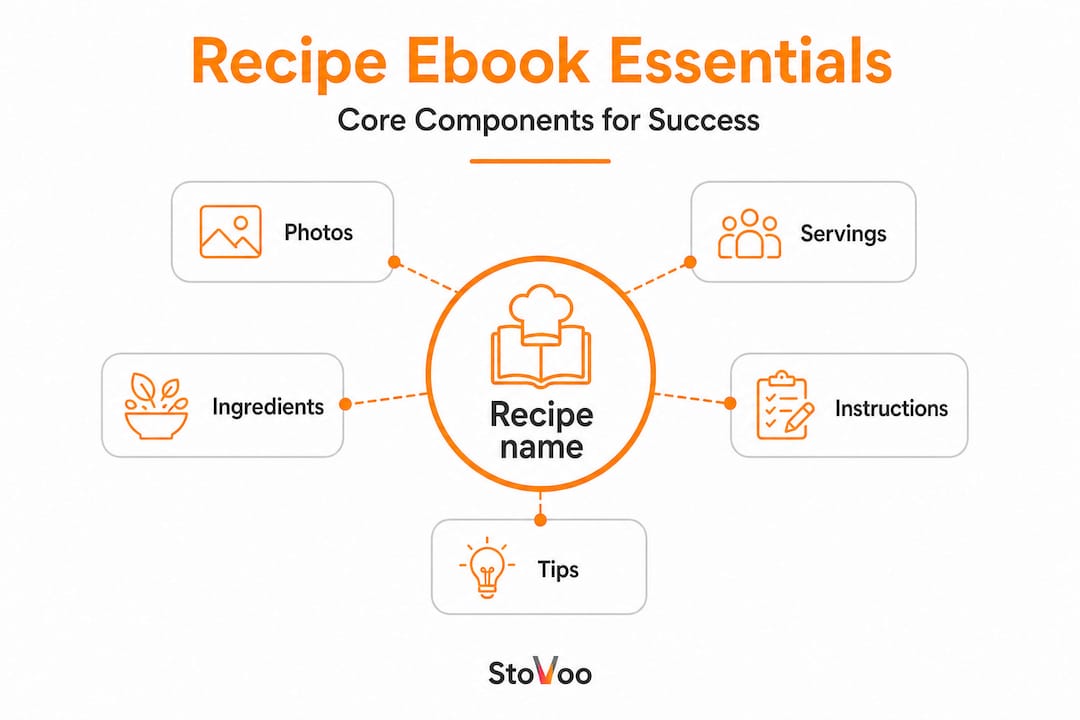
Here is what a well-built recipe ebook typically includes:
- Recipe name and short description to orient the reader immediately
- Serving size so readers can scale the recipe to their needs
- Prep time and cook time so readers can plan their day
- A complete ingredients list with precise measurements for accuracy and consistency
- Numbered, step-by-step instructions that guide even beginner cooks
- Optional tips, substitutions, and storage recommendations that add genuine extra value
As digital recipe book guidance specifies, standardized recipe blocks covering name, description, servings, times, ingredient lists with measurements, and step-by-step instructions are the core of any sellable recipe ebook. Getting these elements right is the foundation of organizing recipes in a way that customers actually enjoy using.
Core components of a recipe ebook

Now that you know what a recipe ebook fundamentally is, let's get specific about each component and why it matters for your digital product's success. Below is a quick reference table showing essential versus optional elements.
| Component | Type | Why it matters |
|---|---|---|
| Recipe name | Essential | First point of recognition for the reader |
| Short description | Essential | Sets expectations and builds excitement |
| Serving size | Essential | Helps readers plan portions and scaling |
| Prep and cook time | Essential | Allows readers to plan their schedules |
| Ingredients with measurements | Essential | Ensures accuracy and reproducibility |
| Step-by-step instructions | Essential | Guides the reader confidently through cooking |
| Tips and substitutions | Optional | Builds trust and adds perceived value |
| Storage recommendations | Optional | Extends the practical life of the recipe |
| Visual consistency and layout | Essential | Reinforces your brand and professionalism |
Visual consistency deserves its own spotlight. When every page of your ebook follows the same typography, color palette, and layout, the product feels intentional. Readers equate that visual discipline with credibility. It's the difference between a product that looks like it was made in an afternoon versus one that looks like it came from a culinary expert.
Here's a simple numbered process for building a core recipe ebook structure:
- Choose your niche and define your audience before writing a single recipe
- Write and test every recipe to confirm accuracy and reproducibility
- Standardize your template across every recipe in the ebook
- Add your optional elements like tips and substitutions where they genuinely add value
- Design your layout using consistent fonts, colors, and spacing throughout
- Create a compelling cover that communicates the ebook's niche promise immediately
Pro Tip: Match your ebook's visual design to your social media brand colors and fonts. Consistency across touchpoints builds recognition and trust, which directly drives sales.
Designing recipe ebooks that feel polished isn't about having expensive software. It's about making consistent choices and sticking to them. Whether you use Canva, Adobe InDesign, or a purpose-built platform, the discipline of consistency matters far more than the tool. You can also explore different business models for recipe ebooks to understand how creators package their knowledge into products that earn money month after month.
Formats and packaging: How recipe ebooks are delivered
Format choice might seem like a technical detail, but it has a real impact on how your product is received. The two dominant formats for recipe ebooks are PDF and EPUB, and each serves a different purpose.
| Feature | EPUB | |
|---|---|---|
| Layout control | Fixed, exact positioning | Reflowable, adapts to screen size |
| Best for | Cookbook-style with photos | Text-heavy or planner-style content |
| Device compatibility | Universal, all devices | Best on e-readers and some tablets |
| Design experience | Preserves original formatting | More flexible for accessibility |
| Printing | Excellent | Limited |
If your layout must keep photos and recipe cards in exact positions, a fixed-layout format like PDF may better preserve the intended design experience than a reflowable EPUB. Most food creators selling visually rich recipe ebooks default to PDF for exactly this reason. It prints cleanly, it looks identical on every device, and it gives you full control over the visual experience.
Beyond format, packaging is what actually moves product. Recipe ebooks can be monetized as polished digital products with a marketing-oriented approach, meaning your cover image, your niche promise, and your curated recipe collection are all sales tools. The cover is effectively your product's sales page at a glance.
Here are the key packaging decisions that affect your sales:
- Cover design: Should communicate your niche, aesthetic, and value proposition instantly
- Title and subtitle: Be specific. "30 High-Protein Meal Prep Recipes for Busy Professionals" outsells "My Favorite Recipes" every time
- Niche focus: A tight collection of 15 to 25 well-tested recipes for a defined audience outperforms a bloated 100-recipe document
- Delivery experience: A clean, easy-to-download file with clear instructions builds immediate goodwill
Pro Tip: Keep your recipe ebook tightly focused. Buyers looking for vegan dinner ideas don't want a general cookbook. Specificity signals expertise and creates a more satisfying purchase experience.
Comparing recipe formats for your specific business model is worth the time investment. Some creators even push into more dynamic territory, offering interactive recipe experiences that blend digital planners with recipe collections for a premium product feel.
Standing out: Curating and marketing your recipe ebook
Here is where many food creators get stuck. They have great recipes, but they don't know how to build a product people want to buy. Curation and marketing are the two levers that separate successful recipe ebook creators from those who upload a PDF and wait.
The most powerful thing you can do is think of your recipe ebook as a marketable, cohesive product rather than a republishing of recipes. That framing changes every decision you make, from how you select recipes to how you write your description to how you price the product.
Curation is about intentional selection, not volume. Choosing 20 deeply tested, beautifully presented recipes for a specific audience will always outperform 80 loosely connected recipes thrown together. Buyers sense the difference. Tight collections feel authoritative. Bloated ones feel lazy.
Some practical strategies that work for food entrepreneurs who sell digital products:
- Define a specific reader persona before you write anything. Who is this person? What problem does your ebook solve for them today?
- Name your ebook around the transformation or outcome, not just the food type. "Stress-free weeknight dinners in 30 minutes" is a promise. "Chicken recipes" is a category.
- Use your social platforms to build anticipation before launch. Share behind-the-scenes recipe testing. Show your process.
- Price confidently. A well-packaged, niche recipe ebook with clear value can easily sell for $15 to $35. Don't underprice out of fear.
- Treat your ebook download as a customer touchpoint. The experience of receiving and opening the file is part of your brand.
Some creators treat a digital recipe book as a simple PDF, while others use more interactive or planner-style approaches. The product variation is real, and it gives you creative flexibility to position your ebook at any level of the market. You can see ebook curation examples that show how creators build cohesive product lines from focused recipe collections.
Effective recipe ebook marketing starts well before launch and continues long after. Build a waitlist. Offer early-bird pricing. Collect testimonials from recipe testers. Every piece of social proof makes the next sale easier.
Why most recipe ebooks miss the mark: Author's perspective
After seeing hundreds of digital food products come and go, one pattern stands out clearly: most recipe ebooks fail not because the food is bad, but because the product is not positioned as a product. Creators pour love into their recipes and then treat the ebook itself as an afterthought.
The uncomfortable truth is that a beautifully cooked dish and a beautifully designed digital product require entirely different skill sets. And too many food creators assume that great recipes will do the selling for them. They don't. Positioning does.
The marketable, cohesive product mindset is the real differentiator. When you build your ebook as a business asset, you start asking different questions. Who is this for? What outcome are they buying? Why is my curation better than what they can find for free online? Those questions lead to products that actually convert.
Another consistent gap is the lack of unique positioning. Hundreds of creators sell "healthy dinner recipe ebooks." Very few sell "high-protein, dairy-free dinners for postpartum moms." That specificity is not just a marketing trick. It is a product development decision that shapes everything, from which recipes you include to how you describe each dish.
Treating your ebook as a one-time file download is also a missed opportunity. The smartest food entrepreneurs build their recipe ebooks as entry points into a broader relationship with their customer. The ebook builds trust, and that trust leads to subscriptions, premium products, and catering inquiries. Understanding the full range of food business models available to you makes it clear that a recipe ebook is often the best first product in a much larger ecosystem.
The creators who succeed with recipe ebooks consistently do three things: they curate tightly, they design professionally, and they treat every sale as the beginning of a customer relationship, not the end of a transaction.
Build and sell your recipe ebook with StoVoo
You now have a clear picture of what separates a forgettable PDF from a recipe ebook that builds a real business. The next step is putting that knowledge into action with tools built specifically for food creators.
StoVoo is a platform designed for food entrepreneurs who want to create, organize, and sell digital products like recipe ebooks without the chaos of managing spreadsheets, WhatsApp threads, and manual invoices. You get a professional, mobile-first shopfront where customers can browse and start selling recipe ebooks through automated delivery and billing. Whether you're launching your first ebook or scaling a product line, StoVoo gives you the infrastructure to grow with confidence. Explore the food entrepreneur tools available on the platform and see how creators just like you are building steady income from their culinary expertise.
Frequently asked questions
What makes a recipe ebook different from a regular cookbook?
A recipe ebook is a digital product with standardized recipe blocks covering measurements, times, and instructions, optimized for easy digital delivery, while traditional cookbooks are print-based and typically not downloadable or interactive.
Can I sell recipe ebooks in different formats?
Yes. Recipe ebooks are commonly sold as PDFs or EPUBs, and some creators also offer planner-style digital products depending on their audience and design goals.
How many recipes should I include in my recipe ebook?
A focused niche collection of well-tested recipes consistently outperforms large, loosely curated compilations. Quality and relevance matter far more than quantity.
Does it matter if my ebook uses fixed layout or reflowable format?
If you need exact positioning for recipe cards and photos, a fixed-layout format like PDF is the better choice. Reflowable formats like EPUB offer more flexibility for text-heavy or accessibility-focused content.
Is it possible to make my recipe ebook interactive?
Some creators use interactive or planner-style approaches for their recipe ebooks, but most content stays in conventional digital formats. The right choice depends on your audience's expectations and your production capacity.