
TL;DR:
- A weekly meal plan is essential for food entrepreneurs to ensure consistency, reduce waste, and build reliable revenue streams. Effective plans include curated menus, consolidated grocery lists, batch prep schedules, and flexibility for disruptions to adapt to real-world variability. Utilizing structured systems improves customer retention, lowers costs, and creates scalable, predictable food businesses.
Running a food business without a structured weekly meal plan is a bit like cooking without a recipe. You end up improvising, wasting ingredients, and burning energy on decisions that could have been made in advance. Whether you are a solo meal prepper building a subscriber base or a catering chef managing recurring orders, the weekly meal plan is the operational backbone that separates chaotic kitchens from profitable ones. This article breaks down exactly what weekly meal plans are, how they work in practice, and how food entrepreneurs can use them to boost consistency, reduce waste, and build genuinely reliable revenue.
Table of Contents
- What is a weekly meal plan?
- How weekly meal plans operate: Essential mechanics
- Adapting weekly meal plans for business and batch prep
- Handling real-world variability: Flex nights and schedule-proofing
- Weekly meal plans as the engine of recurring revenue
- Why most weekly meal plans fail (and how to make yours stick)
- Ready to transform your meal planning operation?
- Frequently asked questions
Key Takeaways
| Point | Details |
|---|---|
| Weekly meal plan essentials | A weekly meal plan aligns your meals, grocery list, and prep into one simplified, repeatable system. |
| Batch prep advantage | Batch cooking and ingredient overlap save time and support revenue consistency for meal businesses. |
| Flexibility boosts retention | Building flexible elements like 'flex nights' into meal plans helps maintain customer loyalty and reduce churn. |
| Drives predictable operations | Weekly plans power subscription models by enabling recurring revenue and customer engagement. |
| Start simple, iterate | Begin with a straightforward plan, incorporate feedback, and refine your approach for lasting success. |
What is a weekly meal plan?
At its most basic level, a weekly meal plan is a plan for what you will eat across the week, often including recipes and a consolidated grocery list, so you reduce daily decision-making and streamline shopping and cooking. That definition holds true for a home cook and a five-day meal prep business alike. The difference is scale and stakes.
For food entrepreneurs, a weekly meal plan is more than a personal convenience. It becomes a product. It is the structure customers subscribe to, the menu that defines your brand, and the operational map that tells you what to cook, how much to order, and when to deliver. When you think of it that way, building a solid weekly plan is one of the most important things you can do for your business.
Core components of an effective weekly meal plan:
- Weekly menu: A curated set of meals for each day or each meal slot, designed around your customer base and ingredient availability
- Consolidated grocery list: A single, organized shopping list that accounts for batch prep and avoids duplicate purchases
- Batch prep schedule: A cooking timeline that maps out when to prepare each item, including which components can be made ahead
- Portion and packaging guide: Especially important for businesses, this ensures consistent delivery every time
Entrepreneurs who invest in solid menu planning systems report faster prep times, fewer errors, and stronger customer satisfaction. The table below shows a simple example of what a weekly menu structure looks like across different business types.

| Day | Meal prep business | Home-based catering | Solo meal prepper |
|---|---|---|---|
| Monday | Grilled chicken bowls | Client consultation | Batch cook proteins |
| Tuesday | Salmon and rice | Menu confirmation | Prep sauces and grains |
| Wednesday | Vegan stir fry | Shop and prep | Cook and portion meals |
| Thursday | Turkey meatballs | Delivery day | Refrigerate portions |
| Friday | Pasta bake | Follow-up and rest | Consume or freeze |
For larger event catering planning, the weekly meal plan also functions as a project management tool, coordinating staff, equipment, and supply timelines simultaneously.
How weekly meal plans operate: Essential mechanics
Now that we have defined weekly meal plans, it is important to see how these actually operate in practice, step by step. Understanding the mechanics means you can replicate them consistently, not just once.
Effective weekly planning commonly includes planning the week in advance, choosing a small set of repeatable options, doing an inventory, batching and prepping, and intentionally planning for leftovers. Each of these steps compounds on the others. Skip one and the system starts to crack.
Step-by-step weekly planning workflow:
- Check your schedule and commitments — Identify delivery days, customer windows, and any events that affect capacity
- Run a full inventory — Before buying anything, audit your fridge, freezer, and pantry to reduce waste and duplicate costs
- Select your menu — Choose meals based on seasonal availability, customer preferences, and ingredient overlap
- Build your grocery list — Consolidate ingredients across all meals to minimize shopping trips and maximize bulk savings
- Schedule batch prep — Block prep time in your calendar like a business appointment, not an afterthought
- Plan for leftovers intentionally — Designate one or two nights where leftover-based meals fill the schedule
Pro Tip: Build a "rotation library" of six to eight core meals that you cycle across the month. This reduces decision fatigue, stabilizes your grocery costs, and keeps customers satisfied without needing to reinvent your menu every week.
Compare the two approaches below to see why systematized planning wins every time:
| Workflow feature | Ad hoc planning | Systematized weekly plan |
|---|---|---|
| Menu decisions | Daily, reactive | Weekly, proactive |
| Grocery shopping | Multiple trips | Single consolidated shop |
| Prep time | Scattered, inefficient | Batched, focused |
| Food waste | High | Significantly reduced |
| Customer consistency | Unpredictable | Reliable and repeatable |
| Revenue predictability | Low | High |
For food entrepreneurs looking for snack menu inspiration and variety ideas to keep menus fresh without overcomplicating operations, rotating themed days (think "Taco Tuesday" or "Grain Bowl Thursday") is an excellent structural shortcut that customers actually enjoy.
Understanding these operating structures early gives you a head start on building a food business that scales without burning you out.
Adapting weekly meal plans for business and batch prep
Having mastered the basics, let's see how business operations and batch prep benefit from a more structured weekly system. For food entrepreneurs, the stakes are higher. A missed delivery or inconsistent meal quality directly affects your reputation and recurring revenue.
Practical business methodology centers on planning a weekly system around a few core meals, reusing ingredients, creating one consolidated grocery list, and using a leftover map so ingredients carry across the week. This approach does something powerful. It treats your kitchen like a small factory with predictable inputs and predictable outputs.
Batch cooking is the engine of this system. Rather than cooking each meal fresh every day, batch cooking means preparing large quantities of core components (proteins, grains, sauces, and roasted vegetables) once or twice a week, then assembling them into different meals. The result is faster prep, consistent quality, and dramatically lower labor costs per meal.
Essentials of a business-focused weekly meal plan:
- Core ingredient anchors: Choose two or three proteins and two or three grain bases that can be mixed across multiple meals
- Carryover planning: Design meals so Tuesday's roasted sweet potato reappears in Wednesday's grain bowl
- One consolidated order: Combine all weekly ingredients into a single supplier order to reduce cost and admin time
- Packaging and labeling system: Pre-label containers on prep day to streamline assembly and delivery
- Customer-facing menu calendar: Share your weekly menu with subscribers in advance so they know what to expect
Pro Tip: Use a "leftover map," a simple visual or spreadsheet that tracks which ingredients will carry from one meal to the next. This prevents over-ordering, reduces spoilage, and ensures no ingredient is ever wasted across the week.
Research from meal planning platforms shows that businesses using structured meal-prep automation tools can reduce prep decision time by up to 40% weekly. That is time you can redirect into customer acquisition, recipe development, or simply taking a break.
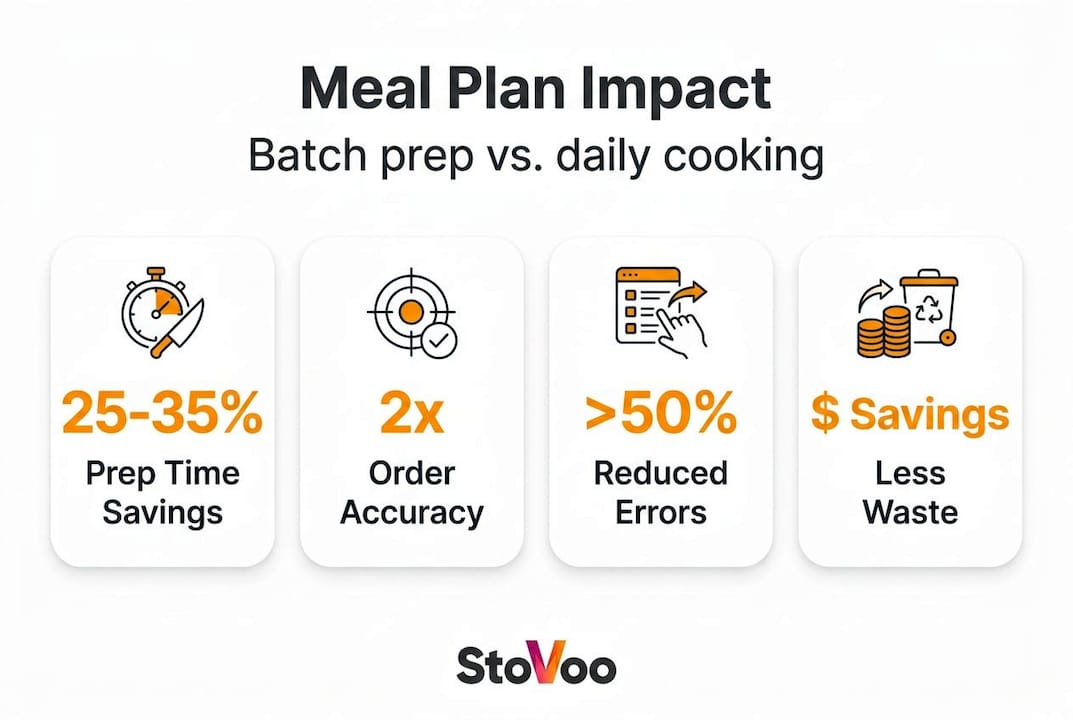
Stat callout: Food businesses that shift from ad hoc daily cooking to systematized batch prep report an average 25 to 35% reduction in food costs over the first three months, largely driven by reduced spoilage and more accurate ordering.
Handling real-world variability: Flex nights and schedule-proofing
Even the best plans go off track. A supplier runs out of stock. A customer requests a last-minute change. You get sick. The goal of a resilient weekly meal plan is not to be rigid. It is to be prepared for disruption without unraveling.
Expert planning guides recommend accounting for schedule and calendar disruptions, leaving flex nights, and using theme and fallback structures so the plan survives real-world variability. This is especially critical for food businesses where a single missed delivery can trigger a cancellation.
Tactics for building anti-fragile weekly meal plans:
- Schedule two flex nights per week — These are unassigned slots where you can use whatever is available, accommodate a customer request, or insert a simpler fallback meal
- Maintain a "pantry meal" list — A shortlist of meals you can make entirely from shelf-stable or frozen ingredients, ready when fresh supplies fall short
- Use theme structures — Themed days (like a weekly pasta night or soup Sunday) give you variety within a predictable framework
- Build in a buffer — Order 10% more of your core ingredients than you expect to use, giving you room to adjust
- Communicate proactively with customers — If a substitution is needed, tell customers before delivery, not after
"Flexibility is not the opposite of planning. It is the highest form of it. When your weekly plan can absorb disruption without losing customer trust, you have built something genuinely resilient."
For catering operations handling portion-sensitive events, understanding snack portion planning as part of weekly prep is another layer of schedule-proofing that prevents both shortfalls and costly overruns.
The difference between meal prep operations that retain customers long-term and those that churn quickly often comes down to this flexibility layer. Customers do not expect perfection. They expect reliability and honest communication when things shift.
Weekly meal plans as the engine of recurring revenue
With flexibility in mind, it is vital to see why weekly meal plans are the backend engine for recurring, sustainable food revenue models. The weekly planning unit is not just a convenience. It is the fundamental structure that makes food subscriptions work.
Subscription meal operations use weekly menus as recurring operational units to drive predictable engagement, and they are commonly packaged as tiered weekly meal quantities such as 3, 5, or 7 meals per week, with retention-focused economics built into each tier. This tiering system does two things at once. It gives customers choice while giving the business operational predictability.
Stat callout: Meal-kit churn rates average around 10.8% per month and approximately 73.6% annually in the food and grocery subscription category. That number should motivate every food entrepreneur to take retention seriously from day one.
The good news is that weekly meal plans, when structured well, are one of the most effective tools for fighting churn. When customers know exactly what is coming, can skip a week without canceling, and see genuine variety across the month, they are far more likely to stay subscribed.
Here is what a tiered weekly subscription menu structure could look like for a meal prep business:
| Tier | Meals per week | Price range | Best for |
|---|---|---|---|
| Starter | 3 meals | $60 to $90 | Solo customers or light users |
| Core | 5 meals | $95 to $140 | Busy professionals and families |
| Full week | 7 meals | $140 to $195 | Fitness-focused subscribers |
| Custom | Flexible | Negotiated | Corporate clients or large households |
Skip and pause features directly impact long-term customer value (LTV). Customers who can pause their subscription are far less likely to cancel entirely. Businesses that offer subscription menu tiers with built-in flexibility consistently see lower churn and higher average customer lifetime value compared to rigid, all-or-nothing plans.
Why most weekly meal plans fail (and how to make yours stick)
Here is the uncomfortable truth that most planning guides skip over. Weekly meal plans do not fail because the food is bad or the menu is wrong. They fail because the system behind the plan is too rigid, too complicated, or built for an ideal week that never actually exists.
Most templates assume a perfectly predictable week. They ignore supplier issues, customer schedule changes, seasonal ingredient gaps, and the simple reality that people's tastes shift over time. A meal plan built for perfection collapses the first time life gets messy, and for a food business, that collapse can mean losing subscribers.
The better frame is to think of your weekly meal plan not as a fixed document, but as a living operating system. It should be designed to be updated, iterated, and refined based on what actually happens, not just what you planned. Review your week every Sunday. Which meals sold out? Which ones had leftover portions? Which ingredients were under or over-ordered? Those data points are your feedback loop.
Menu fatigue is the other silent killer. A customer who gets the same rotation every four weeks for six months will cancel, even if the food is excellent. Building in one new recipe per month, rotating seasonal specials, or polling your subscribers on what they want next are small moves that create big loyalty wins.
From a behavioral standpoint, consistency is what keeps subscribers. But consistency should apply to the experience (reliable delivery, good quality, easy communication), not necessarily to the exact same dishes every cycle. Explore real-world operational strategies that keep your plan flexible while maintaining the reliability your customers expect.
The food entrepreneurs who succeed long-term are the ones who start with a simple, executable plan, expect disruption as part of the process, and iterate based on real customer engagement patterns rather than trying to build the perfect plan from day one.
Ready to transform your meal planning operation?
Turning a great weekly meal plan into a repeatable, revenue-generating system requires more than a spreadsheet. You need tools that automate the admin, manage your customers, and keep your operation running smoothly week after week.
Stovoo is built specifically for food entrepreneurs who want to stop juggling WhatsApp messages and manual invoices and start running a professional meal business. With Stovoo's operational tools for food businesses, you can set up tiered meal subscription plans, automate billing, manage customer orders from a single dashboard, and share your shopfront link directly through social media or messaging apps. Whether you run weekly meal prep, catering, or sell digital recipes, Stovoo gives you the structure to grow with confidence and consistency. Your weekly plan deserves a platform that works as hard as you do.
Frequently asked questions
How do weekly meal plans increase customer retention?
Weekly meal plans foster predictable engagement and allow for adjustable offerings, keeping subscribers loyal by balancing variety with consistency. When customers know what to expect and can customize within a structure, they stay longer.
What's the best way to handle leftovers in a weekly meal plan?
Intentionally plan for leftover nights and carryover ingredients, using a leftover map for efficient ingredient use and reduced food waste. PlanEat AI's planning guide recommends building this carryover structure directly into your weekly system from the start.
How do you prevent subscriber fatigue with weekly meals?
Build in variety, use theme nights, and make it easy for subscribers to skip or pause, which reduces monthly churn and increases overall satisfaction. Even small menu rotations once a month can significantly extend subscriber loyalty.
Are weekly meal plans only for subscription businesses?
No, weekly meal plans benefit solo meal preppers, batch cookers, and traditional foodservice operations by reducing last-minute decisions and boosting efficiency. As Everyday Health notes, anyone who plans meals ahead gains time, saves money, and reduces daily stress regardless of business model.