

Food creators and small food businesses have eight core meal-delivery business models to choose from: subscription weekly meal plans, pre-order/limited-menu, on-demand prepared meals, catering and events, click-and-collect/pickup, marketplace/platform sales, wholesale/B2B, and digital products like recipes and classes. If recurring revenue and low admin overhead are your goals, start with a niche subscription or a B2B-anchored hybrid. Both reduce churn, stabilize cash flow, and give you direct customer ownership.
Which model to pilot first, by goal:
- Steady weekly income with low logistics: Weekly subscription meal plan with porch pickup
- Higher-value orders and lower churn: B2B wholesale to gyms, corporate accounts, or senior centers
- Zero delivery overhead: Digital products (recipe ebooks, cooking classes)
Key Takeaways
Recurring-revenue models anchored by niche subscriptions or B2B accounts consistently outperform one-off and marketplace models on margin stability and operator workload.
| Point | Details |
|---|---|
| Start with subscriptions or B2B | These models reduce churn and stabilize cash flow faster than on-demand or marketplace sales. |
| Model your unit economics first | Food cost (28–35% of AOV), delivery ($3.50–$7.00/order), and platform fees (15–30%) determine viability before you price. |
| Keep your pilot small and pre-sold | 5–10 pre-sold customers, one production day, and one delivery/pickup day is enough to validate any model. |
| Own your customer list | Direct models (subscription, pre-order, pickup) give you full CRM control; marketplace models do not. |
| Stovoo centralizes the stack | Stovoo handles subscription billing, shopfronts, catering bookings, and digital sales from one dashboard. |
Table of Contents
- What are the main types of meal delivery models?
- How do these models compare on cost, margin, and complexity?
- How do you choose the right model for your food business?
- What operational and compliance essentials do you need?
- What technology do you need for each meal delivery model?
- Real examples of each model in action
- How to run a 30/60/90-day pilot with minimal risk
- What daily life actually looks like on each model
- Stovoo gives food creators one place to run it all
- Sources
- FAQ
What are the main types of meal delivery models?
Each of the eight meal delivery service types works differently at the order, fulfillment, and billing level. Here is a practical snapshot of each.
Subscription weekly meal plans run on recurring billing. Customers sign up for a weekly or biweekly box, you batch-cook on one production day, and you deliver or offer pickup on a set schedule. Revenue is predictable; customer ownership is entirely yours. Disciplined operators commonly see net margins in the low double digits, with B2B and niche subscriptions providing more stable revenue than pure residential direct-to-consumer.
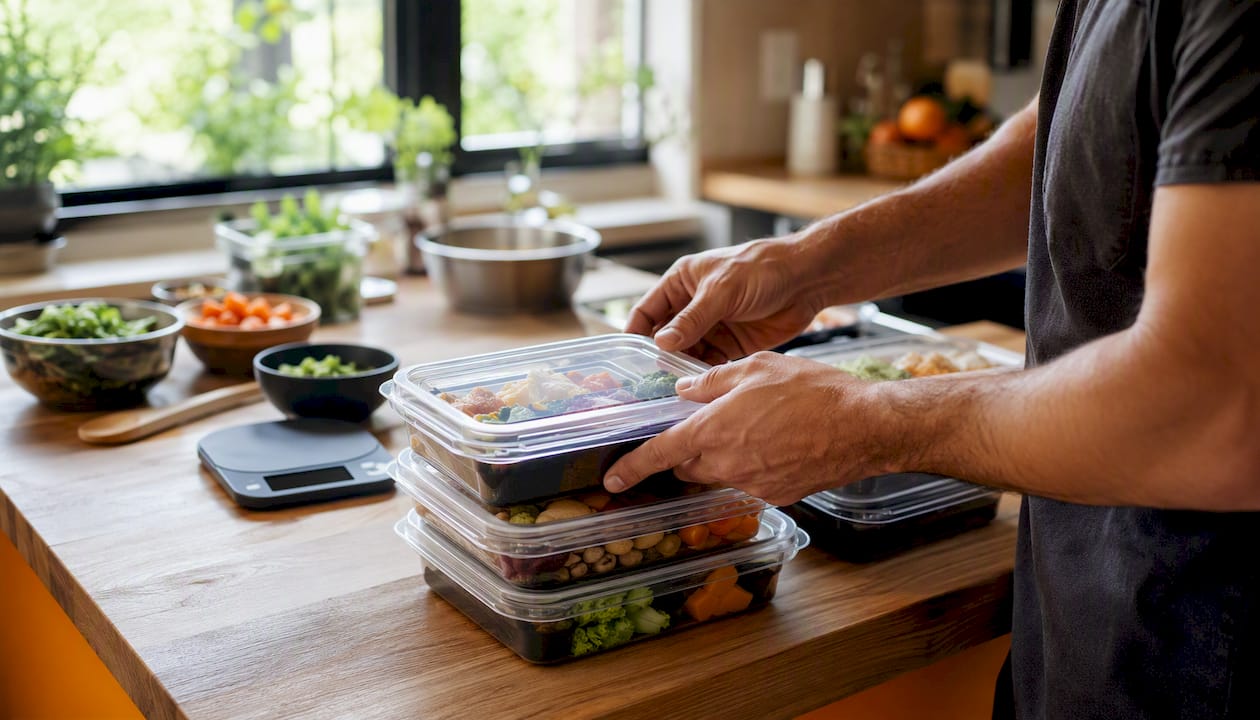
Pre-order/limited-menu models open an ordering window (say, Tuesday through Thursday) for a Saturday delivery or pickup. You only cook what is sold, which cuts waste dramatically. Revenue is recurring-ish but tied to each cycle rather than auto-billed.
On-demand prepared meals are ready-to-eat or heat-and-eat orders placed and fulfilled same-day or next-day. Hot-delivery needs are high, cold-chain is critical, and margins get squeezed by delivery cost. This model suits operators with commercial kitchen access and a dense local customer base.
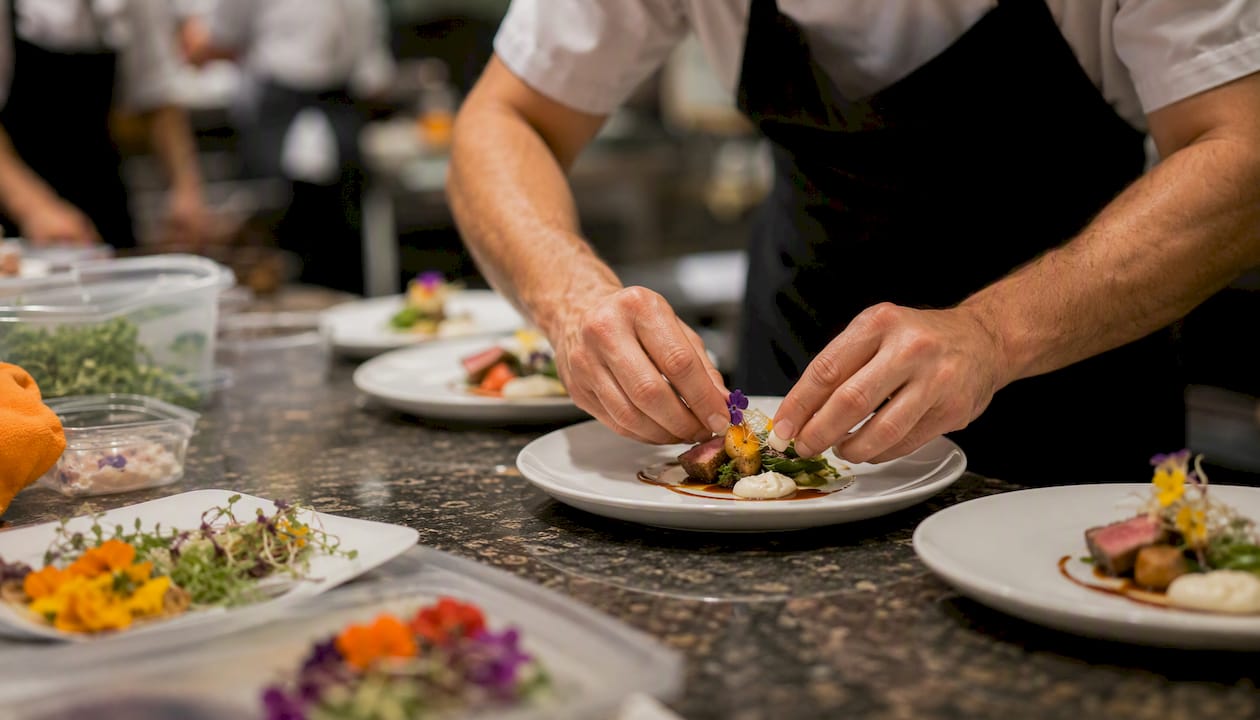
Catering and events generate high-value one-off or repeat bookings. Orders flow through inquiry, quote, deposit, and final payment. Fulfillment is self-managed; delivery is usually self-handled or contracted per event. Revenue is lumpy but average order value is high.
Click-and-collect/pickup eliminates delivery cost entirely. Customers order online and pick up at a set window. Small vendors running compact delivery zones of 5–15 miles often pair pickup with one route day to keep logistics manageable.
Marketplace/platform sales (listing on third-party apps) put your meals in front of a built-in audience. The trade-off: platforms typically charge restaurants 15–30% commission, plus delivery and service fees, which compress margins sharply. You also surrender customer data.
Wholesale/B2B means selling in bulk to gyms, corporate offices, senior centers, or meal-program operators. Orders are larger, churn is lower, and billing is usually net-30 invoicing. Margins per unit are thinner, but volume and stability compensate.
Digital products (recipe ebooks, cooking courses, live class tickets) have near-zero fulfillment cost and no cold-chain requirement. Revenue is one-off per sale unless you build a membership. Perfect as a revenue layer on top of any physical model.
How do these models compare on cost, margin, and complexity?
Per-order unit economics show that food cost (28–35% of average order value), delivery cost ($3.50–$7.00 per order), and marketplace fees (15–30%) are the three levers that most affect contribution margin. Model your numbers before you set prices.
Key margin signals to watch:
- Marketplace fees plus delivery cost can consume a substantial portion of revenue on low-AOV orders
- Click-and-collect and digital products carry the highest net margins of any model
- B2B wholesale trades per-unit margin for volume and payment reliability
How do you choose the right model for your food business?
Work through this checklist before committing to a pilot.
- Define your customer segment. Gyms, GLP-1 patients, seniors, and corporate accounts all have different order cadences and price tolerance. B2B clients yield higher-value, lower-churn orders than residential subscribers.
- Assess your production capacity. One weekly batch day supports subscription and pre-order models. On-demand requires daily or near-daily production.
- Set a margin target. Calculate food cost, packaging, delivery, and any platform fees against your target price. If the math does not work at your local price ceiling, eliminate that model before launch.
- Check your channel reach. Do you have an existing audience (social, email, WhatsApp)? Direct models (subscription, pre-order, pickup) depend on owned channels. Marketplace models trade margin for discovery.
- Confirm regulatory readiness. Cottage-food laws vary by state. Some permit home-kitchen sales; others require a licensed commercial kitchen for any delivery. Check your local health department before choosing a model.
- Rate your tech readiness. Subscription billing, route planning, and customer CRM are non-negotiable for recurring-revenue models. If you are starting from spreadsheets and WhatsApp, pick a platform before picking a model.
Red flags that signal a model is wrong for you right now:
- On-demand delivery without a commercial kitchen or a reliable third-party courier
- Marketplace sales when your AOV is below $20 (fees will erase margin)
- Catering-only if you need weekly cash flow (bookings are too lumpy)
Pro Tip: Start B2B-first or niche-subscription-first. A single gym or corporate account can anchor your weekly production volume, reduce residential churn risk, and give you a predictable base to build on before opening DTC sales.
What operational and compliance essentials do you need?
Running any physical meal-delivery model safely requires getting the basics right before the first order ships.
Packaging and reheating: Use tamper-evident containers with clear reheating instructions printed on the label (temperature, time, covered vs. uncovered). For cold items, include ice packs rated for your delivery window plus one hour of buffer. Fresh food delivery quality control depends on packaging integrity as much as recipe quality.
Labeling requirements: At minimum, include your business name, ingredient list, allergen callouts (the FDA's Big 9), net weight, and a "best by" date. Many states add cottage-food-specific label language; check your state's department of agriculture rules.
Permits and insurance checklist:
- Local health department permit or cottage-food registration
- Food handler certification for yourself and any staff
- General liability insurance (food businesses typically need a rider)
- Vehicle insurance if using a personal car for delivery
- Sales tax registration if your state taxes prepared food
Cost categories:
Lean launch costs for small meal-prep businesses typically run $8,000–$25,000 for a properly equipped operation. A cottage-food subscription model with porch pickup can launch for far less.
Legal note: food-safety laws, cottage-food exemptions, and permit requirements vary by state and county. Confirm current rules with your local health department before launch.
What technology do you need for each meal delivery model?
The minimal tech stack differs by model, but five components recur across almost all of them: online ordering, recurring billing, customer CRM, payment processing, and a customer-facing shopfront. Online ordering platforms have fundamentally changed how customers discover and buy from small food businesses, making a mobile-first storefront a baseline requirement rather than a nice-to-have.
By model:
- Subscription plans: Recurring billing is the critical component. You need automated charge cycles, pause/cancel management, and a customer portal.
- Pre-order/limited-menu: A simple order form with a cutoff date and manual or automated billing works at small scale.
- On-demand: Route optimization and real-time order tracking become necessary above 10 orders per day.
- Catering: Inquiry forms, quote generation, deposit collection, and calendar blocking.
- Digital products: A storefront with secure download delivery and optional membership billing.
Stovoo centralizes subscription plans, automated billing, shopfronts, and customer management for food creators, letting vendors run subscription meals, catering bookings, and digital product sales from one dashboard. That matters because the alternative — stitching together a Google Form, a PayPal link, and a spreadsheet — breaks down the moment you hit 20 weekly customers.
Pro Tip: Before adding routing software, test your delivery zone manually for 4–6 weeks. Real route data from your own runs will tell you where to optimize far better than any algorithm working from a blank map.
Integration options worth knowing: Stripe or Square for payment processing, Google Sheets or Airtable for early-stage inventory tracking, and QuickBooks or Wave for accounting. As volume grows, purpose-built food-business platforms handle all of these in one place.
Real examples of each model in action
Subscription weekly plan: A meal prepper targeting GLP-1 patients launches a 10-subscriber pilot at $35/week using porch pickup. After 60 days, she has 22 subscribers and one bake day per week. Key metric to watch: weekly retention rate. Weekly subscription boxes priced around $25–$35 with 3–5 items let operators run a single production day and reach predictable weekly revenue from a small subscriber base.
B2B wholesale: A catering chef lands a corporate office account for 40 lunches every Tuesday and Thursday. The account generates more monthly revenue than 30 residential subscribers, with zero marketing cost after the initial pitch. Lesson: B2B clients have lower CAC and near-zero churn once onboarded.
Click-and-collect: A home baker runs a Saturday pickup window from her driveway. She pre-sells 15 boxes every week through a simple order link, bakes Thursday, and collects payment automatically. No delivery cost, no routing headache.
The model that looks hardest to scale is often the one that actually sticks. A 15-subscriber porch-pickup subscription with a single production day outperforms a 200-order marketplace presence on net margin, customer loyalty, and operator sanity — every time.
Digital products: A catering chef packages her signature spice-blend recipes into a $29 ebook. With no fulfillment cost, every sale is nearly pure margin. She cross-sells it to her catering inquiry list and earns passive revenue between event bookings.
How to run a 30/60/90-day pilot with minimal risk
A time-boxed pilot lets you test a model without overcommitting resources.
Days 1–30: Setup and pre-sell
- Choose one model and one customer segment.
- Build your shopfront, order form, and billing flow.
- Set a menu of 3–5 items maximum.
- Pre-sell to 5–10 customers before cooking anything.
- Run one production day and one delivery/pickup day.
- Track: weekly orders, delivery cost per order, and any customer complaints.
Days 31–60: Optimize
- Survey your first customers on packaging, taste, and convenience.
- Adjust your delivery zone or pickup window based on actual demand geography.
- Test one upsell (add-on item, larger box, digital recipe).
- Calculate your contribution margin per order: price minus food cost, packaging, and delivery.
- Track: retention rate week-over-week, average order value.
Days 61–90: Go/no-go decision
- Assess whether weekly orders are growing, flat, or declining.
- Check if contribution margin is positive after all variable costs.
- Decide: scale, pivot to a second model, or stop.
- If scaling, add one B2B account or one new neighborhood before adding complexity.
KPIs for the full 90 days: weekly order count, customer retention rate, contribution margin per order, and delivery cost per stop. A micro-CSA with around 10 members can deliver steady monthly income in the expected range — a realistic benchmark for a subscription pilot's first 90 days.
What daily life actually looks like on each model
Most articles describe meal-delivery models as revenue strategies. They are also operational realities you live with every week.
Subscription plans are the most admin-friendly once set up. Billing runs automatically, production is predictable, and customers self-manage through a portal. The pain point is churn: one bad week of packaging or a missed delivery can cancel a subscriber who took months to acquire. Own your customer list from day one.
On-demand delivery is the opposite. High order volume, daily production, routing complexity, and constant customer service. The margin math rarely works below 30 orders per day, and third-party couriers solve the logistics problem while creating a margin problem.
Catering is high-reward but lumpy. Two shortcuts worth taking: outsource event staffing before outsourcing menu development, and own your booking and deposit flow so you are never chasing payment after an event.
Digital products deserve more attention than most food creators give them. The overhead is near-zero, the margin is exceptional, and they compound: a recipe ebook sold to a catering inquiry list costs nothing to deliver and builds authority that converts future bookings.
The one rule that holds across every model: recurring revenue beats one-off revenue at every scale. Build toward it, even if you start with a single pre-order cycle.
Stovoo gives food creators one place to run it all
Running a subscription meal plan, a catering calendar, and a digital recipe shop from three different tools creates exactly the kind of admin chaos that kills small food businesses. Stovoo was built to fix that.
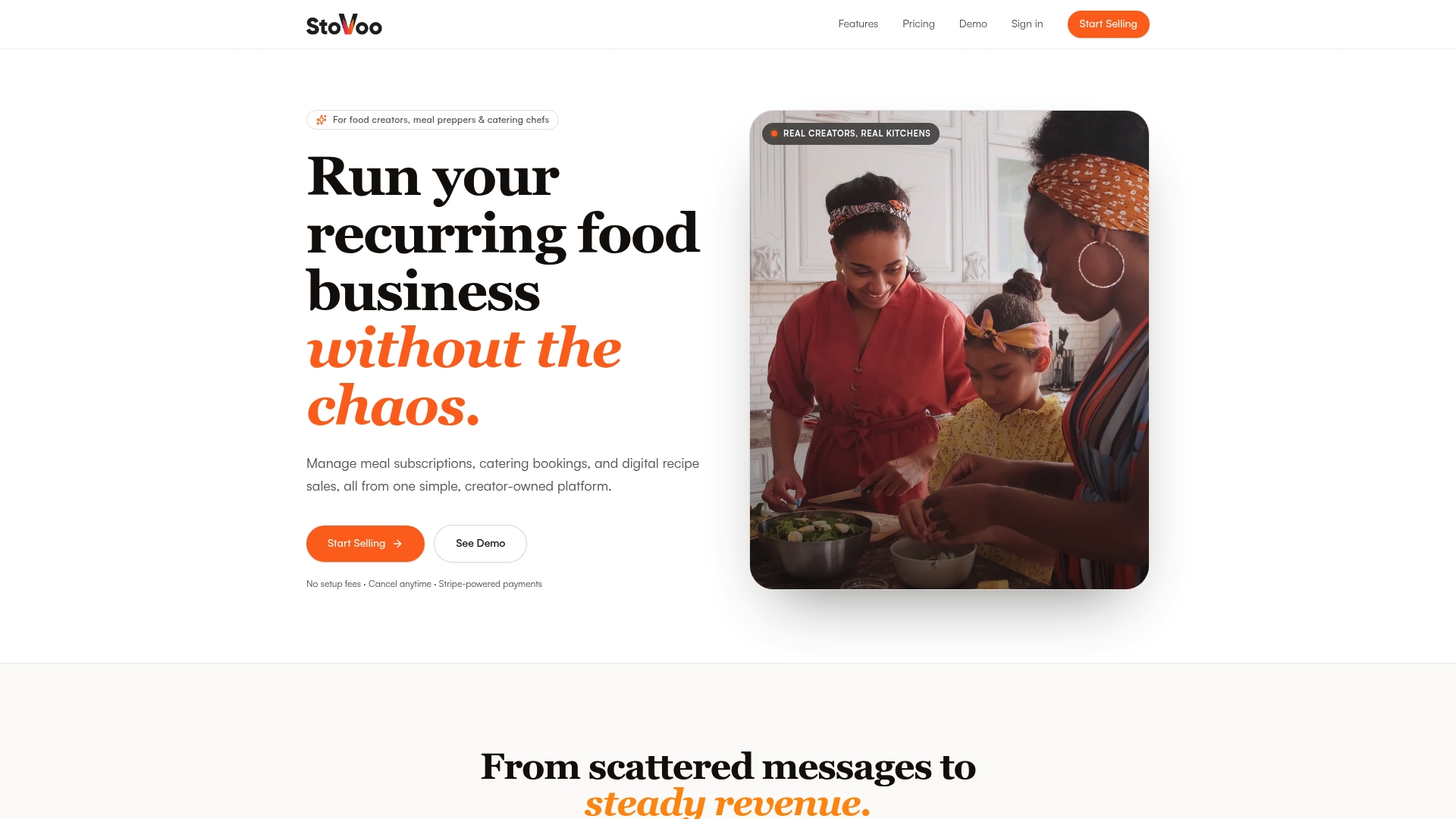
The platform gives food creators a central dashboard to manage meal subscription plans, catering bookings, and digital product sales, with automated billing and a mobile-first shopfront you can share across Instagram, WhatsApp, or any channel where your customers already are. Vendors like Express Kitchen use Stovoo shopfronts to list meal plans and manage orders without a separate website or payment system. You keep full customer ownership, which means your subscriber list is yours, not a platform's.
Start a free pilot on Stovoo and have your shopfront live before your next production day.
Sources
- How do you start a meal prep service business in 2027? — PulseRevOps
- The Cottage Food Delivery Playbook — FindHomegrown
- FoodTech Unit Economics: Per-Order Profitability, Delivery Costs, and Break-Even Analysis — RevenueMap
FAQ
What is the most profitable meal delivery model for small food businesses?
Click-and-collect and digital products carry the highest net margins because they eliminate delivery cost entirely. For physical meals, niche subscription plans with porch pickup consistently outperform marketplace sales on contribution margin.
How much does it cost to launch a meal delivery business?
Lean launch costs for a small meal-prep operation typically run $8,000–$25,000 for a fully equipped setup. A cottage-food subscription model with porch pickup can launch for significantly less, often under $2,000 in startup costs.
Should I use DoorDash, Uber Eats, or Grubhub to sell my meals?
They work best as a short-term discovery channel, not a long-term revenue foundation.
What technology do I need to run a subscription meal plan?
At minimum: a customer-facing shopfront, recurring billing with pause/cancel management, and a basic CRM to track subscribers. Stovoo provides all three in one dashboard built specifically for food creators.
How long does it take to validate a new meal delivery model?
A 90-day pilot is enough to validate any model. Pre-sell to 5–10 customers in the first 30 days, optimize based on real feedback in days 31–60, and make a go/no-go decision by day 90 using weekly order count, retention rate, and contribution margin per order.