
TL;DR:
- Choosing the appropriate catering business model depends on client needs, operational capacity, and resource availability.
- Successful operators evaluate client segments and fulfillment options, adapting their strategies over time to maximize profit and efficiency.
Picking the right catering business type can feel overwhelming when the industry throws around overlapping terms like "full-service," "drop-off," "ghost kitchen," and "corporate catering" without much clarity. Your choice of model shapes everything: who you serve, how you staff your events, what equipment you need, and ultimately how profitable you become. The good news is that the confusion largely disappears once you filter your options through a simple, practical framework. This article breaks down each major catering type, compares fulfillment models side by side, and gives you the decision tools to pick a structure that matches your resources and goals.
Table of Contents
- How to evaluate types of catering businesses
- Major event and customer segments in catering
- Core service and fulfillment models: full-service, drop-off, buffet, and more
- Alternative kitchen footprints: shared, ghost, and commissary models
- Making your catering business type work: operational nuances and hybrid strategies
- A practical take: why your catering type should evolve with you
- Scale your catering business with smart solutions
- Frequently asked questions
Key Takeaways
| Point | Details |
|---|---|
| Segment your market | Choose your catering model based on your ideal event type and client needs. |
| Understand service models | Full-service, drop-off, buffet, and food truck catering each have distinct operational and staffing needs. |
| Leverage kitchen options | Ghost and shared kitchens offer low-risk paths for startup and scale. |
| Track catering separately | Treat catering as its own business for clear financials and staff focus. |
| Evolve with demand | Adapt your catering type as client preferences and kitchen resources change. |
How to evaluate types of catering businesses
Once you recognize the selection challenge, it's simpler to evaluate business types using reliable, industry-driven criteria. Most owners make the mistake of categorizing catering businesses by cuisine or event size alone. That's too narrow. The real decision framework runs along three axes.
According to a practical how to start a catering business guide, owners should treat catering types as a combination of who the event is for, how food is produced and logistically fulfilled, and the staffing level and experience promised. These axes change your sales process, staffing ratios, equipment needs, and risk tolerance in meaningful ways.
Here's what to map before you commit to a model:
- Client and event type: Corporate lunches, weddings, school meals, and stadium concessions all demand different menu complexity, lead times, and pricing.
- Kitchen and logistics model: Do you own a commercial kitchen, rent shared space, or operate from a food truck? Each option carries different overhead and flexibility.
- Service format: Are you staffing an event end-to-end, or just delivering food and stepping away?
Pro Tip: Before committing to a model, list your current assets, specifically your kitchen access, vehicle capacity, and reliable staff count. Overlay those against each model's requirements. The model that demands the least new investment while matching local demand is usually your smartest starting point.
The catering industry is growing fast, which means more room for well-positioned operators. If you want to boost profit and streamline operations, matching your business type to your actual operational capacity is the clearest path forward.
Major event and customer segments in catering
After considering how to evaluate business types, it's smart to look at who you'll be serving and what that means for your operation. Common catering business types segment by event and customer, including corporate, wedding, and social events, as well as by service and fulfillment model such as mobile food trucks, buffet or plated service, and drop-off versus full-service delivery.
The catering market by end-user spans corporate events, educational institutions, healthcare facilities, social and private functions, sports events, and a mix of independent and chain or franchise providers. Each segment operates under a distinct set of expectations.
Here's a quick breakdown of what each segment demands from you as an operator:
| Segment | Key client expectation | Repeat business potential | Complexity level |
|---|---|---|---|
| Corporate | Punctuality, consistency, volume | High | Medium |
| Wedding | Customization, presentation, emotion | Low | High |
| Social/private | Flexibility, affordability | Medium | Low to medium |
| Healthcare | Dietary compliance, safety | Very high | High |
| Education | Budget control, volume, nutrition | Very high | Medium |
| Sports events | Speed, portability, scale | Medium | High |
"The most sustainable catering businesses often anchor in one primary segment while developing complementary offerings for adjacent markets. Corporate clients offer repeat contracts; weddings offer premium pricing. The smartest operators find ways to capture both."
What this table makes clear is that chasing multiple segments without preparation leads to operational chaos. Corporate catering rewards systems and reliability. Wedding catering rewards creativity and customization. Healthcare catering is non-negotiable on compliance. Education catering lives or dies by cost efficiency.
Chain and franchise caterers often win in high-volume, low-variation segments like corporate and education because their repeatable processes keep costs down. Independent caterers tend to dominate in weddings and social events, where personalization and culinary creativity matter more than standardization.
Core service and fulfillment models: full-service, drop-off, buffet, and more
Knowing your end-user lets you choose the most effective service and fulfillment model. Here's how the main options compare in practice.
Full-service and drop-off catering differ by whether staffed on-site execution, including setup, service, and breakdown and cleanup, is included or not. That staffing difference directly affects your cost structure, margin, and client experience. Menu and format add another layer, with buffet-style service running differently from individually plated meals. Operationally, caterers often choose between restaurant-based, independent, and food-truck-based models, each with different infrastructure, risk, and logistics profiles.
| Model | Staffing level | Typical cost to client | Guest experience | Best for |
|---|---|---|---|---|
| Full-service | High | Premium | Seamless, attended | Weddings, galas, corporate dinners |
| Drop-off | Minimal | Low to mid | Self-managed | Office lunches, casual social events |
| Buffet | Medium | Mid | Informal, high variety | Company picnics, large parties |
| Plated | High | Premium | Formal, curated | Formal dinners, seated weddings |
| Food truck | Low to medium | Mid | Casual, exciting | Street events, festivals, pop-ups |
Pro Tip: Many caterers successfully blend formats. A drop-off lunch package with an optional on-site staff add-on, for example, lets you upsell without changing your core production workflow. Clients appreciate the flexibility, and you capture higher revenue from the same base prep work.
Here's a quick look at the owner-level pros and cons:
- Full-service: Higher revenue per event but demands more staff management and on-site logistics coordination.
- Drop-off: Lower labor costs and simpler execution, but you lose control over presentation quality at the venue.
- Buffet: Great for high headcounts and variety, but food waste management becomes a real cost factor.
- Plated: Commands the highest per-head pricing but requires precise timing and experienced serving staff.
- Food truck: Low facility overhead with strong brand visibility, but geography and permits create ongoing constraints.
If you're still mapping out your approach to full-service vs drop-off operations, consider starting with the model that requires the fewest new hires and the smallest equipment investment, then layering complexity as revenue grows.
Alternative kitchen footprints: shared, ghost, and commissary models
Once your service style is chosen, consider which kitchen and production model fits, especially if you're starting up or scaling fast. Your kitchen is your production engine, and the type of kitchen you use shapes your costs, compliance path, and growth ceiling more than most owners realize.
Alternative kitchen footprints such as commissary kitchens, shared-use kitchens, ghost kitchens, and incubator-style facilities function as production-model variants for catering and foodservice operators. Each option carries different implications:
- Shared-use kitchen: Multiple operators rent time in a licensed commercial kitchen. Low barrier to entry, no long-term lease, ideal for testing a new concept or managing seasonal overflow.
- Commissary kitchen: A central production facility you use as your base for prepping food that gets transported and finished elsewhere. Common among food truck operators and drop-off caterers.
- Ghost kitchen: A delivery or order-focused operation with no dining room. Increasingly used by caterers who want to handle online orders without running a brick-and-mortar space.
- Incubator kitchen: Shared facilities often run by food business development programs, typically offering low rents plus business coaching. Good fit for early-stage operators.
"Access to a licensed, compliant commercial kitchen is usually the first real bottleneck for new catering operators. Non-traditional kitchen models remove that barrier without requiring a five-year lease."
Pro Tip: Shared-use and commissary kitchens let you pilot new service types at minimal financial risk. If you want to test a new segment like healthcare meal delivery or add a ghost kitchen arm to handle more modern ghost kitchen models, a short-term commissary arrangement is far smarter than committing to expensive real estate before you know the demand is there.
The labor and compliance implications are real too. Shared kitchens mean you're sharing scheduling, storage space, and sometimes equipment. Ghost kitchens require clear separation of your orders from other operators sharing the facility. Both models demand that you track your production separately and maintain strict food safety records. New caterers who build these habits early scale much more smoothly.
Making your catering business type work: operational nuances and hybrid strategies
With all types covered, it's crucial to understand how leading owners combine models and keep finances and opportunities clear. The biggest operational mistake catering owners make is treating catering as an extension of an existing operation rather than its own business unit.
Catering as a business within a business is a real operational nuance. Staffing, P&L tracking, and client development in catering can differ significantly from dine-in restaurant operations, even when using the same kitchen. If you don't track your catering revenue, food costs, and labor separately, you're flying blind on profitability.
Here's a practical approach to implementing hybrid or evolving models as demand grows:
- Start with one model. Pick the fulfillment type that matches your current resources. Launching a drop-off model before a full-service offering lets you build cash flow and systems before adding staffing complexity.
- Track catering P&L independently. Even if you share a kitchen with a restaurant or a home operation, create a separate cost center for catering. Know your food cost percentage, your labor percentage, and your event margin individually.
- Pilot new formats before scaling. Before adding a full-service package, run two or three events at the new format and review what broke. This is where ghost kitchen production or commissary arrangements earn their value.
- Build client relationships by segment. Corporate clients need a different sales approach than wedding clients. Develop separate pitch decks, pricing sheets, and communication cadences for each.
- Review quarterly. The catering landscape shifts with seasonality, local economic conditions, and venue availability. Build a quarterly review into your operations calendar to assess whether your current model mix still fits your market.
Pro Tip: Many successful caterers scale by piloting new formats on low-risk events first, such as drop-off lunches for local startups or commissary-based meal prep for a small recurring corporate client, before committing to full operational changes.
For more on tips for managing catering as a separate business unit, separating your books and your staffing strategy is consistently the biggest differentiator between operators who grow and those who plateau.
A practical take: why your catering type should evolve with you
Here's an industry-insider view on evolving your strategy as the market and your resources shift. Most catering owners assume the hardest decision is picking the right model at launch. It isn't. The harder decision is recognizing when to evolve it.
The catering market rewards flexibility. Operators who lock into a single model and refuse to adapt often find themselves squeezed by lower-cost competitors or outgrown by client demand. The caterers who sustain strong businesses over five or ten years almost always started in one place and grew into hybrid approaches over time.
The conventional wisdom says "pick your niche and own it." That's partially right. Specialization creates a compelling brand and makes operations efficient. But specialization without adaptation leads to stagnation, especially when local market conditions shift, a new commissary kitchen opens up, or a major corporate client starts requesting a service type you don't currently offer.
Here are the practical signals that it's time to pivot or add a new model to your operation:
- Plateaued sales for two or more consecutive quarters. If you're not growing, your current model mix isn't capturing available demand.
- High fixed costs eating into margins. If your kitchen overhead is outpacing your event revenue, a shared-use or commissary arrangement could immediately improve your numbers.
- New and repeated event requests you keep turning down. Client demand is the clearest signal of where adjacent opportunity lives.
- Availability of a commissary or ghost kitchen nearby. New infrastructure lowers your barrier to adding a new production model.
- Staffing improvements that make a more complex model viable. As your team builds skills, more premium service formats become accessible.
The best approach to streamlining your catering business over time is building your model with intentional flexibility from the start. That means keeping fixed costs manageable, building client relationships across more than one segment, and reviewing your service mix at least once a year.
Scale your catering business with smart solutions
With your model picked and strategy in hand, technology can make the difference in running operations smoothly.
Running a catering business across multiple formats, kitchen models, and client segments generates real administrative complexity. Stovoo is built specifically for food entrepreneurs who want to manage bookings, menus, payments, and client relationships from a single platform without the chaos of spreadsheets and scattered messaging apps.
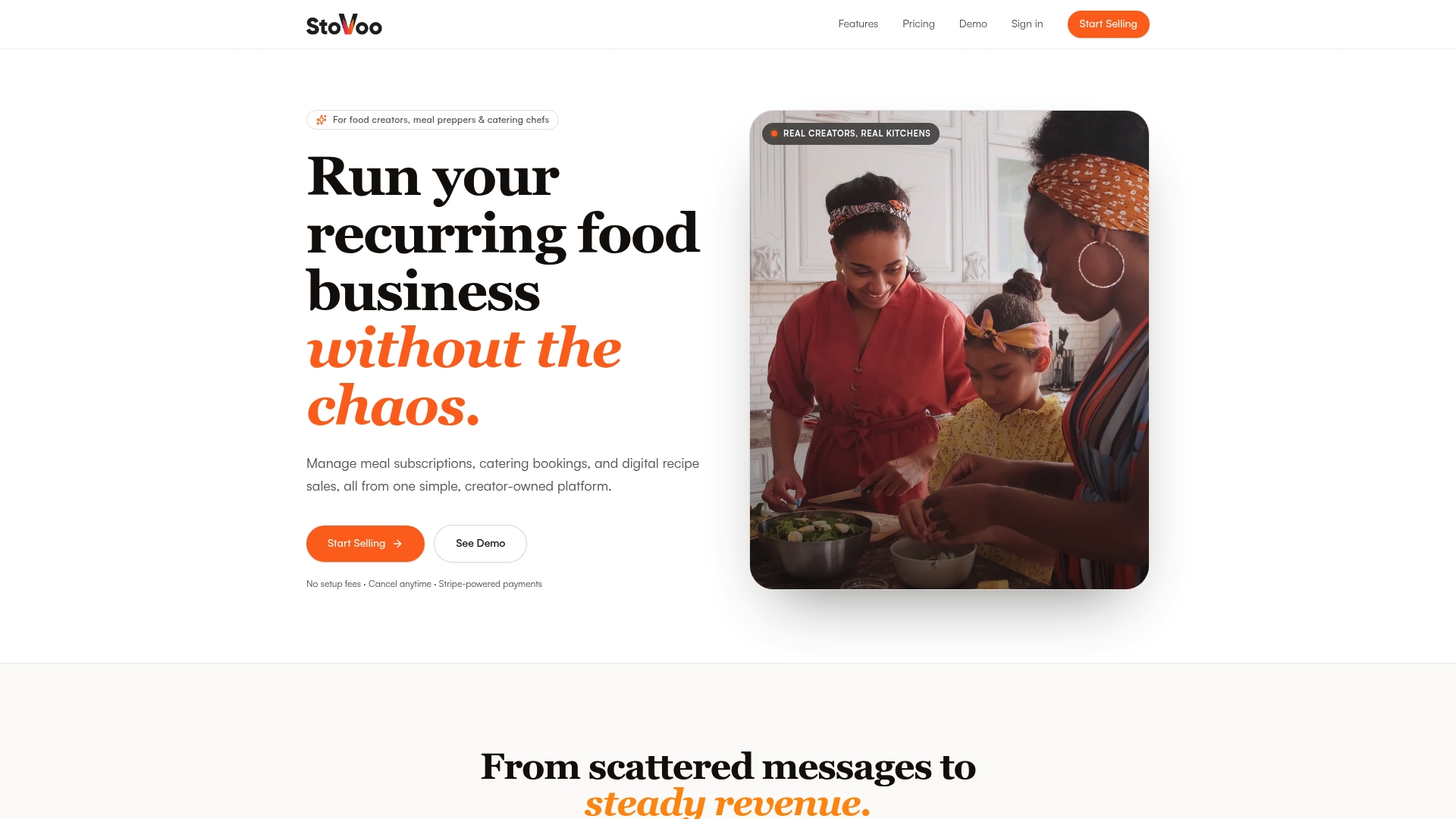
Whether you're running drop-off corporate lunches, building a full-service wedding catering brand, or scaling through modern kitchen solutions, Stovoo gives you the tools to handle enquiries, automate billing, and maintain a professional client-facing shopfront. You can see Amara's catering menus for a real example of how operators present their offerings on the platform. Ready to simplify your operations? Get started on Stovoo today and spend more time cooking and less time on admin.
Frequently asked questions
What is the most profitable type of catering business?
Full-service and specialized corporate catering often generate higher margins due to premium pricing and repeat contract potential, though profitability always depends on your local demand and cost structure. Corporate and full-service catering command premium positioning when executed consistently.
How do shared or ghost kitchens benefit new catering businesses?
They provide flexible, lower-risk production space without requiring a long-term lease or heavy upfront capital investment. Alternative kitchen models like shared-use and ghost kitchens are specifically designed for operators who need compliance and capacity without fixed overhead.
Can I run both drop-off and full-service catering from one kitchen?
Yes, managing multiple fulfillment models from a single kitchen is common among growing operators, but staff training and logistics scheduling must match each service type's demands. Catering as a business within a business is a well-established operational model where separate fulfillment approaches are managed under one roof.
What legal requirements should I check for alternative kitchens?
Always verify local health department rules, food handler licensing, and zoning approvals before signing any shared, commissary, or ghost kitchen agreement. Alternative kitchen arrangements require specific regulatory compliance that varies significantly by city and state.