

TL;DR:
- Technology in the food industry enhances safety, reduces waste, and creates more efficient supply chains through AI, IoT, blockchain, and precision agriculture. These connected systems improve food production, supply management, and product innovation while overcoming barriers like data silos, infrastructure costs, and workforce readiness. The future of food tech lies in systems integration, predictive models, and green solutions that offer competitive advantages and better adapt to growing global demand.
Technology in the food industry is the application of AI, IoT, blockchain, and precision agriculture to produce safer food, reduce waste, and build more efficient supply chains. The role of tech in food industry operations has shifted from optional upgrade to operational necessity. A scoping review of 46 studies from 2015–2025 found an 89% improvement in food safety and an 83% reduction in food loss when digital technologies were applied across supply chains. Those numbers signal a fundamental change in how food gets grown, moved, and sold.
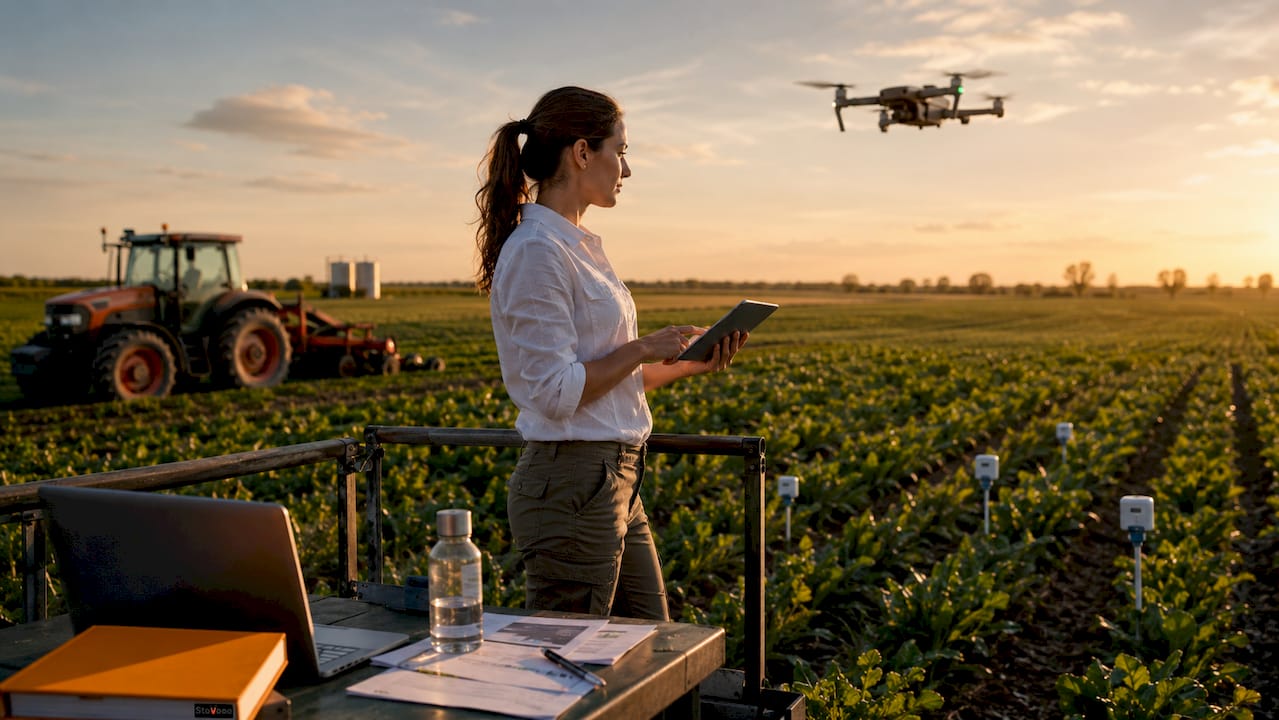
How does the role of tech in food industry operations work?
Technology in food production is not a single tool. It is a connected system where AI, IoT sensors, blockchain ledgers, and biotechnology each solve a specific problem. AI analyzes crop data and predicts spoilage. IoT sensors monitor temperature and humidity in real time. Blockchain creates an auditable trail from farm to fork. Precision agriculture applies data analytics to reduce water, fertilizer, and pesticide use. When these tools work together, the impact on food safety, yield, and sustainability multiplies.
Food industry innovation built on isolated gadgets rarely delivers lasting results. Integrated digital and green processes that optimize the entire food value chain yield greater benefits than any single technology deployed alone. That means food professionals need to think in systems, not tools.
How does technology improve food production and farming efficiency?
Global population growth will require a 50% increase in food production by 2050. That demand cannot be met by simply farming more land. Precision agriculture and soilless cultivation are the two most credible paths to meeting it without destroying natural resources.
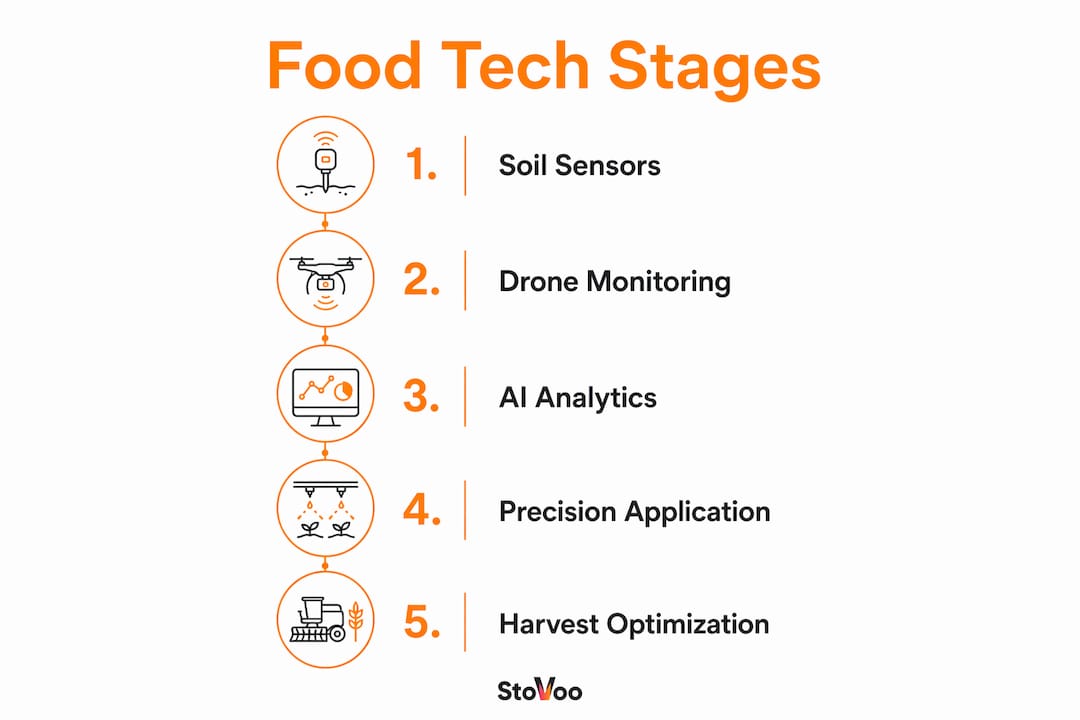
Precision agriculture: sensors, drones, and AI analytics
Precision agriculture uses soil sensors, aerial drones, and AI analytics to apply exactly the right amount of water, fertilizer, and pesticide to each section of a field. The result is less waste, lower cost, and higher yield per acre. Companies like John Deere and Trimble have built entire product lines around GPS-guided machinery and field mapping software. Farmers using these systems report measurable reductions in input costs alongside yield improvements.
Smart farming technology also includes variable rate application, where a tractor automatically adjusts fertilizer output based on real-time soil data. That level of precision was impossible without connected sensors and machine learning models trained on years of field data.
Soilless cultivation: hydroponics and aeroponics
Hydroponics and aeroponics grow crops in controlled environments without soil, using nutrient-rich water or mist. These methods use a fraction of the water required by conventional farming and can produce crops year-round regardless of climate. Vertical farms in cities like New York and Singapore use these techniques to supply fresh produce with minimal transport distance. The tradeoff is high energy cost, which is why pairing soilless cultivation with renewable energy is the next frontier for food industry professionals.
- Soil sensors detect nitrogen, phosphorus, and moisture levels in real time
- Drones map field health using multispectral imaging
- AI models predict optimal harvest windows based on weather and growth data
- Hydroponics reduces water use compared to conventional field farming
- Aeroponics delivers nutrients directly to roots, accelerating growth cycles
Pro Tip: Before investing in precision agriculture hardware, audit your existing data collection. Most farms already generate usable data from weather stations and yield monitors. Connecting those sources through a platform like Climate FieldView or John Deere Operations Center costs far less than buying new sensors.
What impact does technology have on supply chain management and food waste reduction?
Food waste is one of the most expensive problems in the industry. AI-powered spoilage prediction and inventory management reduce food waste by approximately 30% and cut CO2 emissions by shifting operations from reactive to predictive. That shift alone changes the economics of running a food business.
IoT sensors embedded in refrigerated trucks and cold storage units monitor temperature, humidity, and gas levels continuously. When a reading falls outside safe parameters, the system alerts operators before spoilage occurs. This is a direct improvement over manual checks, which catch problems only after damage is done. Pairing IoT data with food business analytics gives operators a real-time picture of inventory health across multiple locations.
Blockchain adds a layer of transparency that IoT alone cannot provide. Every transaction, temperature log, and location update gets recorded on an immutable ledger. Retailers like Walmart have used IBM Food Trust, a blockchain platform, to trace the origin of leafy greens in seconds rather than days. That speed matters enormously during a food safety recall.
Conventional vs. tech-enabled supply chain: a direct comparison
| Process | Conventional approach | Tech-enabled approach |
|---|---|---|
| Temperature monitoring | Manual checks every few hours | Continuous IoT sensor alerts |
| Spoilage detection | Visual inspection at delivery | AI prediction before shipment |
| Traceability | Paper records, days to trace | Blockchain ledger, seconds to trace |
| Inventory management | Weekly manual counts | Real-time automated tracking |
| Waste reduction | Reactive disposal | Predictive reordering and routing |
The gap between these two columns is not theoretical. Blockchain, IoT, and AI applied together across storage and transportation produced the 83% food loss reduction documented in recent research. That is the compounding effect of connected systems.
How is technology transforming food processing and product innovation?
Food processing faces a convergence of pressures that technology is uniquely positioned to address. Rapid innovation cycles, raw material volatility, and consumer scrutiny are redefining what processors must deliver. Consumers now expect clean labels, personalized nutrition, and full ingredient transparency. Meeting those expectations without technology is nearly impossible at scale.
Automation and robotics handle repetitive processing tasks with greater consistency than manual labor. Robotic arms from companies like ABB and Fanuc sort, cut, and package food products at speeds that reduce both labor costs and contamination risk. Automated quality control cameras detect defects that human inspectors miss. These tools do not replace skilled food scientists. They free those scientists to focus on formulation and innovation instead of line monitoring.
Digital meal planning and data analytics are reshaping how new products reach consumers. Food companies now use purchase data, social media sentiment, and dietary trend analysis to identify product gaps before competitors do. That data-driven approach compresses the product development cycle from years to months.
Key technology applications driving product innovation:
- Clean-label formulation tools that identify natural ingredient substitutes
- AI-driven flavor modeling that predicts consumer acceptance before production
- Personalized nutrition platforms that match products to individual dietary profiles
- Automated allergen detection systems that reduce labeling errors
- Subscription model tools that gather real-time consumer preference data
Pro Tip: Use consumer purchase data from your subscription or delivery platform to identify which product variations sell fastest. That feedback loop is faster and cheaper than traditional focus groups, and it reflects actual buying behavior rather than stated preferences.
What challenges come with adopting technology in the food industry?
Technology adoption in food businesses is not frictionless. The most common failure points are predictable, and knowing them in advance saves significant time and money.
-
Data silos and interoperability gaps. A major challenge for small and medium businesses is data integration. IoT sensors, inventory systems, and ERP platforms often cannot communicate with each other. The result is expensive data that nobody can act on. Before buying new technology, map your existing systems and confirm they share a common data format or API.
-
The traceability trap. Blockchain and sensor networks generate enormous amounts of monitoring data. But current open-loop configurations track issues without triggering automated corrective actions. You get visibility without control. Businesses that invest in traceability tech without a plan for acting on the data end up with static dashboards instead of dynamic process improvement.
-
Hidden infrastructure and energy costs. AI adoption requires substantial energy, infrastructure, and workforce training. Practitioners consistently report being surprised by the total cost of implementation. Cloud computing fees, data storage, and model maintenance add up quickly. Budget for ongoing operational costs, not just the initial purchase.
-
Workforce readiness. Technology supplements human decision-making but does not replace domain expertise. A food safety manager with 20 years of experience brings contextual judgment that no AI model currently replicates. The most successful implementations pair experienced staff with AI tools, using technology to surface insights and humans to act on them.
-
Unrealistic expectations about speed. Most food businesses see meaningful results from digital transformation within 12–24 months, not weeks. Setting realistic timelines with measurable milestones prevents early abandonment of tools that would have delivered value with more patience.
Key Takeaways
Technology transforms food industry operations only when AI, IoT, blockchain, and precision agriculture work as a connected system rather than isolated tools.
| Point | Details |
|---|---|
| Connected systems outperform single tools | Integrated digital and green processes deliver greater value than any one technology deployed alone. |
| AI cuts waste by ~30% | Predictive spoilage models shift operations from reactive disposal to proactive inventory control. |
| Blockchain speeds traceability | Retailers using blockchain trace food origins in seconds, not days, improving recall response. |
| Data silos are the top barrier | Interoperability gaps between IoT and inventory systems prevent businesses from acting on sensor data. |
| Human expertise remains critical | AI supplements decision-making but cannot replace the contextual judgment of experienced food professionals. |
The future of food tech belongs to systems thinkers, not gadget buyers
Every year I watch food businesses spend serious money on technology and walk away disappointed. The pattern is almost always the same. They buy a sensor network, a blockchain platform, or an AI inventory tool in isolation. Six months later, the data sits in a silo, the team doesn't know how to interpret it, and the ROI conversation gets uncomfortable.
The businesses that succeed with food industry innovation treat technology as an ecosystem. They ask: how does this tool connect to what we already have? Who on our team will own the data it generates? What decision will we make differently because of it? Those questions sound simple. Most businesses skip them entirely.
The sustainability angle is where I think the biggest opportunity sits right now. The digital-green transition in food technology is not just a regulatory trend. It is a genuine competitive advantage. Businesses that use IoT and AI to reduce waste and energy consumption are building cost structures that conventional competitors cannot match. That gap will widen as energy prices and food waste regulations tighten.
The future of food technology is predictive and personalized. AI models will anticipate demand, adjust production, and recommend formulations before a human analyst even frames the question. But the food professionals who thrive will be the ones who understand both the technology and the food. The algorithm tells you what the data says. You still have to know what to cook.
— freeman
How Stovoo helps food businesses grow with technology
Running a food business means managing orders, customers, subscriptions, and payments across too many platforms at once. Stovoo brings all of that into one place.

Stovoo is built specifically for food creators, meal preppers, catering chefs, and small food businesses that want to run recurring revenue without the admin chaos. You get a mobile-first shopfront, automated billing, and full customer ownership from day one. Whether you run weekly meal plans, catering bookings, or sell digital recipe downloads, Stovoo handles the operations so you can focus on the food. Start your food business on Stovoo today and see how straightforward running a modern food operation can be.
FAQ
What is the role of tech in the food industry?
Technology in the food industry covers AI, IoT, blockchain, and precision agriculture applied to improve food safety, reduce waste, and increase production efficiency. A scoping review of 46 studies found these tools delivered an 89% improvement in food safety and an 83% reduction in food loss.
How does AI reduce food waste in supply chains?
AI-powered spoilage prediction models analyze temperature, humidity, and inventory data to flag quality risks before products deteriorate. This predictive approach reduces food waste by approximately 30% and lowers CO2 emissions compared to reactive disposal methods.
What is precision agriculture and why does it matter?
Precision agriculture uses soil sensors, drones, and AI analytics to apply water, fertilizer, and pesticides at exactly the right rate for each field section. It matters because global food production must increase by 50% by 2050, and precision methods are the most resource-efficient path to meeting that demand.
What are the biggest barriers to adopting food technology?
Data integration is the top barrier. IoT sensors, inventory systems, and ERP platforms often lack interoperability, creating costly data silos. Hidden infrastructure costs and the need for workforce training are the next most common obstacles practitioners report.
How does blockchain improve food traceability?
Blockchain records every transaction, temperature log, and location update on an immutable ledger. Retailers using platforms like IBM Food Trust can trace the origin of a food product in seconds rather than days, which is critical during safety recalls.