
Your subscription cancellation policy needs one clear line: tell customers exactly when they must act to skip the next charge, what happens to orders already cooking, and whether they get a refund or a credit if they miss the window. Publish that line at checkout and in the account portal, and back it with a cancellation button that is just as easy to click as the "subscribe" button was. Stovoo builds those controls into every shopfront, so you're not stitching this together with spreadsheets and a payment processor's default settings.
TL;DR:
- A clear cancellation cutoff time, such as 48 hours before delivery, must be stated explicitly in the customer’s local time zone and matched to kitchen prep timelines.
- Customers should be able to cancel or pause their subscription with at least as much ease as signing up, ideally with a dedicated button in their account portal.
- Refunds are generally not provided once an order is in prep, but credits are common, provided the policy clearly states proof requirements for damages or errors.
- The short cancellation disclosure must appear near the checkout button, with the full policy linked directly in the account portal and confirmation emails.
- Maintaining automated logs of customer consent and cancellations, with timestamps, is essential for compliance and dispute resolution.
Table of Contents
- What Should Your Subscription Cancellation Policy Actually Say?
- What Does the FTC Require for Subscription Cancellations?
- How Do Kitchen Timelines Shape Your Cut-Off Rules?
- What Wording Should You Put on Checkout and in Your Terms?
- Where Should You Display This in Your Stovoo Shopfront?
- Why Fair Cancellation Terms Are a Retention Tool, Not a Loss
- Publish Your Cancellation Policy Without Building It From Scratch
- Sources
- FAQ
What Should Your Subscription Cancellation Policy Actually Say?
A subscription termination policy for a meal plan has to answer five questions before a customer even asks them. Skip one, and you'll spend your Friday afternoons refunding orders that were already in a delivery van.
Here's the checklist that separates a policy that actually protects your kitchen from one that just sounds official:
- Billing cycle and renewal mechanics. State the exact renewal date, how trial periods convert to paid plans, and what the customer is charged once that trial ends.
- Cut-off time and time zone. "Cancel by 6:00 PM ET two days before delivery" works. "Cancel anytime" does not, because your kitchen still has to shop, prep, and pack before the truck leaves.
- Future subscription vs. order in production. Cancelling next week's plan is different from cancelling Thursday's box that's already portioned. Say so, plainly, in two separate sentences.
- Refunds, credits, and replacements. Spell out what happens when a delivery is missed, an ingredient is wrong, or food arrives damaged, and what proof (a photo, a timestamp) you'll ask for.
- Failed payments and chargebacks. Note how many retry attempts you allow before pausing the account, and what triggers an automatic hold.
What Does the FTC Require for Subscription Cancellations?
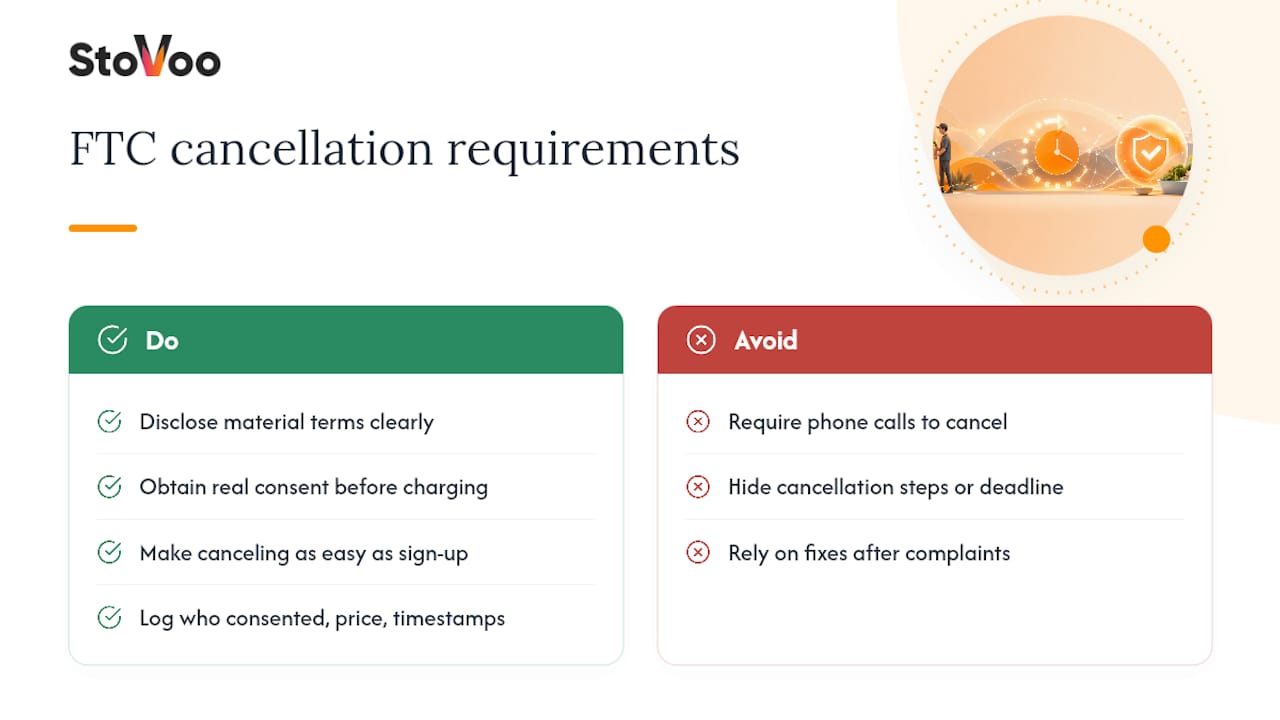
The short version: disclose clearly, get real consent, and make canceling as easy as signing up. That's the whole spirit of the FTC's negative-option enforcement approach, and it applies to your weekly meal box exactly as it applies to a streaming service.
The FTC's amended negative option rule requires businesses to clearly and conspicuously disclose the material terms of a recurring plan and to offer a cancellation mechanism that's at least as simple as the sign-up flow. If a customer can subscribe with two taps, they should be able to cancel with two taps, not a phone call routed through a retention script.
Four disclosures, one screen. The FTC's finalized click-to-cancel rule says these four things need to sit right next to where a customer agrees to recurring charges: that the charge will recur, the deadline to stop it, the amount and frequency of the charge, and exactly how to find the cancellation mechanism.
That rule was later vacated on procedural grounds, but the underlying enforcement posture hasn't gone anywhere. The FTC still pursues negative-option violations under existing consumer protection law, and several states run their own automatic-renewal statutes with similar teeth. Building compliance in from day one, rather than patching it after a complaint, is the cheaper path either way.
Keep a simple log: who consented, when, to what price, and when they canceled. If a dispute ever lands in your inbox, that timestamp is your best defense, and the FTC's Negative Option Rule text explicitly calls out consent verification as part of what regulators expect sellers to maintain.
How Do Kitchen Timelines Shape Your Cut-Off Rules?
A meal subscription doesn't run on a billing calendar. It runs on a prep calendar, and your policy needs to match the second one, not the first.
Picture the timeline: a customer subscribes on Monday, your kitchen shops Wednesday, preps Thursday morning, and delivers Thursday evening. Somewhere in that window is a single moment when an order stops being a request and starts being food. That moment is your cut-off, and everything else in the policy flows from it.
- Pick one lock-time and say it out loud. "Orders lock at 6:00 PM two days before delivery" is concrete enough that a customer can set a phone reminder around it.
- Decide 24 hours vs. 48 hours based on your supply chain. If you order proteins fresh two days out, a 24-hour cut-off will bankrupt you in wasted stock. If you batch-prep from a standing pantry, 24 hours might be plenty.
- Set the after-cut-off rule now, not during a heated email. Most food businesses offer a credit toward the next cycle rather than a cash refund once prep has started, since the ingredients are already bought.
- Build pause and skip separately from cancel. A skipped week isn't a cancellation. Treat it as its own toggle so customers don't cancel entirely just to avoid one unwanted delivery.
- Give your staff a script. Something as short as "I can lock in a credit toward your next box since the order already went into prep, would that work?" keeps a late-cancellation conversation calm instead of confrontational.
Pro Tip: Tie your cut-off language to a real kitchen action instead of a vague time. "Orders lock when the manifest prints Tuesday at 6:00 PM" reads as fair because customers can picture exactly what happens after that moment.
What Wording Should You Put on Checkout and in Your Terms?
Customers don't read fine print. They read the one line sitting closest to the "subscribe" button, so that line must carry the entire weight of your cancellation terms.
Keep the checkout disclosure short and put the full membership cancellation terms behind a link for anyone who wants the details:
- Checkout short line: "Renews weekly on Sundays. Cancel or pause anytime before Friday 6:00 PM ET to skip your next box. See full policy."
- Confirmation email line: "Your next charge of $X hits on [date]. Manage or cancel your plan in your account before the Friday cut-off."
- Account portal button label: "Cancel Subscription" or "Pause This Week," never buried under a generic "Settings" tab.
- FAQ entry: "Can I get a refund after the cut-off?" answered with your exact credit or refund rule, no hedging.
For the full-length version, a workable template covers: what "subscription" means for your business, how billing and renewal dates work, the exact cut-off time and time zone, what happens to orders already in production, your refund/credit/replacement rules with any evidence requirements, how pauses and skips work, what happens after a failed payment, and one direct contact method for cancellation questions.
That one paragraph, published once and linked everywhere, does more to prevent disputes than a dozen back-and-forth emails ever will.
Where Should You Display This in Your Stovoo Shopfront?
Publishing a policy is only half the job. It has to live in the three places a customer actually looks: right before they pay, inside their account, and in the email that lands after they subscribe.
- Checkout and consent box: Put your short disclosure line directly above the payment button, not in a footer link nobody scrolls to.
- Account portal: Link the full policy from the same screen where customers manage their plan, so cancellation terms and the cancel button live side by side.
- Confirmation emails: Restate the renewal date, amount, and cut-off in every billing confirmation, matching the FTC's guidance on adjacent disclosure.
- Consent and cancellation logging: Stovoo's automated billing system timestamps every charge and every cancellation request automatically, so you're not manually screenshotting emails to prove a customer agreed to the terms.
- Pause, skip, and cancel toggles: Configure these as separate, customer-visible buttons rather than one blunt "cancel" option that forces people to quit entirely just to skip a week.
Pro Tip: Set your order cut-off field once in Stovoo and it applies across every plan automatically, which means you never have to remember to manually block a late order during a busy prep morning.
Give your kitchen staff a one-page checklist too: how to confirm a cancellation request, when to issue a credit versus a refund, and where to log any exception you make outside the standard rule.
Why Fair Cancellation Terms Are a Retention Tool, Not a Loss
The instinct in food businesses is to make cancellation quietly difficult, hoping a little friction buys another billing cycle. It doesn't work that way. A customer who feels trapped doesn't renew out of loyalty; they file a chargeback, and chargebacks cost you more in fees and reputation than the missed subscription ever would.
The businesses that keep subscribers longest are the ones that make canceling painless and make pausing even easier. A skip-a-week button removes the reason to cancel in the first place. Refund versus credit isn't a moral question either. It's a supply chain question: credit protects you when ingredients are already bought, and customers accept that trade when the rule was disclosed upfront instead of discovered mid-dispute.
— freeman
Publish Your Cancellation Policy Without Building It From Scratch
Writing the policy is one job. Enforcing it every single week, across every subscriber, is another, and that's where most food businesses quietly fall apart, chasing cancellations through a shared inbox while orders are already in prep. Stovoo is built so that job never lands back on you manually: automated billing tracks every renewal date and charge, the account portal gives customers a cancel or pause button that's as easy to find as the subscribe button was, and every consent and cancellation event gets a timestamp automatically.
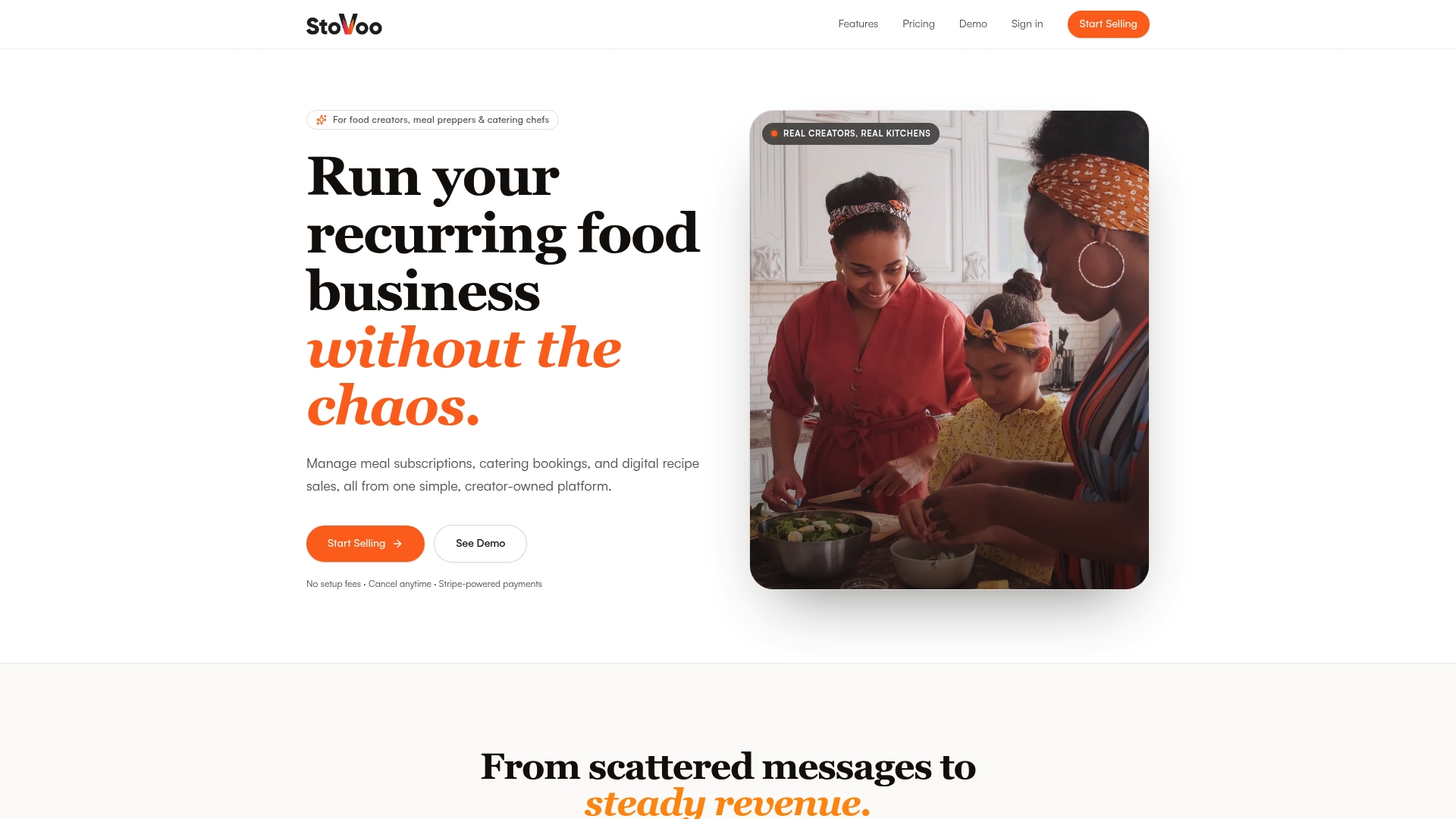
You can set your own cut-off fields, turn on skip and pause toggles, and link your full policy straight into your shopfront's checkout and confirmation emails, no developer required. If you want to see how this looks on a live storefront before setting up your own, browse an example shopfront like ami, London or Savoury Kitchen, Nairobi to see policy placement in action. When you're ready to publish your own, create your Stovoo account and have your cancellation policy live before your next billing cycle runs.
FAQ
What Is a Subscription Cancellation Policy for a Food Business?
It's a published set of rules stating how and when customers can cancel a recurring meal plan, what cut-off applies to the next delivery, and whether they receive a refund, credit, or replacement if something goes wrong. Stovoo lets you publish this policy directly in your shopfront's checkout and account portal.
How Do I Handle Automatic Renewal Cancellation for Meal Plans?
State a fixed cut-off time and time zone, such as 48 hours before the next delivery, and require the cancellation button to work at least as easily as the subscribe button did, per FTC guidance. Anything harder than that invites disputes and chargebacks.
Should I Offer Refunds or Credits After the Cancellation Cut-Off?
Most food businesses offer a credit toward the next cycle rather than a cash refund once an order has entered prep, since the ingredients are already purchased. Avoid a blanket no-refund rule for perishable goods; pair any denial with a clear, reasonable evidence process instead.
Where Should I Display My Subscription Refund Policy?
Put a short disclosure line at checkout next to the payment button, then link the full policy in your account portal and every confirmation email. The FTC's click-to-cancel rule treats adjacency to the consent screen as a core disclosure requirement.
How Do I Cancel My Membership if I'm a Customer, Not a Vendor?
Customers should use the cancel button inside their account portal, which needs to be as accessible as the original sign-up flow. If a food business makes this harder, that's a direct violation of the simple-cancellation principle regulators now enforce.