
Create a niche 4-week meal plan PDF or subscription, load it into a simple shopfront, and test a $9–$29 entry price this week. Digital meal plans work because you build the content once and sell it on repeat, with almost no marginal cost per customer. A shopfront tool like Stovoo lets you launch that first product without touching code, which means the biggest barrier left is picking a niche and hitting publish.
TL;DR:
- Selling static PDF plans in the $9 to $29 range is ideal for testing niches and generating initial sales with minimal effort.
- Offering personalized plans requires more time but commands higher prices, often up to $150 for one-time or recurring custom content.
- A professional shopfront platform simplifies operations, automates billing, and helps retain ownership of customer relationships, unlike marketplaces or scattered tools.
- Successful initial launch relies on prelaunch testing, targeting trusted audiences, and gathering quick feedback rather than perfecting the product beforehand.
- Pricing should be tested and adjusted based on conversion and renewal rates, with clear differentiation between general wellness and medical advice to stay within legal bounds.
Table of Contents
- Why Sell Meal Plans Online (And Who It's Really For)
- Choose Your Product: Formats, Scope, and Niche
- How Do You Create a Meal Plan That's Ready to Sell?
- Where Should You Sell Your Meal Plans?
- Pricing and Monetization: What to Charge and How to Test It
- What's the Legal Line Between a Meal Plan and Medical Advice?
- Launch and First-Sales Playbook
- How Stovoo Supports Meal-Plan Sellers
- What I've Learned Watching Meal-Plan Businesses Get Off the Ground
- Start Selling Meal Plans With Your Own Shopfront
- Sources
- FAQ
Why Sell Meal Plans Online (And Who It's Really For)
The math behind digital meal plans is simple: you write the recipes, portion guides, and grocery lists once, then sell that same file or subscription to hundreds of customers without rebuilding it each time. That's the entire appeal. A meal plan business model built this way scales in a way one-on-one coaching never can, because your time input per sale drops toward zero after the first version ships.
This path fits a specific set of sellers well:
- Registered dietitians who want a lower-touch revenue stream alongside client sessions
- Fitness coaches who already sell training programs and want a natural upsell
- Meal-prep chefs who cook professionally and want to package that expertise as content
- Food content creators with an audience but no product yet
Meal plans also slot neatly into a bigger product ladder. A free 3-day sample plan works as a lead magnet. A paid 4-week PDF or subscription becomes your core offer. From there, a high-touch coaching package or custom plan service becomes the natural upsell for buyers who want more attention. Coaches and trainers frequently bundle meal plans directly into existing service packages rather than selling them as standalone products, which raises the price of the whole bundle without adding much production time.
The people who succeed at this fastest are rarely the ones with the most nutrition credentials. They're the ones who ship a decent plan in week one instead of perfecting an elaborate one for three months.
Choose Your Product: Formats, Scope, and Niche
Before you write a single recipe, decide what you're actually building. Three formats dominate this market, and each asks something different of you as a seller.
- Static PDF plans. A fixed 1, 2, or 4-week plan sold as a one-time download. Lowest effort to produce, easiest to price low, and the best format for testing a niche before you invest more.
- Subscription meal plans. New weekly or monthly content delivered on a recurring basis. Higher retention value and predictable revenue, but it demands a real production cadence you have to sustain.
- Personalized plans. Built from an intake form and delivered per client. Commands the highest price of the three, but takes real time per order unless you build a templated base plan you can adjust quickly.
Once you know the format, validate the niche before building anything substantial. Run through this checklist:
- Can you name the exact person this plan is for (a 35-year-old marathon runner, a postpartum client, a busy parent doing meal prep on Sundays)? Vague audiences produce vague plans that don't sell.
- Does anyone actually search for this? Check phrases like "high-protein meal plan" or "budget meal prep plan" for volume before committing.
- Will people pay for it? Post a sample day of meals on Instagram or in a Facebook group and gauge real interest before building the full product.
For your first SKU, keep it narrow. A "7-day high-protein meal prep plan for beginners" outsells a generic "healthy eating plan" because it tells a buyer exactly what they're getting. Good starter packaging includes a single 4-week plan, a 3-pack bundle covering different calorie targets, or a starter plan paired with a grocery list add-on. Resist the urge to launch five products at once. One well-made plan that sells is worth more than five mediocre ones sitting unsold in a shopfront, and a guide to meal plan business models walks through how to expand the lineup once your first offer proves itself.
How Do You Create a Meal Plan That's Ready to Sell?
A sellable meal plan needs a consistent anatomy: a weekly calendar view, full recipes with exact portions, a consolidated grocery list organized by store section, and basic nutrition notes per meal. Skip any of these and customers feel like they bought half a product. The grocery list matters more than most sellers realize. It's the feature that turns a plan from "nice recipes" into "I can actually follow this on a Tuesday."
If you're building personalized plans, a short intake form does the heavy lifting. A minimal version with six fields, goal, allergies, dislikes, weekly schedule, budget, and any relevant prior conditions, captures enough to customize a plan meaningfully without straying into clinical advice territory. Anything beyond that starts to look like an assessment only a licensed professional should be doing.
Production works best as a batch process, not a one-off scramble:
- Build a base 4-week template first, with core recipes and structure locked in
- Create swap lists for proteins, carbs, and vegetables so you can vary the plan without rewriting it
- Draft, test, and photograph recipes in one sitting rather than spreading it across weeks
- Run a final check for portion consistency, allergen labeling, and correct grocery list totals before publishing
Batch-creating a base template with variable swap lists means you can personalize a client's plan in under 30 minutes once the core structure exists, instead of building each one from scratch.
Formatting for mobile matters just as much as the content. Most customers will open your PDF on a phone while standing in a grocery store aisle, not at a desk. Use large, legible fonts, short line lengths, and a grocery list that scrolls cleanly on a small screen. A beautifully designed plan that requires pinch-to-zoom on every page will get abandoned faster than a plain one that's easy to read.
Pro Tip: Photograph or design your grocery list as its own single page that customers can screenshot. Nobody wants to scroll through five pages of a meal plan while standing in the cereal aisle.
Where Should You Sell Your Meal Plans?
Three broad categories cover almost every option available, and each trades control, speed, and margin differently.
- Owned website. Full control over branding, pricing, and customer data, but the slowest to set up and the most technical overhead.
- Marketplace platforms. Fast to list a product with built-in traffic, but you typically give up a meaningful cut of revenue and have limited control over the customer relationship.
- Dedicated shopfront tools. A middle path: purpose-built for food sellers, quick to launch, and structured to keep you owning the customer relationship without needing developer skills.
The trade-off between speed and margin is real. Marketplaces and hosted storefronts let you start selling within a day, but the platform fee on every sale eats into take-home revenue in a way that compounds as you scale. A $19 plan sold through a marketplace charging a 20% cut nets you $15.20; the same plan sold through your own shopfront link nets closer to full price minus payment processing.
Hosted ecommerce tools built for instant digital delivery, the kind Payhip and similar platforms offer, work well for a first PDF sale because setup takes minutes. But once you're running a recurring subscription with dozens of active customers, you need more than file delivery. You need automated recurring billing, a client portal for renewals and updates, and a way to manage customer messages that isn't scattered across three different apps.
That's the signal to graduate from a bare-bones storefront to a platform built specifically for food businesses. Look for these operational cues before switching:
- You're manually re-billing subscribers each month instead of it happening automatically
- Customer questions are piling up across WhatsApp, Instagram DMs, and email with no single inbox
- You've outgrown a single PDF and now sell multiple plans, add-ons, or catering alongside them
Pricing and Monetization: What to Charge and How to Test It
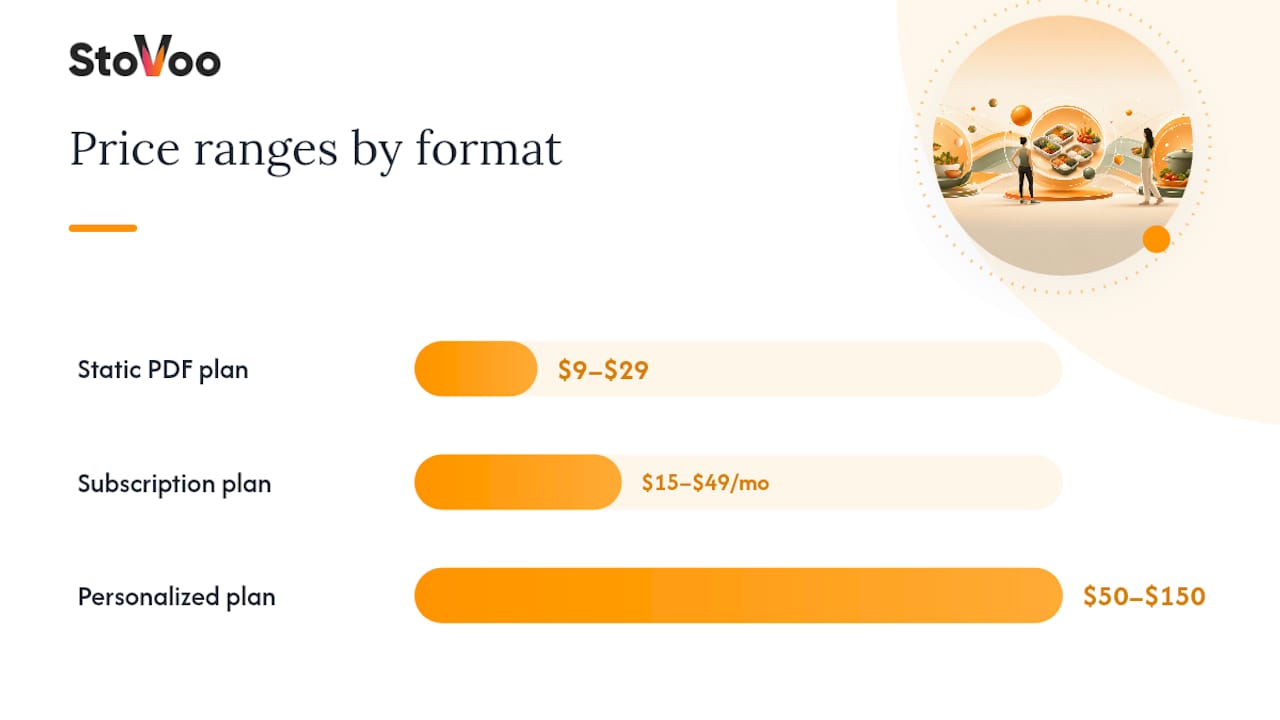
Price by format, not by gut feeling. Static PDF plans typically sell in the $9 to $29 range for a single 4-week plan. Subscription meal plans command $15 to $49 per month depending on how much personalization and new content you deliver weekly. Personalized, intake-based plans push higher, often $50 to $150 as a one-time fee or recurring charge, because they require real time per customer.
Bundling changes the math further. Coaches commonly add a meal plan to an existing coaching package and charge an additional $50 to $150 on top of the base service, rather than selling the plan on its own. That's often more profitable than selling meal plans as a standalone product, since the customer is already paying for the relationship and the meal plan just increases perceived value.
Fee math matters more than most new sellers expect. A $19 subscription sold through a platform taking a 15% cut plus payment processing nets roughly $15 to $16 per customer per month. Run that same subscription through a tool with lower fees and automated billing, and the gap between gross and net revenue over a year of 50 subscribers becomes the difference between a side project and real income.
To find your price, don't guess once and stick with it. Run a simple test:
- Launch at your best estimate and track conversion rate for two weeks before touching the price
- Raise the price 20% if conversion holds steady, since that usually signals you priced too low
- Watch renewal rate on subscriptions more closely than the initial sale, since a $29 plan with 20% monthly churn earns less over a year than a $19 plan with 5% churn
- Ask non-buyers who visited your shopfront but didn't purchase what held them back, and adjust copy or price accordingly
Presentation shifts what people are willing to pay just as much as the content inside. A branded PDF or client portal experience materially increases perceived value compared to a plain, unbranded document, which is one more reason a professional shopfront outperforms a generic file dropped in an email.
What's the Legal Line Between a Meal Plan and Medical Advice?
You do not need a Registered Dietitian license to sell general meal plans. Selling structured meal ideas, recipes, and grocery guides to the public is not regulated the same way individualized medical nutrition therapy is. But individualized nutrition advice tied to a diagnosed condition crosses into territory that legally requires a license in most states, and the wording on your product pages is what separates the two.
Avoid language that implies you're diagnosing, treating, or managing a medical condition. Phrases like "manage your diabetes with this plan" or "reverse insulin resistance" step into medical claims regardless of your intent. Safe replacements focus on general wellness and lifestyle framing instead:
- Swap "treats" or "manages [condition]" for "supports general wellness goals"
- Swap "personalized nutrition therapy" for "customized meal planning based on your preferences"
- Swap "diagnosis-based plan" for "general meal plan, not a substitute for medical advice"
If a buyer discloses a medical condition through your intake form, the safest move is a simple referral note pointing them to a Registered Dietitian or physician rather than adjusting the plan around their diagnosis yourself. That one habit protects both you and the customer, and it costs you nothing but a sentence in your intake confirmation email.
Launch and First-Sales Playbook
Getting your first meal plan into paying hands takes a tighter sequence than most new sellers expect, as explained in the Role of Online Food Ordering for Restaurants and Customers which highlights key trends influencing food businesses today. Work through it in order.
- Prelaunch checklist, three to five days out. Test your checkout end to end, name and format every file for mobile viewing, write a plain-language refund policy, and confirm delivery emails actually land in an inbox and not a spam folder. Quickshops' prelaunch checklist covers this exact sequence and it catches the mistakes that kill first impressions.
- Soft launch to your warmest audience. Email your list or post directly to followers who already know you, days one through three. This group converts at the highest rate because trust is already built.
- Public launch across channels. Push to Instagram, TikTok, or wherever your audience already spends time, days four through seven. Include a real preview image of the plan, not just a text post.
- Collect and act on feedback fast. Send a short survey to your first ten buyers within a week of purchase asking what they liked and what confused them, then fix the plan before your next promotional push.
Track three numbers from day one: conversion rate from shopfront visit to purchase, refund rate, and (if you're running a subscription) month-two renewal rate. Renewal rate tells you more about product quality than sales volume ever will.
Pro Tip: Don't wait for a "perfect" launch moment. Sell your first plan to five people you already know before you ever run an ad. Their feedback is worth more than any amount of pre-launch polishing.
How Stovoo Supports Meal-Plan Sellers
Running a meal-plan business across five different apps, one for payments, one for messaging, one for file delivery, one for scheduling, is exactly the chaos that kills momentum before a seller finds out if their product actually works. Stovoo centralizes that operation into a single dashboard: shopfront creation, automated recurring billing, customer management, and digital product delivery all live in one place instead of scattered across WhatsApp threads and spreadsheets.
The platform supports several business models at once, so a seller isn't locked into one format:
- Weekly or monthly meal subscription plans with automated recurring charges
- One-time digital recipe or plan sales delivered instantly on purchase
- Catering inquiries and bookings alongside meal plan sales for vendors running a broader food business
Real vendor shopfronts already running on the platform, including abc, ami in London, and the healthy junk in Abuja, show what a working storefront looks like once a seller has a customized link they can drop into an Instagram bio or WhatsApp broadcast.
| What sellers need | How it's handled |
|---|---|
| Recurring billing without manual invoicing | Automated subscription charges per customer |
| A single customer inbox | Centralized customer management dashboard |
| A shareable storefront | Customized shopfront link for social and messaging |
| Digital plan delivery | Instant download or access on purchase |
Sellers who want deeper operational detail can work through Stovoo's meal plan management guide, which walks through the workflow behind the dashboard in more depth than a quickstart can cover.
What I've Learned Watching Meal-Plan Businesses Get Off the Ground
The sellers who struggle most aren't the ones with weak recipes. They're the ones who spend eight weeks perfecting a plan nobody has asked for yet. Ship the rough version, sell it to a handful of real people, and let their feedback tell you what to fix. That single habit separates people who launch from people who plan to launch someday.
The second lesson is about month one specifically: expect it to be quiet. Your first ten sales will come from people who already trust you, not from strangers finding you through search. Treat that first month as a listening exercise, not a revenue benchmark, and the frustration of slow early sales stops feeling like failure and starts looking like normal.
Where most new sellers waste time is picking the platform before picking the niche. Get the niche and the first plan right, then let the tooling catch up.
— freeman
Start Selling Meal Plans With Your Own Shopfront
Stovoo replaces the WhatsApp threads, spreadsheet invoices, and scattered payment links most meal-plan sellers start with, giving you one dashboard for your shopfront, billing, and customer messages instead of three or four disconnected tools.
Once your first meal plan is ready, the setup itself takes minutes: build your shopfront, price your plan, and share the link anywhere your audience already spends time—Instagram bio, WhatsApp broadcast, TikTok. Recurring billing runs automatically, so you're not manually re-invoicing subscribers every month, and you keep full ownership of your customer list instead of renting it from a marketplace. Vendors like CakesbyCoco and Culater Catering's in Lagos already run their storefronts this way. If you're ready to move past spreadsheets and test your first meal plan this week, create your account and start selling.
Sources
- How to Sell Meal Plans Online When You're Not a Registered Dietitian - Playing Jackal
- How to Sell Meal Plans Online as a Coach in 2026
FAQ
What Is the 3-3-3 Rule for Meals?
The 3-3-3 rule is a meal-structuring shortcut some coaches use, generally referring to balancing three meals with three components each (protein, carb, and vegetable) across three main meals a day. Definitions vary by coach, so state your own version clearly in any plan you sell rather than assuming buyers know the term.
How Can I Get Paid for My Recipes?
Package recipes into a digital PDF or subscription and sell them through a shopfront or storefront tool that handles checkout and file delivery automatically. Platforms like Stovoo let you set a price, share a shopfront link, and collect payment without building a website from scratch.
How Much Money Do I Need to Start a Meal Prep Business?
A digital meal plan business can start with minimal upfront cost since you're selling a file or subscription, not physical inventory. Your main investments are your own time to build the first plan and a low-cost platform subscription for the shopfront and billing tools.
What Is the Best Way to Sell Meal Plans Online?
The strongest setup pairs a narrow, well-defined niche with a dedicated shopfront that handles billing and delivery automatically, rather than a generic plan sold through scattered payment links. A platform built specifically for food sellers, like Stovoo, keeps recurring billing, customer messages, and digital delivery in one place instead of across multiple apps.