

TL;DR:
- Online ordering boosts small food businesses' revenue by increasing order value and capturing off-hours demand.
- Owning customer data and focusing on pickup-first fulfillment enhance margins and operational control.
Online ordering is a primary revenue and efficiency channel for small food businesses, not just a convenience feature. Direct online orders typically produce a higher average order value than phone orders, and that lift compounds when you own the customer relationship. Three moves matter most right now:
- Capture orders you own. A direct shopfront keeps customer data in your hands, not a marketplace's.
- Match fulfillment to your menu. Pickup and dine-in accounted for 60.1% of direct orders in 2025–2026, making pickup-first the smart default for most small concepts.
- Use order data to drive retention. The median reorder gap is approximately a week to ten days, so your retention window is narrow and predictable.
Table of Contents
- How online ordering directly affects your revenue and operations
- Which ordering model fits your food business?
- What changes in your kitchen and workflow once orders go online
- Costs, margins, and a simple way to estimate your ROI
- How to choose the right online ordering technology
- What to measure and how to test your way to better results
- Your launch checklist: from planning to live in 30 days
- Legal and compliance basics for online food orders
- Key Takeaways
- What actually works for small food businesses
- Stovoo gives you the direct channel you actually need
- Useful sources
- FAQ
How online ordering directly affects your revenue and operations
The impact of online food ordering on a small food business shows up in four places: order value, labor, accuracy, and marketing data.
Average order value rises because customers browse at their own pace, see upsell prompts, and aren't rushed by a phone queue. The 15–20% AOV lift is consistent across platform reports. That means a $25 phone order becomes a $29–$30 online order, with no extra labor.
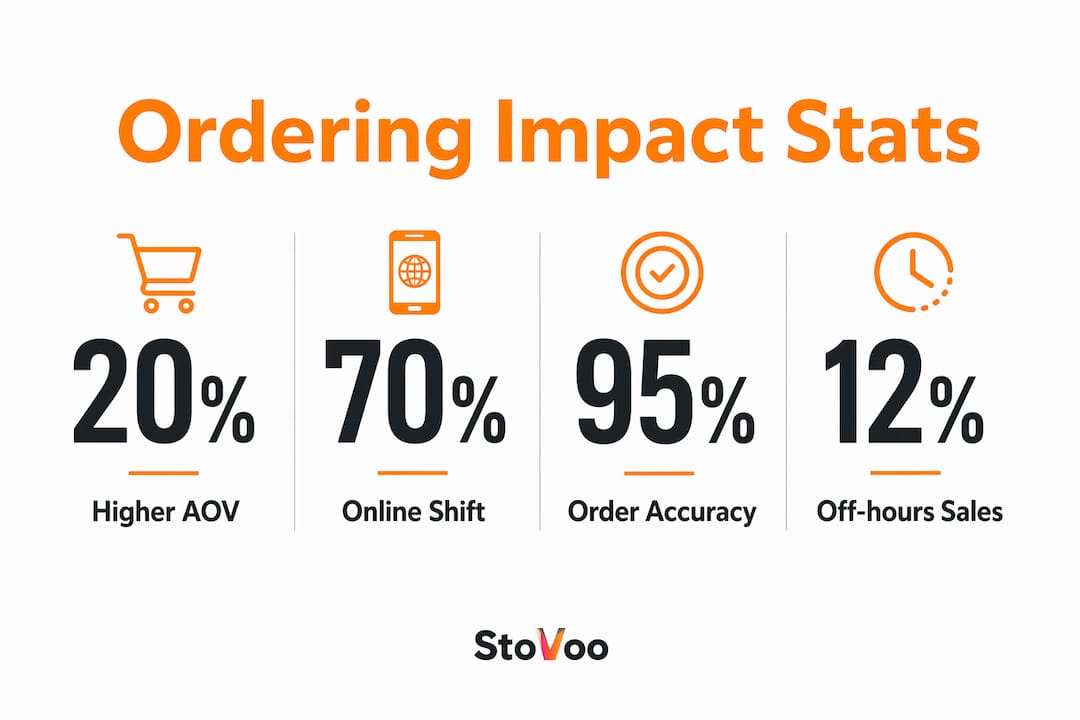
Labor savings are real and measurable. When roughly 70% of orders migrate online, operators typically recover about 3 labor hours per day. Those hours can shift to prep, quality control, or customer care instead of answering calls.
Order accuracy improves sharply. Phone orders run at 80–90% accuracy; online orders approach near-perfect because customers enter their own modifiers and addresses. Fewer remakes, fewer refunds, happier customers.
Off-hours orders are net new revenue. Between 8–12% of online orders arrive outside business hours via preorders and scheduled orders. That's demand you'd otherwise miss entirely.
Pro Tip: Present add-ons as a grouped "Complete Your Order" section at checkout rather than scattering them across the menu. Attachment rates climb when the upsell feels like a natural next step, not an afterthought.
| Metric | Benchmark |
|---|---|
| AOV lift vs. phone orders | 15–20% |
| Pickup + dine-in share of direct orders | 60.1% |
| Orders outside business hours | 8–12% |
| Labor recovered at ~70% online order share | ~3 hours/day |
| Median reorder gap | 8.9 days |
Which ordering model fits your food business?
Three models exist: a direct hosted shopfront (commission-free), third-party marketplace apps, or a hybrid of both. Choosing wrong costs you margin or reach, sometimes both.
Direct shopfront works best for pickup-heavy concepts, subscription meal plans, and catering businesses where repeat customers and data ownership matter. You pay a flat platform fee instead of per-order commissions. Third-party apps frequently charge 15–30% commission per order, which erodes margin fast on low-ticket items.
Third-party marketplaces offer reach and built-in demand, but the research is clear: chains benefit more than independents. For small operators, the primary value is dine-in spillover and brand discovery, not direct takeout profit. Use marketplaces to acquire new customers, then migrate them to your direct channel.
Hybrid makes sense for expansion-focused businesses that want marketplace visibility while protecting margin on loyal customers. The operational cost is managing two order streams.
Pro Tip: Let fulfillment follow menu behavior, not channel hype. If your concept is cafe or bakery, Restolabs data shows pickup exceeds most orders in many cafe or bakery concepts. Build your checkout flow around that reality before investing in delivery infrastructure.
| Model | Reach | Margin impact | Customer data ownership | Best fit |
|---|---|---|---|---|
| Direct shopfront | Your audience | High (flat fee) | Full ownership | Meal prep, catering, subscriptions |
| Third-party marketplace | Large, built-in | Low (15–30% commission) | Platform owns it | Discovery, new-market entry |
| Hybrid | Broad | Mixed | Partial | Growth-stage, multi-channel |
What changes in your kitchen and workflow once orders go online
Fulfillment mix reshapes everything: prep windows, packaging, and staffing schedules all shift when pickup becomes your primary channel. Pickup orders need a dedicated staging area and clear labeling. Delivery orders need packaging that holds temperature and presentation. These are different operational setups, and trying to run both from the same workflow creates bottlenecks.
Menu engineering for self-service is a different skill than writing a printed menu. Descriptions need to answer the questions a customer would normally ask a server. Photography earns its cost by reducing confusion and increasing conversion. Structured modifiers (size, protein, sauce) convert better and reduce remakes; free-text "special instructions" fields should be limited to a catch-all "other" option only.
Pro Tip: Build every customization as a structured modifier, not a free-text note. A dropdown for "sauce on the side" eliminates kitchen ambiguity. A text box invites "extra extra sauce please no wait just a little" and a remake.
When online orders reduce phone volume, recovered staff time should go somewhere specific:
- Expediting and quality-checking outgoing orders
- Proactive customer communication on delays
- Prep work that improves consistency
- Packaging and presentation upgrades
For caterers, managing catering operations with online booking flows also reduces back-and-forth quoting time, freeing hours for actual cooking.
Costs, margins, and a simple way to estimate your ROI
The cost structure for digital food ordering breaks into four buckets: platform subscription or per-order commission, payment processing (typically 2.5–3% per transaction), packaging, and delivery costs if you run your own fleet.
The ROI math is straightforward. Take your current average order value, apply a 15–20% lift, multiply by monthly order volume, then subtract the platform fee and any incremental packaging cost. Add the value of recovered labor hours at your local wage rate. For most small operators running 150–300 orders per month, the net gain covers platform costs within the first 30–60 days.
Protect margin at checkout with service fees, order minimums, or packaging charges. A $3 packaging fee on delivery orders is standard and rarely causes cart abandonment when disclosed early. Hiding fees at the final step does cause abandonment.
| Input | Example figure |
|---|---|
| Current phone order AOV | $29–$30 |
| Monthly AOV gain | $800–$1,— |
For subscription and catering pricing, online ordering also enables prepayment and deposit collection, which improves cash flow and reduces no-shows.
How to choose the right online ordering technology
The feature checklist that matters for small operators is shorter than vendors want you to think. Prioritize these:
- POS sync: Orders must flow directly to your kitchen display or printer without manual re-entry.
- Customer data ownership: You need the email and order history, not just aggregate reports.
- Menu controls: The ability to 86 an item in real time, adjust prices, and add modifiers without calling support.
- Scheduling and preorders: Critical for meal prep, catering, and off-hours capture.
- Reporting: AOV, repeat rate, and order source at minimum.
Integration order matters. Connect inventory and POS first. Add marketing and loyalty tools once order volume is stable. The role of technology in food business decisions compounds: a bad POS integration creates double-entry work that wipes out your labor savings.
Pro Tip: Pilot with pickup and one menu subset for 2–6 weeks before opening all channels. This lets you stress-test your modifier setup, packaging workflow, and order routing before delivery complexity enters the picture.
For digital loyalty programs tied to your ordering platform, small coffee shops and cafes in particular see strong repeat-rate gains when loyalty is built into the checkout flow rather than bolted on as a separate app.
What to measure and how to test your way to better results
Primary KPIs to track from day one: AOV, repeat rate at 30 and 90 days, median reorder gap, order accuracy rate, and conversion rate (site visits to completed orders).
Secondary metrics worth checking monthly: outside-hours order percentage, pickup share, delivery cost per order, and customer acquisition cost for direct versus marketplace channels.
The most valuable test you can run early is reorder timing. Returning customers drive roughly 80% of orders in direct-ordering datasets, and the median reorder gap is 8.9 days. A re-engagement message sent on day 7–10 after a first order consistently outperforms messages sent later.
| KPI | Why it matters | Target cadence |
|---|---|---|
| AOV | Measures upsell and menu mix effectiveness | Weekly |
| 30-day repeat rate | Early retention signal | Monthly |
| Order accuracy rate | Tracks modifier and menu clarity | Weekly |
| Outside-hours orders % | Measures scheduled order adoption | Monthly |
| Conversion rate | Checkout flow health | Weekly |
For customer retention strategies beyond timing, test subject lines and offer types in small batches before rolling out to your full list.
Your launch checklist: from planning to live in 30 days
- Day 0: Menu audit. Remove low-margin or hard-to-package items. Write clear descriptions. Add structured modifiers for every item with customization options.
- Day 0: Photography. Shoot your top 10 items at minimum. Natural light, clean backgrounds.
- Day 1–3: POS integration. Connect your ordering system to your kitchen display or printer. Test five orders end-to-end before going live.
- Day 3–5: Staff training. Walk every team member through the order flow, pickup staging, and the fallback phone process for system issues.
- Day 5–7: Packaging decisions. Source packaging for pickup and delivery separately. Test temperature retention on your highest-margin items.
- Day 7: Soft launch. Open with a limited menu (your top 10–15 items). Staff an expeditor on the first three shifts. Monitor every order in real time.
- Week 1: Collect feedback. Ask first-time online customers one question: "Was anything unclear about your order?" Fix what comes up.
- Days 7–10: Welcome offer. Push a small incentive to first-time direct customers to trigger the second order inside the reorder window.
- Month 1: Review accuracy and speed. If accuracy is below 95%, audit your modifier structure before expanding the menu.
- Month 1–3: Retention campaigns. Schedule re-engagement messages timed to the 8.9-day median reorder gap. Test two subject lines per campaign.
- Month 3: Expand fulfillment. If pickup data supports it, add delivery or catering booking. Let the numbers decide, not the plan.
For home-based food businesses, this same sequence applies with smaller order volumes and tighter packaging budgets.
Legal and compliance basics for online food orders
Food safety compliance doesn't change because an order comes in online, but the documentation trail does. Every online order creates a timestamped record, which helps with traceability if a food safety issue arises. Make sure your allergen information is accurate and visible on your online menu, not just on in-store signage. The FDA's Food Safety Modernization Act (FSMA) applies to food businesses regardless of order channel.
Data privacy is a real obligation. When you collect customer emails, addresses, and payment information through your ordering platform, you're subject to applicable state privacy laws. California's CPRA, for example, gives consumers rights over their personal data. Use a platform that processes payments through PCI-compliant infrastructure and has a clear data retention policy. Never store raw card numbers yourself.
For catering and subscription businesses specifically, written terms covering cancellation, refunds, and delivery scope protect both you and your customers. A one-page terms document linked at checkout is standard practice and reduces disputes.
This article is general information, not legal or regulatory advice. Confirm current requirements with the relevant regulatory body or a qualified professional for your specific situation.
Key Takeaways
Online ordering functions as both a revenue channel and an operational lever for small food businesses, with pickup-first fulfillment and direct customer ownership driving the strongest margin outcomes.
| Point | Details |
|---|---|
| AOV lift is immediate | Online orders produce a 15–20% higher average order value than phone orders. |
| Pickup dominates direct orders | Pickup and dine-in account for 60.1% of direct orders; build your workflow around that. |
| Retention window is narrow | The median reorder gap is approximately a week to ten days; re-engage customers on day 7–10 for best results. |
| Own your customer data | Direct shopfronts give you full ownership; third-party apps keep the data and charge 15–30% commission. |
| Stovoo centralizes the operation | Stovoo's dashboard manages meal plans, catering, subscriptions, and billing from one place without marketplace fees. |
What actually works for small food businesses
The conventional wisdom says "get on every platform." The operators who build durable businesses do the opposite. They pick one direct channel, own it completely, and use marketplaces only as a discovery layer, not a revenue backbone. The math is simple: a 20% commission on every order is a 20% tax on your labor, your ingredients, and your time. That's not a distribution cost; it's a margin ceiling.
What's underestimated is how much the reorder window matters. Most food entrepreneurs focus on acquiring new customers when the data consistently shows that returning customers drive the overwhelming majority of revenue. A well-timed message on day 8 after a first order outperforms any acquisition campaign at a fraction of the cost. The operators who figure this out early stop chasing reach and start protecting the relationship they already have.
The other pattern worth noting: pickup-first pilots almost always outperform delivery-first launches for small concepts. Lower complexity, better margins, faster feedback loops. Delivery can come later, once the core ordering experience is dialed in.
Stovoo gives you the direct channel you actually need
Running a food business through scattered messages and manual invoices costs you time you don't have. Stovoo gives food creators, meal preppers, and catering chefs a single dashboard to manage meal subscription plans, catering bookings, automated billing, and a branded mobile-first shopfront, without paying per-order commissions to a marketplace.
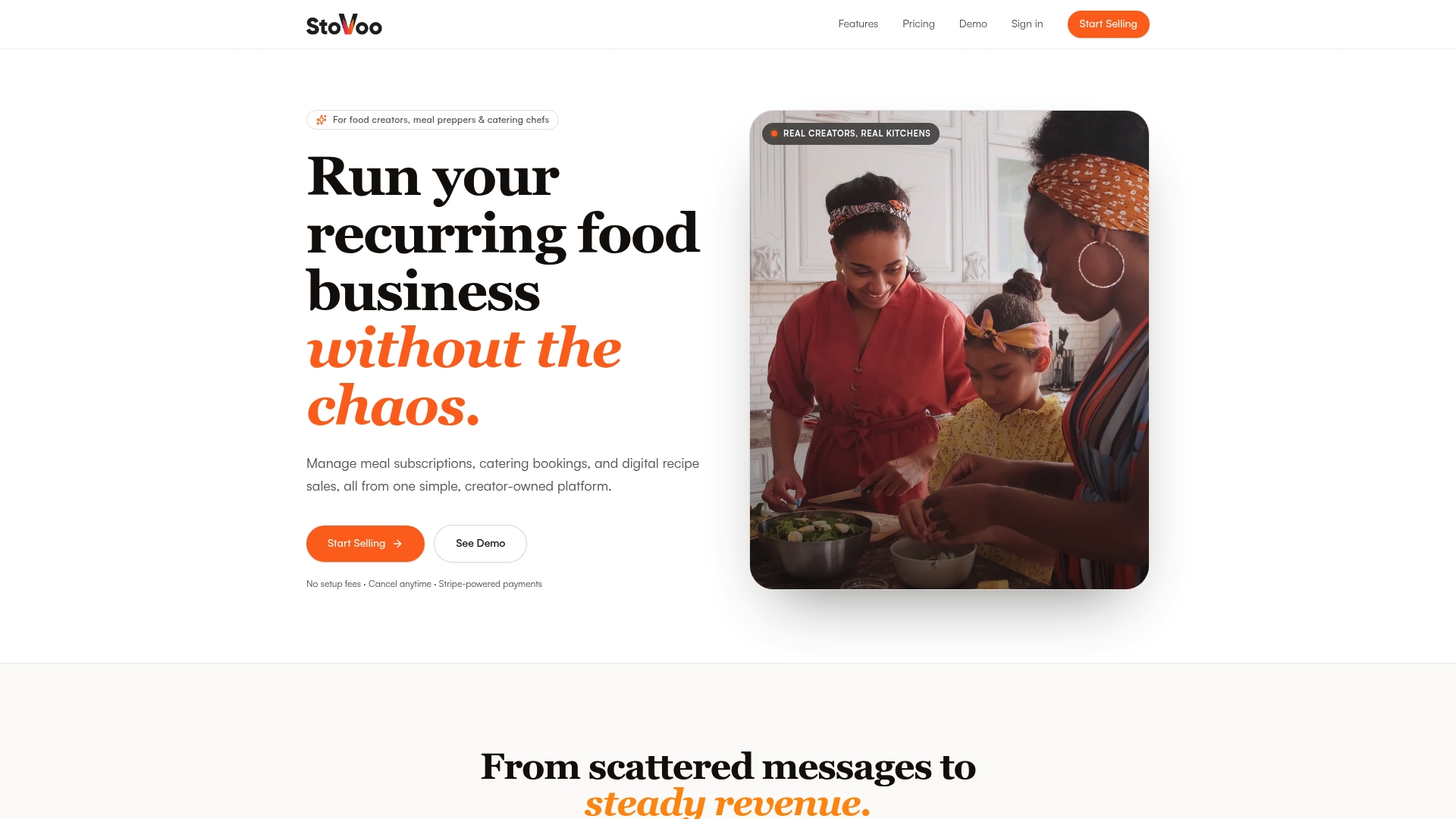
The customer data stays yours. The recurring revenue is predictable. And the shopfront takes minutes to set up and share across social media or messaging apps. For caterers specifically, the booking and inquiry flow replaces the back-and-forth that eats hours every week. See how a live Stovoo shopfront works, or visit stovoo.com to set up your own and start accepting orders today.
Useful sources
| Source | Topic |
|---|---|
| DirectOrders: Benefits of Online Restaurant Ordering | AOV lift, labor recovery, order accuracy, off-hours orders |
| Restolabs: Food Industry Report 2026 | Pickup vs. delivery split, reorder gap, retention data |
| Restolabs: Restaurant Industry Outlook Through Direct Ordering | Category-level fulfillment data, returning customer share |
| UpMenu: Benefits of Online Ordering for Restaurants | Commission cost benchmarks, direct vs. marketplace margin |
| Management Science: On-Demand Delivery Platforms and Restaurant Sales | Third-party platform effects on independents vs. chains |
| Stovoo platform | Direct ordering, subscriptions, catering, and branded shopfronts |
| Stovoo blog: Digital sales in culinary ventures | Digital revenue channels for food creators |
| Stovoo blog: Food business marketing tips | Retention and marketing tactics for small operators |
FAQ
Does online ordering actually increase revenue for small food businesses?
Yes. Direct online orders produce a 15–20% higher average order value than phone orders, and 8–12% of orders arrive outside business hours as net new demand.
Should I use a third-party app or build my own direct shopfront?
For most small operators, a direct shopfront protects margin because third-party apps charge 15–30% commission per order and retain your customer data. Use marketplaces for discovery, then move loyal customers to your direct channel.
What is the best time to send a reorder message to customers?
Send re-engagement messages on day 7–10 after a customer's first order. The median reorder gap is approximately a week to ten days, and returning customers drive the majority of revenue in direct-ordering datasets.
How does Stovoo support online ordering for small food businesses?
Stovoo provides a branded shopfront, automated billing, meal subscription management, and catering booking in one dashboard, with no per-order commissions and full ownership of your customer data.
What legal requirements apply to online food orders in the US?
Allergen disclosures must appear on your online menu, food safety rules under FSMA apply regardless of order channel, and customer data collection is subject to applicable state privacy laws. Confirm specifics with a qualified professional for your situation.