
A recipe paywall is a merchant-facing storefront tool that lets food creators sell individual recipes, ebooks, or subscription access directly to customers. Yes, you should build one — especially if you're a food creator, meal-prep business, or catering chef with original content sitting unpublished. You can launch a minimum-viable version in 48–72 hours: publish one gated recipe, set a price, and connect a payment method on your shopfront. Platforms like Stovoo make this possible without a developer. Food creators who stack digital product sales alongside ads and affiliate income report the most durable revenue — a paywall for cooking content is one of the fastest ways to add that layer.
Key Takeaways
A recipe paywall built on a dedicated platform like Stovoo lets food creators generate recurring revenue from individual recipes, ebooks, and subscriptions with a minimum-viable launch achievable in 48–72 hours.
| Point | Details |
|---|---|
| Launch fast | Publish one gated recipe with a payment link and automated delivery within 48–72 hours. |
| Price with value in mind | Ebooks typically sell for $7.99–$22; single recipes for $3–$8; micro-licenses for $20–$200. |
| Track six core KPIs | Monitor conversion rate, AOV, churn, LTV, refund rate, and traffic source ROI from day one. |
| Document license and tax terms | Add a copyright notice, permitted-use statement, and confirm sales tax obligations by state. |
| Use Stovoo to centralize | Stovoo handles shopfront, digital delivery, recurring billing, and customer management in one dashboard. |
Table of Contents
- What does a recipe paywall checklist look like for a 48–72 hour launch?
- How should you price recipes and choose a business model?
- What are your technical options for delivering paid recipes securely?
- What are the legal and tax basics for selling recipes in the United States?
- How do you promote paid recipes and improve conversion?
- Which metrics should you track for a recipe paywall?
- What does a 4-week launch roadmap look like?
- How Stovoo helps food creators launch a recipe paywall fast
- Why recipes deserve to be treated as products, not content
- Stovoo gets your recipe paywall live without the technical headache
- Sources
- FAQ
What does a recipe paywall checklist look like for a 48–72 hour launch?
Speed matters. Here's the minimum-viable setup, broken into three phases.
Hours 0–24: Content and media
- Write and format one complete, tested recipe with a normalized ingredient list (weights, not just "a handful").
- Create a short preview: the dish photo, a one-paragraph description, and two or three teaser steps that stop before the key technique.
- Write a two-sentence author blurb and a one-line license note ("For personal use only. Commercial use requires a separate license.").
Hours 24–48: Payments and delivery
- Create a product listing: set a one-off purchase price or a subscription tier.
- Connect a payment processor and configure automated download delivery or gated-post access.
- Write a short refund policy (digital goods are typically non-refundable; state this clearly).
Hours 48–72: QA, mobile test, and soft launch
- Open your shopfront on a phone and complete a test purchase end-to-end.
- Confirm the receipt email arrives with the download link attached.
- Add standard checkout terms: permitted use, refund policy, and a brief copyright notice.
Pro Tip: Before you go live, send the purchase flow to one trusted contact on a different device. The most common early refund trigger is a broken download link on mobile — catching it before launch costs nothing.
How should you price recipes and choose a business model?
The four models most food creators use are single-recipe sales, themed ebooks, subscription plans, and micro-licensing. Each fits a different audience size and content type.

Value-based pricing outperforms cost-plus pricing for digital recipe products. Price around what the buyer saves or gains, not what it cost you to write. A $12 weeknight dinner plan that saves a buyer 45 minutes of meal planning every week is priced well below its perceived value.
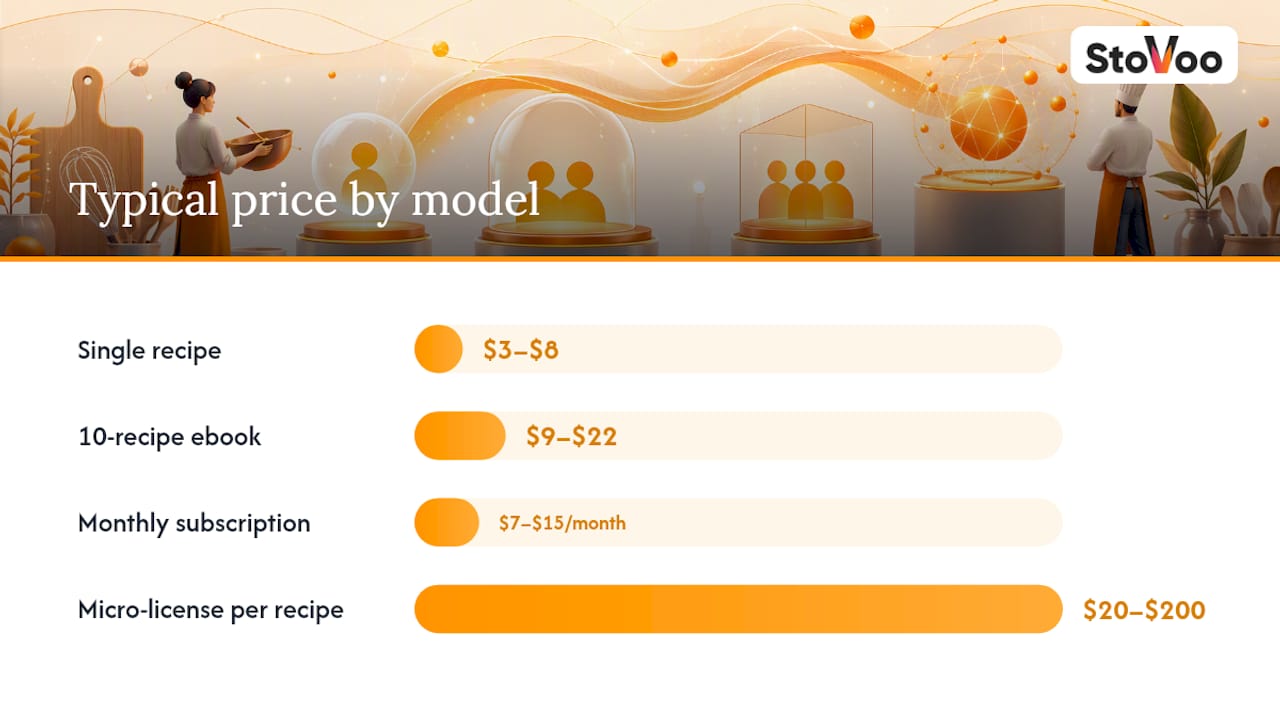
Digital recipe ebooks priced between $7.99 and $22 are the most common entry product. Single recipes typically sell for $3–$8. Subscription tiers work best once you have a content library and a returning audience. Micro-licensing is an emerging channel: a single recipe with a commercial-use license can sell for $20–$200, while a curated dataset pack can command $1,000–$10,000 from startups and researchers.
| Model | Sample price | Best use case | Expected conversion |
|---|---|---|---|
| Single recipe download | $3–$8 | Impulse buyers, first-time customers | 2–5% of visitors |
| 10-recipe themed ebook | $9–$22 | Niche audiences, gift buyers | 1–3% of visitors |
| Monthly subscription | $7–$15/month | Creators with weekly new content | 2–5% of visitors |
| Micro-license (commercial) | $20–$200 per recipe | Food brands, app developers | Low volume, high margin |
- Single recipe: Low commitment, easy impulse buy. Good for testing demand before building a full ebook.
- Themed ebook: Higher perceived value. A "30-Minute High-Protein Dinners" collection justifies $15–$22 more easily than a generic bundle.
- Subscription: Requires consistent publishing. Subscription strategies tied to chef-led content build loyalty faster than one-off sales alone.
- Micro-licensing: Requires structured metadata and a machine-readable license block, but the per-unit revenue is significantly higher.
Run a simple A/B test: offer the same ebook at $9.99 to one traffic segment and $14.99 to another for two weeks. Measure revenue per visitor, not just conversion rate. A lower conversion at the higher price often produces more total revenue.
What are your technical options for delivering paid recipes securely?
Delivery method shapes both buyer experience and your anti-piracy exposure. The four main options are:
- Gated blog post: The recipe lives behind a login or membership wall. Easy to set up with a plugin like MemberPress, which lets you lock individual recipes and mix one-off purchases with subscription perks on the same site.
- Protected PDF download with an expiring link: The buyer pays, receives a time-limited download URL, and gets the file. Simple, low-friction, and works on every device.
- Membership area with a content library: Best for subscription models. Buyers log in to access a growing archive. Higher setup effort, but it supports tiered access and recurring billing naturally.
- Video-on-demand or live class streaming: Premium tier. Pairs well with a written recipe download as a bundle.
For technical setup, confirm these four things before launch: payment processor connected, automated receipt with download link firing on purchase, link expiration set (48–72 hours is standard), and mobile checkout tested on iOS and Android.
Formatting recipes with proper metadata also prepares your content for dataset licensing later, which is worth doing from day one.
Pro Tip: Start with a protected expiring download link before investing in full DRM. Most early-stage sellers find that a clear license note deters casual sharing more effectively than technical locks, and it creates far less friction for legitimate buyers.
What are the legal and tax basics for selling recipes in the United States?
Copyright: You own original recipes you create, including the written instructions, headnotes, and photos. The ingredient list itself is not copyrightable, but the expression around it is. Assert ownership with a short notice on every recipe page: "© Your Name] [Year]. Personal use only. Commercial reproduction prohibited without a license." For deeper guidance on ownership language, [digital recipe ownership resources cover the key distinctions.
Sales tax on digital goods: The U.S. has no uniform federal rule. Whether your state taxes digital downloads depends on state law, and rules vary significantly. States including New York, Texas, and Washington generally tax digital goods; others do not. Register for a sales tax permit in states where you have nexus, collect the applicable rate at checkout, and remit on schedule. Consult a tax specialist before your first sale to confirm your obligations.
Customer policies to include at checkout:
- Refund policy (recommend: no refunds on digital downloads after delivery, stated clearly pre-purchase)
- Permitted use (personal vs. commercial, with a link to your licensing page)
- A brief disclaimer: "Recipes are for informational purposes. Results may vary based on ingredients and technique."
Keep a simple sales log: date, product, amount, buyer state. This makes quarterly tax filing straightforward.
This section is general information, not legal or tax advice. Confirm your specific obligations with a qualified professional.
How do you promote paid recipes and improve conversion?
The highest-leverage move is building an email list before you launch. Offering a free sample recipe in exchange for an email address is the most reliable way to build a launch audience. That list becomes your primary sales channel.
Four-email launch sequence:
- Welcome (Day 0): Deliver the free recipe, introduce your paid library, set expectations.
- Value add (Day 3): Share a cooking tip or behind-the-scenes story. No pitch.
- Launch (Day 7): Announce the paid product with a clear benefit statement and a direct link.
- Scarcity close (Day 10): Limited-time price or bonus (an extra recipe) for subscribers who buy this week.
Beyond email, short-form video demos paired with a gated recipe link convert well because they demonstrate the result and provide immediate access in one step. Post the finished dish on Instagram Reels or TikTok, then put the recipe link in bio. Pinterest evergreen pins drive long-tail traffic for months after posting.
For additional passive income alongside your paid recipes, Instacart affiliate links embedded in recipe pages convert well because shopping intent is already high when someone is reading a recipe.
Quick conversion optimizations: keep your preview snippet to 2–3 steps (enough to show value, not enough to cook the dish), place your purchase CTA above the fold on mobile, and use a price anchor ("Usually $15 — launch price $9") for the first 30 days.
Which metrics should you track for a recipe paywall?
Focus on six numbers. Everything else is noise until you're past your first 100 sales.
- Conversion rate (visitor to buyer): 2–5% is a healthy range for a direct-sales shopfront.
- Average order value (AOV): Bundles and upsells move this number faster than price increases.
- Subscription churn rate: If more than 10% of subscribers cancel each month, the content cadence or perceived value needs work.
- Customer lifetime value (LTV): AOV multiplied by average purchase frequency. This tells you how much you can spend to acquire a customer.
- Refund rate: Above 5% usually signals a mismatched preview or a delivery problem.
- Traffic source ROI: Which channel (email, Pinterest, TikTok, search) produces buyers, not just visitors?
Run one experiment at a time. Test preview length first (2 steps vs. 4 steps), then price point, then bundle vs. single. Wait at least two weeks per test before drawing conclusions.
What does a 4-week launch roadmap look like?
| Week | Deliverables | Success criteria |
|---|---|---|
| Week 1 | Finalize 1–3 recipes, create cover images, write license and refund policy | Content ready to publish |
| Week 2 | Set up shopfront, connect payment processor, configure delivery, mobile QA | Test purchase completes end-to-end |
| Week 3 | Soft launch to email list, post short-form video, publish Pinterest pin | First 5–10 sales, zero delivery errors |
| Week 4 | Analyze conversion data, run first A/B test, reach out to one partner or affiliate | Baseline metrics established |
Estimated costs to launch:
- Platform or SaaS fee: $0–$49/month depending on the tool
- Payment processing: typically 2.9% + $0.30 per transaction (standard Stripe rate)
- Design or photography: $0 (phone camera + free Canva) to $200 for a one-time shoot
- Total first-month outlay: as low as $30–$80 if you use existing content and a mobile-first platform
Creators who build consistent digital product libraries often see meaningful recurring revenue after 18–36 months, but early wins from targeted launches and affiliate integrations can arrive much sooner.
How Stovoo helps food creators launch a recipe paywall fast
Stovoo is built specifically for food creators who want to sell recipes, run meal subscriptions, and manage catering bookings from one place. Here's what the platform handles out of the box:
- Shopfront creation: A mobile-first, branded storefront you can share via social media or a direct link, live in minutes.
- Digital product downloads: List a recipe PDF or ebook, set a price, and Stovoo handles automated delivery on purchase.
- Recurring billing: Subscription tiers with automated billing, so you're not chasing payments manually.
- Order and customer management: A centralized dashboard replaces the WhatsApp threads and spreadsheets most small food businesses rely on.
- Multiple business models in one account: Sell a single recipe download, a subscription plan, and take catering inquiries from the same shopfront.
Quick-start steps on Stovoo:
- Create your account at Stovoo.
- Add a digital product (your recipe or ebook), set the price and license type.
- Enable download delivery and write a short product description with a preview snippet.
- Share your shopfront link on Instagram, TikTok, or via email.
A meal-prep creator using Stovoo can go from zero to a live, purchasable recipe page in under an hour. The platform's meal plan monetization approach supports both one-off recipe sales and recurring subscription revenue, making it easy to test both models before committing to one.
Why recipes deserve to be treated as products, not content
Most food creators undervalue what they've built. A tested, well-written recipe is productized knowledge: it solves a real problem (what to cook, how to cook it, what to buy), it can be delivered infinitely at zero marginal cost, and it compounds in value as your library grows.
The shift in thinking that matters most is this: content is something you give away to build an audience; a product is something you sell because it delivers specific, repeatable value. Your best recipes already do that. Putting a price on them isn't a barrier for your audience. It's a signal that the work is worth something.
Start with one recipe. Measure what happens. Iterate from there. The creators who build durable income from digital products are rarely the ones who launched with the most content. They're the ones who launched first and learned fastest.
Stovoo gets your recipe paywall live without the technical headache
Food creators who want to sell recipes, run subscriptions, and manage customers from one place have a direct path with Stovoo. The platform gives you a branded, mobile-first shopfront, automated download delivery, and recurring billing support — without stitching together three separate tools.
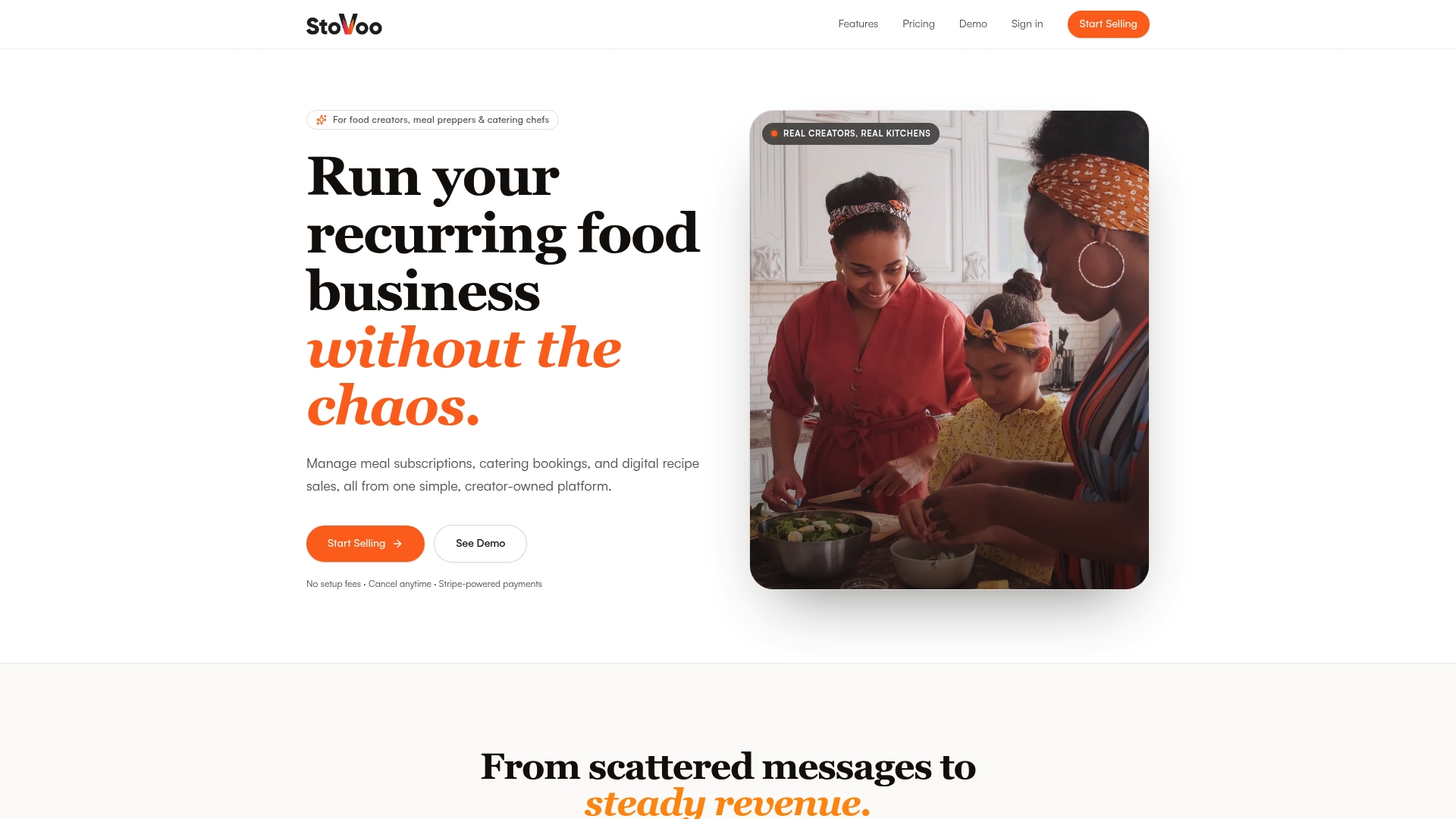
You can list your first paid recipe, set a price, and share your shopfront link the same day you sign up. No developer needed, no complicated integrations. Stovoo also supports catering bookings and meal subscription plans on the same account, so your entire food business runs from one dashboard. See what a live shopfront looks like at Stovoo, then create your account and publish your first paid recipe today.
Sources
- Food Blog Income Streams in 2026: Ads, Brand Deals & Beyond
- How to Make a Digital Recipe Book to Sell Online
- MemberPress: Monetize your food blog
- How to Sell Recipes Online in 2026 (Step-by-Step Guide)
- Ethical Ways to Monetize Your Recipe Library in AI Era
FAQ
What is a recipe paywall for food creators?
A recipe paywall is a merchant-facing tool that lets food creators gate and sell recipe content — individual recipes, ebooks, or subscription access — through a shopfront. Buyers pay before accessing the content, and delivery is automated.
How much should I charge for a recipe download?
Single recipe downloads typically sell for $3–$8, while themed ebooks range from $7.99 to $22. Price around the value the buyer receives, not the time it took you to write the recipe.
Do I need to collect sales tax on digital recipe sales in the U.S.?
It depends on your state. States like New York, Texas, and Washington generally tax digital goods; others do not. Register for a sales tax permit where you have nexus and consult a tax specialist to confirm your obligations.
How does Stovoo support recipe paywall sales?
Stovoo provides a mobile-first shopfront, automated digital download delivery, recurring billing for subscriptions, and a customer management dashboard — all in one platform built specifically for food creators and small food businesses.
What is the fastest way to launch a paid recipe?
Create one complete recipe page with a preview snippet, connect a payment method, and enable automated download delivery. Using a platform like Stovoo, you can have a live, purchasable recipe page ready in under an hour.