
MRR for a food business is the predictable monthly income generated from subscriptions, memberships, or recurring orders, calculated by multiplying active subscribers by average revenue per user. The single priority above all else: measure contribution margin per subscriber, not just revenue, and watch churn weekly instead of monthly. Get those two right and the calculation math below becomes a growth lever instead of a vanity number.
TL;DR:
- Food businesses must focus on contribution margin per subscriber and weekly churn tracking, not just revenue, to turn MRR into a growth lever.
- Proper normalization of weekly and annual plans to monthly figures, along with immediate cancellation and refund handling, is essential for accurate MRR calculation.
- Fulfillment, delivery costs, and spoilage significantly impact profitability, often eroding apparent gross margins, especially in perishables.
- Seasonality causes predictable demand swings, so planning for pauses, seasonal menus, and flexible inventory management prevents overreaction to dips.
- Using purpose-built platforms for subscription management reduces admin errors and support friction, safeguarding margins and ensuring reliable revenue tracking.
Table of Contents
- What MRR Means for a Food Business
- How Do You Calculate MRR for a Food Business?
- Accounting and Revenue Recognition for Food Subscriptions
- What Are Good Unit Economics for a Food Subscription?
- Practical Strategies to Grow MRR Without Killing Margins
- Which KPIs Should You Track Weekly vs. Monthly?
- Two Worked Examples You Can Copy Into a Spreadsheet
- How Do Seasons Affect Food Business MRR?
- Handling Perishable Inventory Costs Within MRR
- Regulatory and Compliance Considerations for Recurring Food Revenue
- Technology Platforms for Managing MRR in Food Services
- Author Perspective: Lessons From Building Recurring Revenue in Food
- Set Up Subscriptions and Billing Without the Spreadsheet Chaos
- Sources
- FAQ
What MRR Means for a Food Business
MRR stands for monthly recurring revenue, and the core formula is simple: multiply your number of active subscribers by your average revenue per user (ARPU), or sum every recurring charge you're set to collect that month. Software companies invented this metric to track subscription health, and the fundamentals still apply when you're selling weekly meal plans instead of software seats.
But food businesses inherit a version of MRR that behaves differently than the SaaS playbook most calculators assume. A subscriber who stops opening your app costs a software company almost nothing extra. A subscriber who stops opening your meal box after you've already bought the salmon costs you real money in spoiled inventory. That distinction changes how you should read the number.
Three things make food MRR uniquely tricky:
- Perishability forces production commitments before payment clears fully, unlike digital products where delivery costs approach zero.
- Fulfillment and shipping absorb a meaningful share of revenue, so the same MRR figure can hide wildly different profitability depending on your delivery model.
- Seasonality swings harder than most software categories, since eating habits shift with weather, holidays, and school calendars in ways that recurring software use rarely does.
Predictable MRR lets you staff a kitchen with confidence, order proteins three days ahead instead of guessing, and negotiate better rates with suppliers because you can show a forecast, as explained in the Role of Online Food Ordering for Restaurants and Customers. That operational payoff matters more here than the finance-department bragging rights the number carries in horizontal SaaS. The restaurant industry's own subscription research frames recurring revenue in food primarily as an operational predictability tool, not a fundraising metric, and that framing should guide how you use it.
How Do You Calculate MRR for a Food Business?
Calculating MRR correctly means normalizing every recurring charge to a monthly equivalent and stripping out anything that isn't truly recurring. Get this wrong and you'll either overstate your growth to yourself or scare off an investor with numbers that don't hold up to scrutiny.
The core formula, as Paddle's MRR guide lays out, is ARPU multiplied by total active subscribers, or the sum of all recurring charges due in a given month. ARPU is your total recurring revenue divided by your subscriber count. For a food business with mixed plan types, calculate ARPU as a weighted average across every tier you sell.
Here's the normalization checklist:
- Convert weekly plans to monthly. Multiply the weekly charge by 4.33 (the average number of weeks per month), not by 4, or you'll underreport revenue by roughly 8%.
- Prorate annual plans. Divide the annual charge by 12 and count only that fraction each month, even though the customer paid you the full amount upfront.
- Exclude one-time charges. Setup fees, first-box "welcome kits," and delivery surcharges billed once don't belong in MRR, even if they hit your bank account the same day as a subscription charge.
- Handle refunds and cancellations immediately. Remove a canceled subscriber's contribution the month the cancellation takes effect, not when you happen to notice it in your books.
- Treat add-ons carefully. A recurring add-on (extra protein portion every week) counts. A one-time add-on (a holiday gift box ordered once) does not.
Pro Tip: Run your MRR calculation the same day every month, ideally right after your billing cycle closes. Calculating it on inconsistent dates is one of the most common reasons food founders see confusing swings that aren't real.
Worked example: say you run a weekly meal-prep subscription with 140 active subscribers paying $42 per week. Convert to monthly: $42 × 4.33 = $181.86 per subscriber per month. Multiply by 140 subscribers and your MRR is $25,460. Stripe's guidance on MRR reinforces that this normalization step, not the multiplication itself, is where most founders introduce errors.
Accounting and Revenue Recognition for Food Subscriptions
Charging a customer and earning that revenue are two different events, and conflating them is the fastest way to make your MRR lie to you. If you charge a customer's card on the 1st for a meal plan you'll deliver across four separate weeks, recognizing the full amount as revenue on the 1st inflates your books even though you haven't cooked or shipped anything yet.
The fix: hold prepayments in a deferred revenue liability account and recognize revenue only as you fulfill each delivery. This matters most for prepaid weekly meal plans charged monthly but delivered incrementally, since a mid-month cancellation now owes the customer a partial refund you need to have already accounted for correctly.
A cleaner month-end process looks like this:
- Book the full charge as deferred revenue on the payment date.
- Recognize a proportional slice as earned revenue each time you actually deliver a meal or catering service.
- Keep subscription fees in a separate ledger line from transactional commissions, delivery surcharges, or one-time onboarding charges.
- Reconcile deferred revenue against fulfillment logs monthly so the balance never silently drifts.
Stripe's resources on recurring revenue specifically flag delivery-based businesses as a case where recognition timing changes the accuracy of MRR, and vertical restaurant SaaS platforms often layer subscription fees alongside payment-processing and hardware revenue, which makes separating recurring from transactional income a reporting necessity, not a nice-to-have.
Pro Tip: If your bookkeeper is used to standard retail accounting, walk them through deferred revenue explicitly. Food subscriptions confuse generalist bookkeepers more often than any other line item on your P&L.
What Are Good Unit Economics for a Food Subscription?
Healthy food-subscription unit economics start with contribution margin per order, not gross margin, because gross margin hides the fulfillment costs that make or break a food subscription's viability. Contribution margin subtracts the variable cost of goods, packaging, and shipping from each order's revenue. Gross margin often looks fine on a spreadsheet while contribution margin quietly bleeds you out.
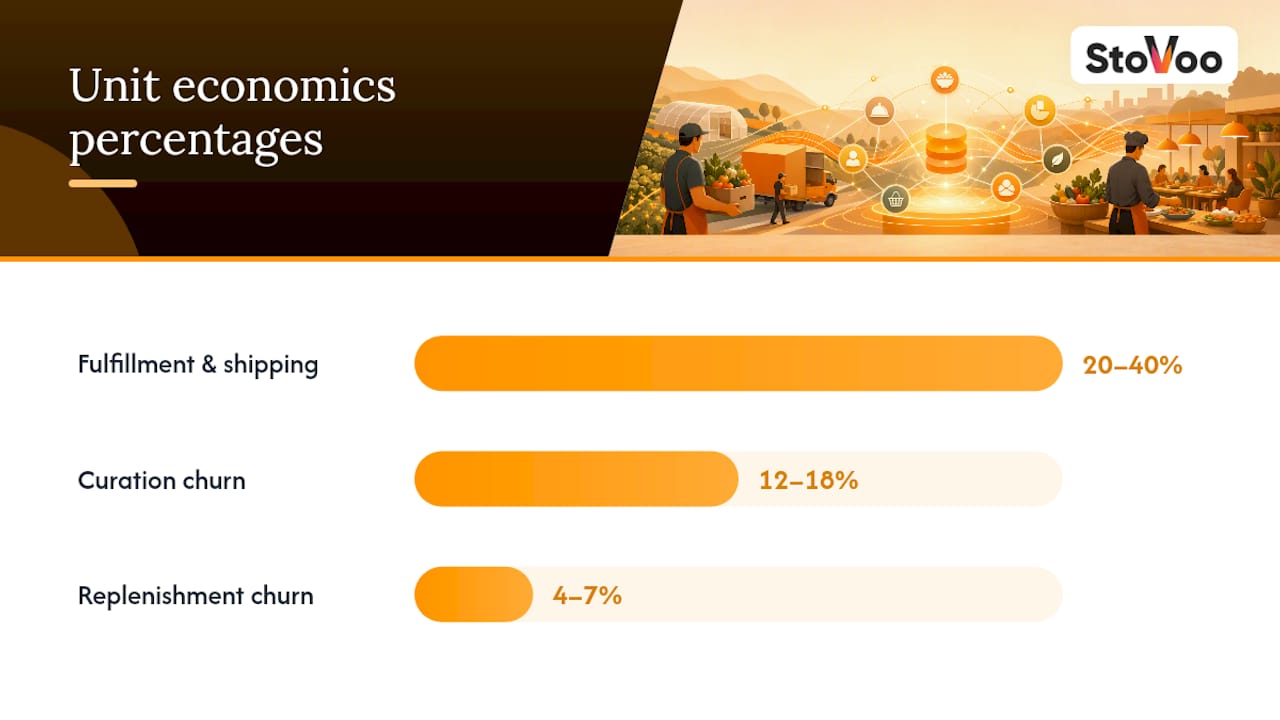
Fulfillment and shipping can eat 20% to 40% of revenue for perishable items, which means a subscription box with a 60% gross margin can still lose money once you account for cold-pack shipping and last-mile delivery. This is the gap that catches new food founders off guard: the P&L says profitable, the bank account says otherwise.
Churn also behaves differently depending on your model.
| Metric | Replenishment model | Curation model |
|---|---|---|
| Monthly churn | 4% to 7% | 12% to 18% |
| Customer behavior driver | Habit and convenience | Novelty and variety |
| Typical fulfillment cost share | Lower, standardized SKUs | Higher, variable packaging |
| Retention lever that works best | Auto-reorder defaults | Fresh menu rotation |
To compute CAC payback, divide your customer acquisition cost by your average contribution margin per order. If it costs $45 to acquire a subscriber and each delivery nets $15 in contribution margin, you need three orders just to break even on the acquisition spend before that customer generates real profit.
Red flags worth acting on immediately: churn creeping above the curation-model ceiling, CAC payback stretching past four or five orders, or contribution margin per order sitting below $8 to $10 for a weekly plan. Any one of these means fix the unit economics before spending another dollar on growth marketing, per the benchmarks Eightx compiled for food brands.
Practical Strategies to Grow MRR Without Killing Margins
Growing MRR the wrong way just means bigger losses at scale. The levers below are ranked roughly by how much they protect contribution margin while they grow revenue.
- Introduce tiered pricing with a minimum order threshold. A base plan and a premium plan with more portions or exclusive recipes let high-intent customers pay more without you having to acquire a new customer segment.
- Bundle instead of discount. Pairing a meal plan with a digital recipe guide or a live cooking class ticket raises perceived value without cutting your per-unit price. Meal subscription ideas built around bundling show how varied this can get across cuisines and formats.
- Offer prepay discounts for quarterly or annual commitments. You trade a small margin hit for locked-in cash flow and lower churn exposure, since a customer who paid three months upfront rarely cancels in month one.
- Build a corporate or wholesale tier. Office catering subscriptions or standing wholesale orders to cafes carry higher order values and dramatically lower churn than individual consumer plans.
- Cap redemptions per cycle. Setting a maximum number of meals or classes per membership period protects your kitchen capacity and prevents your most active users from silently eroding your margin.
Retention deserves equal attention to acquisition. A strong onboarding sequence in the first two weeks, personal check-ins after a missed delivery, and clear communication about menu rotation all reduce the early-cycle cancellations that quietly cap your MRR growth. Restaurants that have shifted regulars into paid memberships report that subscriptions built around loyalty and increased visit frequency outperform one-off promotions for long-term revenue stability.
Pro Tip: Test a price increase on new subscribers only before rolling it out to your existing base. You'll learn whether demand holds at a higher price point without risking a churn spike among people who already trust you.
On the operational side, protecting margin often matters more than chasing top-line growth. A minimum order size, a fulfillment radius that keeps delivery costs sane, and menu items chosen for shelf stability all defend contribution margin while MRR climbs. Raising average order value or shifting to lower-cost packaging tends to shorten CAC payback faster than acquiring new subscribers ever will.
Which KPIs Should You Track Weekly vs. Monthly?
Weekly checks catch problems while they're still cheap to fix; monthly checks tell you whether the business model itself is working. Confusing the two cadences is how founders miss a churn spike for six weeks straight.
Track these core metrics on a recurring basis:
- MRR: total predictable monthly revenue from active subscribers, normalized as covered earlier.
- NRR (net revenue retention): how existing subscriber revenue changes month over month from upgrades, downgrades, and cancellations combined.
- ARPU: average revenue per subscriber, useful for spotting whether growth is coming from more customers or higher-value plans.
- Contribution margin per order: revenue minus variable fulfillment costs, the number that actually tells you if you're profitable.
- Churn by cohort: cancellation rate segmented by signup month, plan type, or acquisition channel.
- CAC payback: how many orders it takes to recoup acquisition spend.
Weekly, look at your top-consuming members (are they about to hit a redemption cap that needs adjusting?), unpaid or failed invoices that need a retry, and support tickets that hint at a fulfillment problem before it shows up in next month's churn number.
Monthly, run your finance close: reconcile deferred revenue, recalculate contribution margin across your full order volume, and segment churn into three buckets, since distinguishing temporary suspensions from permanent cancellations and genuine dissatisfaction changes what you should actually do about it. A member pausing for vacation needs a different response than one who canceled because the food arrived late twice in a row.
Two Worked Examples You Can Copy Into a Spreadsheet
Example A: Restaurant membership. Say your restaurant sells a $30 monthly membership offering a free appetizer and priority reservations. With 200 members, your direct MRR is $6,000. Members also tend to dine more often, and if each member averages more frequent visits with a higher average check, this can add significant incremental dine-in revenue that MRR alone doesn't capture, but your total membership program value should.
Example B: Meal-kit subscription. With 300 subscribers paying $60 weekly, your monthly ARPU converts to $259.80 ($60 × 4.33). Multiply by 300 subscribers for MRR of $77,940. Now subtract fulfillment and variable costs of roughly $95 per subscriber per month, leaving a contribution margin of $164.80 per subscriber. If your CAC runs $180, that's roughly a one-month payback, a solid benchmark for this model.
- Pull your active subscriber count and current billing amount per plan.
- Normalize every plan to a monthly figure using the 4.33 multiplier for weekly billing.
- Subtract fulfillment, packaging, and shipping costs to find contribution margin.
- Divide CAC by contribution margin per subscriber to get payback in months.
Early-stage food SaaS founders often see $1,000 to $5,000 in MRR within their first 12 to 18 months, so don't panic if your numbers start small. The trajectory matters more than the starting point.
How Do Seasons Affect Food Business MRR?
Seasonal swings hit food MRR harder than almost any other subscription category, and pretending otherwise leads to bad hiring and inventory decisions. A meal-prep subscription built around healthy eating typically sees a January surge as resolution-driven signups spike, then a slow bleed through spring as motivation fades. Summer often dips further as people travel and eat out more, while holiday catering subscriptions spike sharply in November and December before going quiet in January.

The mistake many founders make is treating a seasonal dip as churn to panic over, when it's actually predictable and manageable if you plan for it. Build a rolling 12-month MRR chart, not just a month-over-month comparison, so you can see whether this March looks like last March or represents a genuine problem.
Practical adjustments include offering a "pause" option instead of forcing cancellation during predictable low seasons, since a paused subscriber returns far more easily than a canceled one. Consider seasonal menu pivots, lighter summer options, or heartier winter plans, to keep engagement steady even when overall demand softens. Staffing and inventory commitments should flex with your seasonal forecast rather than your trailing 30-day average, which will consistently mislead you around every seasonal inflection point.
Corporate and wholesale accounts tend to smooth seasonal swings better than consumer subscriptions, since office catering rhythms follow business calendars rather than New Year's resolutions. That's one more reason a mixed customer base protects your MRR curve better than betting everything on one segment.
Handling Perishable Inventory Costs Within MRR
Perishable inventory turns MRR from a simple revenue number into a number that needs a cost-aware interpretation. A software company can report $50,000 in MRR and know almost all of it eventually becomes profit. A meal-kit business reporting the same figure could be sitting on spoiled produce that erases a third of that value before it ever reaches a bank account.
The practical fix is to never look at MRR alone. Pair it with a rolling spoilage or waste percentage, calculated as the dollar value of unsold or expired inventory divided by total inventory purchased that month.
Forecasting subscriber counts a few days ahead of your ordering cycle, rather than ordering reactively, reduces the gap between what you buy and what you actually deliver. Locking subscribers into a weekly commitment deadline (say, orders finalized by Wednesday for weekend delivery) gives your kitchen a firm number to shop against instead of guessing.
Menu design also plays a quiet role here. Ingredients with longer shelf lives or that work across multiple recipes reduce the risk that a slow week leaves you holding produce you can't use elsewhere. Track this cost the same way you track churn: by cohort and by menu item, so you know exactly where the money is actually going.
Regulatory and Compliance Considerations for Recurring Food Revenue
Recurring billing for food products carries compliance obligations that a one-time sale doesn't trigger, and ignoring them creates liability that can undo your MRR growth overnight. Subscription commerce in the United States falls under evolving auto-renewal disclosure rules at both the state and federal level, generally requiring clear, easy cancellation and upfront disclosure of recurring charges before a customer's card is billed.
Food safety compliance adds a second layer. If you're preparing and shipping meals, your kitchen typically needs to meet local health department licensing requirements, and interstate shipping of perishable food can trigger additional labeling and handling rules depending on the product category. These requirements vary enough by state and product type that a quick call to your local health department, before you scale a subscription beyond your immediate area, is worth the hour it takes.
Sales tax treatment of food subscriptions also varies, and prepared meals are frequently taxed differently than grocery staples in many states. Getting this wrong doesn't just risk a fine, it risks having to unwind pricing across your entire subscriber base retroactively.
For catering and wholesale contracts layered on top of a subscription model, clear terms of service covering cancellation windows, refund policies, and delivery guarantees protect you from disputes that otherwise show up as chargebacks eating into your MRR. Building these into your signup flow from day one, rather than retrofitting them after a dispute, saves both money and reputation. None of this replaces a conversation with a licensed attorney or accountant familiar with your state's specific rules, but knowing these categories exist means you'll ask the right questions before a regulator asks them for you.
Technology Platforms for Managing MRR in Food Services
Spreadsheets and messaging apps work until they don't, and for most food subscription businesses that breaking point arrives faster than founders expect. Once you're juggling weekly billing cycles, pause requests, refunds, and a growing subscriber list across WhatsApp threads and manual invoices, the admin overhead itself starts eating into the margin you worked so hard to protect.
Purpose-built platforms for food creators and small food businesses centralize subscription management, automated billing, and customer communication in one dashboard instead of scattered across five tools. This matters more for MRR accuracy than it sounds. A platform that automatically prorates a mid-cycle cancellation or generates a deferred-revenue-friendly invoice removes exactly the kind of manual error that makes MRR untrustworthy in the first place.
Beyond billing, a shopfront that lets customers manage their own subscription pause, plan change, or delivery date reduces support ticket volume and, by extension, reduces the friction that drives cancellations. Launching and managing a meal subscription efficiently depends as much on this kind of operational tooling as it does on the recipes themselves.
Choosing a platform built specifically for food businesses, rather than a generic subscription billing tool built for software companies, matters because food has quirks generic tools don't anticipate: delivery-day scheduling, ingredient-based add-ons, and catering inquiries that don't fit a standard recurring-charge model. The right platform should handle all three without forcing you to bolt on a separate tool for each.
Author Perspective: Lessons From Building Recurring Revenue in Food
The pitfall I see most often isn't undercharging or overspending on ads. It's founders celebrating MRR growth while contribution margin quietly goes negative underneath it, because nobody checked fulfillment costs against the excitement of a rising subscriber count.
Operational predictability changes everything once it actually arrives. Knowing next Tuesday's order volume three days ahead means less wasted protein, calmer staff, and better supplier terms. That predictability is the real prize, not the MRR figure itself.
Platforms that automate billing and give customers a real shopfront instead of a WhatsApp thread reduce churn simply by removing friction. Fewer missed payments, fewer confused cancellations, more food subscription trends pointing toward this kind of self-serve convenience as the baseline customers expect.
— freeman
Set Up Subscriptions and Billing Without the Spreadsheet Chaos
Stovoo is built for exactly the operational gaps this article just walked through: automated billing that handles proration and recurring charges correctly, a mobile-first shopfront customers can manage themselves, and a single dashboard for meal plans, catering inquiries, and digital recipe sales instead of five disconnected tools.

If you've been tracking subscribers in a spreadsheet and collecting payments through a patchwork of apps, the admin friction is likely costing you more in churn than any pricing change could fix. Vendors like ami, London and Culater Catering's, Lagos run their meal plans and catering bookings through Stovoo's shopfront rather than juggling separate tools for each function. It fits best for food creators, meal preppers, and catering chefs who are ready to convert loyal customers into paying subscribers without hiring an operations team to manage it. Create your account and start setting up your subscription plans today.
Sources
FAQ
What Does $10K MRR Mean for a Food Business?
MRR means you have predictable recurring revenue expected each month from active subscribers, before subtracting fulfillment costs, ingredients, and other variable expenses tied to delivering those orders.
How Do You Calculate MRR?
Multiply your active subscriber count by your average revenue per user (ARPU), or sum every recurring charge due that month after normalizing weekly and annual plans to their monthly equivalent, as outlined by Paddle's MRR calculation guide.
Is a Food Business Worth Three Times Profit?
Valuation multiples vary widely by business type, growth rate, and margin quality, so a flat three-times-profit rule doesn't hold universally; a food subscription with high contribution margin and low churn typically commands a stronger multiple than one with thin margins and high churn, regardless of the specific number involved.
What Is a Good MRR Growth Rate for a Food Subscription?
There's no single universal benchmark, but steady month-over-month growth paired with churn held below the 4% to 7% replenishment-model range generally signals a healthier trajectory than rapid growth accompanied by rising cancellations.
How Does Churn Affect MRR Differently in Food Businesses?
Churn in food businesses often carries real inventory and fulfillment cost already sunk into a canceled order, unlike software churn, which usually just means lost future revenue with no matching cost already spent.