
The fastest way a local meal prep business wins nearby orders is to claim and fully optimize a Google Business Profile, pair it with at least one local landing page, and run a simple automated review-ask after every delivery. Those three moves alone can shift your map rankings within 30 days.
Your three immediate actions this week:
- Claim or verify your Google Business Profile at business.google.com and fill every field completely.
- Publish one local landing page targeting your city or ZIP code with a clear order link.
- Set up a one-message SMS or email review request that fires 24 hours after each delivery.
Watch for these early signals: Google Business Profile impressions rising in the first two weeks, your business appearing in the local 3-pack for "[city] meal prep" queries, and inbound phone calls or clicks to your order link. Those are your proof points before revenue catches up.
Key Takeaways
Meal prep local SEO produces the fastest results when GBP optimization, unique local landing pages, and a review-ask workflow run together from day one.
| Point | Details |
|---|---|
| GBP is your first priority | Claim, verify, and fully optimize your Google Business Profile before any other SEO task. |
| Unique local pages outrank generic ones | Replace thin, duplicate location pages with neighborhood-specific content to drive organic traffic gains. |
| Reviews drive both rankings and conversions | A two-step automated review-ask after every delivery builds the review velocity local pack rankings require. |
| Track orders, not just traffic | Monitor GBP clicks, phone calls, and GA4 conversion rate to connect SEO work to actual revenue. |
| Stovoo connects local clicks to recurring orders | Stovoo's mobile-first shopfront and billing automation convert local searchers into weekly subscribers. |
Table of Contents
- What does a prioritized meal prep local SEO plan look like?
- How do you claim and optimize your Google Business Profile for meal prep searches?
- How should you structure your website for local meal prep searches?
- What local content actually attracts nearby customers?
- Where should you list your business and which local links move rankings?
- Reviews are your single most important local ranking signal
- Which offline partnerships actually boost your local digital presence?
- How do you measure local SEO results and what does it cost?
- What does a real local SEO success story look like for meal prep?
- How do you convert local searchers into recurring customers?
- Your 7-day local SEO action checklist
- What most meal prep owners get wrong about local pages
- Stovoo turns local traffic into recurring meal prep revenue
- Sources
- FAQ
What does a prioritized meal prep local SEO plan look like?
Local SEO for meal prep is not a single task. It is a sequence, and the order matters because some work pays off in weeks while other work compounds over months.
30/90/180-day roadmap:
- Days 1–30 (foundation): Claim GBP, fix NAP across directories, publish one local landing page, install Google Search Console and Google Analytics (GA4).
- Days 31–90 (content and citations): Add two more local pages, build 10–15 citations in key directories, launch a review-ask workflow, add LocalBusiness schema.
- Days 91–180 (authority and conversion): Publish four blog posts targeting local intent queries, pursue two local link partnerships, run one Google Local Services Ad test, and review GA4 conversion data to optimize checkout.
| Priority | Task | Owner | Est. Hours | Outcome |
|---|---|---|---|---|
| 1 | Claim and optimize GBP | You | 2 | Map visibility, phone calls |
| 2 | Publish local landing page | You / writer | 3 | Local keyword rankings |
| 3 | Fix NAP in top 10 directories | You / VA | 2 | Citation consistency |
| 4 | Install GSC and GA4 | Developer | 1 | Baseline data |
| 5 | Add LocalBusiness schema | Developer | 2 | Rich results eligibility |
| 6 | Launch review-ask workflow | You / tool | 1 | Review velocity |
| 7 | Local link outreach | You / marketer | 4 | Domain authority |
Near-term conversions come from GBP, reviews, and local landing pages. Long-term domain authority comes from content and links. Stagger the work if you are running this solo.
How do you claim and optimize your Google Business Profile for meal prep searches?
Your Google Business Profile is the single most visible real estate you control in local search. A fully optimized profile shows up in the local 3-pack, Google Maps, and the knowledge panel, often before a searcher ever reaches your website.
GBP optimization checklist:
- Business name: Use your exact legal or trading name. No keyword stuffing.
- Primary category: Choose "Meal Delivery Service" or "Caterer" as your primary. Add secondary categories like "Food Delivery Service" or "Personal Chef Service."
- Service area vs. storefront: If you deliver to customers rather than hosting them, set a service area covering your delivery ZIP codes. Do not list a home address publicly.
- Business hours: Include your ordering hours, not just delivery windows. Update for holidays.
- Phone and website: Link directly to your order page or shopfront, not just your homepage.
- Booking/order link: Add your shopfront URL (a Stovoo vendor page, for example) under the "Appointment links" or "Order online" field.
- Photos: Upload at least 10 photos: meal containers, prep process, packaging, and delivery. Profiles with photos receive significantly more direction requests than those without.
- Services section: List each meal plan tier, catering package, and any dietary specialties (keto, vegan, gluten-free).
- GBP posts: Publish a weekly post featuring your current menu or a limited-time offer. Posts keep your profile active and signal relevance to Google.
GBP enhancement tactics, including photos and promotions, are among the most direct levers for food business local visibility.
Pro Tip: If you operate from a commercial kitchen with no public storefront, always choose the service-area setting and hide your address. Showing a residential or shared kitchen address can confuse customers and hurt your local ranking if the address does not match your citations elsewhere.
How should you structure your website for local meal prep searches?
Your website needs pages that match how local customers actually search. Most meal prep sites underinvest here, publishing one generic homepage and wondering why they do not rank.
Pages that matter most:
- Homepage: Clear city mention in the H1, NAP in the footer, and a direct order link above the fold.
- Service pages: One page per core offering (weekly meal plans, corporate catering, event catering). Each page targets a distinct set of catering SEO keywords.
- Location pages: One page per city or neighborhood you serve. Each must be unique, not a copy-paste with the city name swapped.
- Menu/shopfront page: A live, linkable menu that Google can crawl and that customers can order from directly.
For local keyword research, focus on three intent types: "meal prep [city]," "healthy meal delivery near me," and "weekly meal plan [ZIP]." Tools like Google Search Console's Performance report and Google's autocomplete reveal exactly which modifiers your local audience uses.
Meta title pattern for local intent:
Healthy Meal Prep Delivery in [City] | [Business Name]
Meta description pattern:
Fresh, weekly meal plans delivered to [City] and [Neighborhood]. Order online and get your first delivery this week.
Schema is not optional if you want rich results. Add LocalBusiness schema to your homepage and each location page. A minimal, copy-ready example:
{
  "@context": "https://schema.org",
  "@type": "LocalBusiness",
  "name": "Your Business Name",
  "address": {
    "@type": "PostalAddress",
    "streetAddress": "123 Main St",
    "addressLocality": "Austin",
    "addressRegion": "TX",
    "postalCode": "78701"
  },
  "telephone": "+1-512-555-0100",
  "url": "https://yourbusiness.com",
  "servesCuisine": "Meal Prep, Healthy Food",
  "areaServed": "Austin, TX"
}
Mobile-first shopfronts and faster site performance are now baseline expectations for small food businesses, not differentiators. A page that loads in under 3 seconds on mobile keeps bouncing rates low and supports your local rankings. Compress images, use a CDN, and check your Core Web Vitals score in Google Search Console monthly.
What local content actually attracts nearby customers?
Content is where most meal prep businesses leave local traffic on the table. Generic recipe posts do not rank locally. Neighborhood-specific content does.
Content formats that convert nearby customers:
- Neighborhood meal plan pages: "Healthy Meal Prep Delivery in South Austin" with local references, delivery schedule, and an order link.
- Local event catering pages: Target searches like "office lunch catering [city]" or "corporate meal delivery [city]."
- Weekly menu posts: Published every Monday, these create a recurring crawl signal and give customers a reason to return.
- Local ingredient sourcing posts: "We source produce from [Local Farm] every Thursday" builds community trust and earns local links.
Blog topics that pull in local buyers:
- "Best meal prep options for [City] office teams"
- "How to feed a family of four healthy meals in [City] for under $150/week"
- "Keto meal delivery in [Neighborhood]: what to expect"
- "Corporate catering packages for [City] businesses"
For FAQ and voice search, structure answers around questions your customers actually ask. Local landing pages and GBP optimization together create the strongest signal combination for local rankings.
FAQ content ideas to publish on your site:
- "Do you deliver meal prep to [ZIP code]?"
- "How much does weekly meal prep delivery cost in [City]?"
- "Can I customize my meal plan for dietary restrictions?"
- "How far in advance do I need to order?"
Keep each FAQ page focused on one location or one topic. Combining multiple cities on a single FAQ page creates thin content that rarely ranks for any of them.
Where should you list your business and which local links move rankings?
Citations, which are consistent mentions of your business name, address, and phone number across the web, are a foundational local ranking signal. Inconsistency across listings confuses Google and suppresses your map rankings.
High-value citation sources for U.S. meal prep businesses:
- Google Business Profile (primary)
- Yelp (high consumer trust, strong local signal)
- Bing Places for Business
- Apple Maps Connect
- Facebook Business Page
- Local chamber of commerce directory
- Nextdoor Business
- Thumbtack and TaskRabbit (for catering inquiries)
- Local city or neighborhood food blogs and directories
How to audit and fix NAP mismatches:
Use a tool like BrightLocal or Whitespark to pull all existing citations. Export the list, compare name, address, and phone against your GBP, and submit corrections directly to each directory. Do not delete old listings; update them. Deleting a listing with reviews can hurt your overall citation footprint.
Local link ideas worth pursuing:
- Partner with local gyms: offer a co-branded "Fuel Your Workout" meal plan page on their site.
- Reach out to registered dietitians and nutritionists for a referral mention.
- Sponsor a local 5K or community wellness event and request a link from the event page.
- Pitch a local food or lifestyle blogger for a feature.
- Offer corporate catering to co-working spaces in exchange for a listing in their vendor directory.
Do/don't checklist for paid listing services:
- Do pay for verified listings on Yelp and industry-specific directories if they serve your market.
- Do not pay for bulk citation submissions from unknown vendors; many create low-quality or duplicate listings.
- Do not list your business in directories unrelated to food, local services, or your city.
Reviews are your single most important local ranking signal
Reviews influence both where you rank in the local pack and whether a searcher chooses you over the next result. A steady flow of recent, positive reviews outperforms a large but stale review count.
A two-step automated review-ask workflow:
- Trigger: 24 hours after a delivery is marked complete, send an SMS or email: "Hi [Name], how was your meal prep this week? If you loved it, a quick Google review helps us reach more people like you: [link]."
- Reminder: If no review is posted within 5 days, send one follow-up: "We'd love to hear your feedback. It only takes 60 seconds: [link]."
Response templates:
- Positive: "Thank you, [Name]! We're so glad you're enjoying your meals. See you next week!"
- Neutral: "Thanks for the feedback, [Name]. We'd love to make your next order even better. Feel free to reach out directly at [email]."
- Negative: "We're sorry to hear this, [Name]. Please contact us at [email] so we can make it right."
Review do/don't list:
- Do ask every customer after every order.
- Do respond to every review, positive or negative, within 48 hours.
- Do not offer discounts, free meals, or any incentive in exchange for a review. Google and Yelp both prohibit incentivized reviews and can remove listings for violations.
- Do not ask for reviews in bulk from friends or family who have not actually ordered.
- Do not copy-paste the same response to every positive review; Google flags repetitive responses.
Which offline partnerships actually boost your local digital presence?
Offline relationships create online assets when you structure them correctly. A gym partnership is not just a referral source; it is a local link, a citation, and a content opportunity.
Partnership ideas that generate digital signals:
- Office catering programs: Pitch local businesses a weekly lunch subscription. Ask for a mention on their intranet or vendor page. Even an unlinked mention builds brand recognition that drives branded searches.
- Gym and fitness studio partners: Co-create a "Meal Prep + Training" landing page on their site. Offer a QR code at their front desk linking to your order page.
- Co-working spaces: Offer a weekly meal pickup at their location. List the pickup point as a service-area location in your GBP.
- Farmer's markets: A regular booth builds local awareness and earns mentions in market newsletters and social posts, which count as unstructured citations.
Outreach email template:
Hi [Name], I run [Business Name], a local meal prep service delivering to [City]. I'd love to explore a simple partnership where we offer your members/employees a discount on weekly meal plans. In return, I'd be happy to feature your business on our website and social channels. Would a 15-minute call this week work?
When you sponsor or participate in a local event, create an event page on your own site, issue a short press release to local food blogs, and upload photos to your GBP within 48 hours. Each of those steps creates a crawlable asset that ties your business to a local event keyword.
How do you measure local SEO results and what does it cost?
Tracking the right metrics separates businesses that grow from those that spin their wheels. Focus on signals that connect directly to orders, not just traffic.
Primary KPIs to track:
- GBP impressions and direction requests (weekly, in GBP Insights)
- Map pack ranking for your top 3 local keywords (monthly, via a rank tracker)
- Clicks to your order link from GBP and from organic search
- Phone calls from GBP
- Conversion rate from landing page visits to orders placed
- Subscription renewal rate (monthly)
Tool stack:
- Google Business Profile Insights: Free. Tracks impressions, searches, and actions directly on your profile.
- Google Search Console: Free. Shows which queries drive clicks to your site, average position, and index coverage.
- Google Analytics (GA4): Free. Tracks sessions, conversions, and revenue by channel.
- Yelp for Business: Free dashboard showing profile views and customer leads.
- Rank tracker: Tools like BrightLocal or Whitespark track local pack positions by ZIP code, which standard rank trackers miss.
| Approach | Monthly Cost (USD) | Expected First Wins | Steady Growth |
|---|---|---|---|
| DIY (owner-led) | $0–$100 (tools only) | 60–90 days | 6–12 months |
| Part-time contractor | $500–$1,500 | 30 days | 3–6 months |
| Local SEO agency | $1,500–$3,500+ | 30–60 days | 3–6 months |
Integrating online ordering with your local presence shortens the path from a local search click to a completed order, which directly improves the conversion metrics you track in GA4. Expect your first map ranking improvements in 30–60 days; meaningful order volume from organic local search typically builds over 3–6 months.
What does a real local SEO success story look like for meal prep?
A documented case study from Local Cheetah shows what focused local SEO work can produce. The business started with thin, repetitive location pages, inconsistent citations, and no structured data. The interventions were methodical: technical cleanup, unique community-specific content on each location page, and GBP optimization.
The result: 1,462.09% growth in organic traffic and 911.07% growth in unique users after one year of consistent work. The biggest single gains came from replacing duplicate location pages with genuinely unique content and fixing the technical issues that were suppressing crawlability.
Key interventions that drove the biggest gains:
- Removed duplicate location pages and rewrote each with unique, neighborhood-specific content.
- Fixed crawl errors and broken internal links that were blocking Google from indexing key pages.
- Added LocalBusiness schema to every location page.
- Optimized GBP categories, photos, and service descriptions.
For a small meal prep business with a limited budget, the same approach scales down cleanly. Start with one location page done well rather than five thin ones. Fix your technical errors before adding content. Optimize your GBP before spending on ads. The sequence matters more than the budget.
How do you convert local searchers into recurring customers?
Getting a local searcher to your site is step one. Converting them to a weekly subscriber is the goal. The gap between those two outcomes is where most meal prep businesses lose revenue.
Discovery to recurring order workflow:
- Discovery: Searcher finds your GBP or local landing page via "meal prep [city]."
- First incentive: Offer a first-order discount or a free add-on, displayed prominently on the landing page.
- Frictionless checkout: Link directly to your mobile-first shopfront. Every extra click between "I want this" and "order confirmed" reduces conversion.
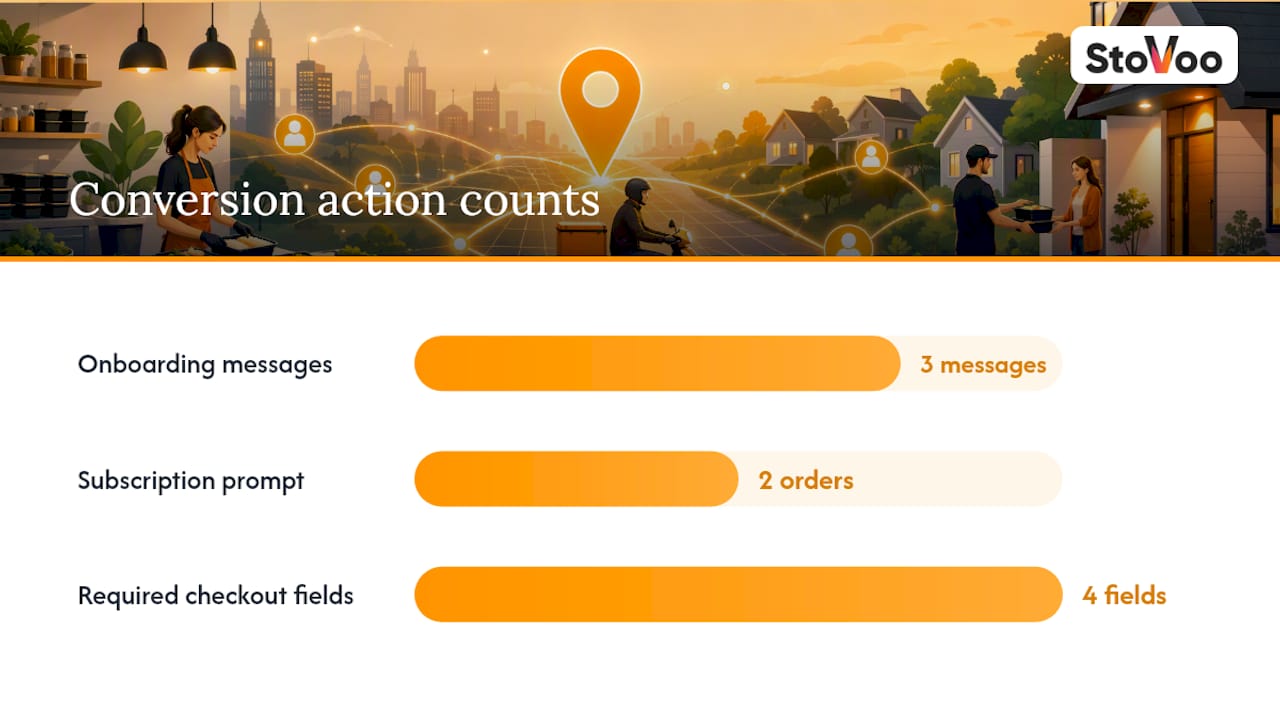
- Welcome series: Send a three-message onboarding sequence (order confirmation, delivery reminder, feedback request) to build the habit.
- Subscription prompt: After the second order, prompt the customer to subscribe for a weekly plan at a slight discount.
Trust signals that lift landing page conversion include: Google review count and rating (embed directly on the page), clear delivery windows, menu photos, and a visible price per meal. EPOS integration with online ordering can further improve accuracy and reduce order errors, which directly affects your review scores.
A platform like Stovoo fits naturally into this workflow. Its mobile-first shopfront handles recurring billing, subscription management, and customer data in one place, so you own the customer relationship rather than depending on a third-party marketplace. See how a vendor shopfront works in practice.
Pro Tip: Remove every optional field from your checkout form. Name, email, delivery address, and payment are enough. Every additional field you require reduces the chance a mobile user completes the order.
Your 7-day local SEO action checklist
Execute these tasks in order. Each one builds on the last.
- Day 1 — Claim GBP (You, 2 hrs) | Watch: profile verified status within 7 days. Priority: High.
- Day 2 — Audit NAP consistency (You / VA, 1.5 hrs) | Watch: citation match rate across top 10 directories. Priority: High.
- Day 3 — Publish one local landing page (You / writer, 3 hrs) | Watch: GSC impressions for city + "meal prep" queries within 30 days. Priority: High.
- Day 4 — Install GSC and GA4 (Developer, 1 hr) | Watch: data flowing into both dashboards within 48 hours. Priority: High.
- Day 5 — Add LocalBusiness schema (Developer, 2 hrs) | Watch: rich result eligibility in GSC's Rich Results Test. Priority: Medium.
- Day 6 — Set up review-ask automation (You / tool, 1 hr) | Watch: first review requests sent; new reviews within 2 weeks. Priority: High.
- Day 7 — Upload 10 GBP photos and write first GBP post (You, 1 hr) | Watch: GBP photo views and profile engagement in GBP Insights. Priority: Medium.
Total estimated time: under 12 hours. Every task has a measurable output you can check within 30 days.
What most meal prep owners get wrong about local pages
Most meal prep businesses treat their local landing pages as placeholders: a city name, a generic paragraph about healthy eating, and a contact form. That approach ranks for nothing and converts no one.
The highest-performing local pages function as conversion assets. They answer the specific questions a local buyer has before ordering: What does a week of meals actually look like? What is the delivery window in my ZIP code? What do other customers in my neighborhood say? A page that answers those questions with specificity, real photos, and an embedded review feed will outperform a generic page every time, regardless of how well the generic page is technically optimized.
The fix is straightforward: pick your top two or three delivery neighborhoods and write one genuinely useful page for each. Include the delivery schedule, a sample weekly menu, two or three customer reviews from that area, and a direct order link. That combination, paired with a fully optimized GBP, is what produces the kind of results documented in the Fitlife Foods-style case studies. Fixing this early, before you invest in ads or link building, shortens the time between your first SEO effort and your first attributable new order.
Stovoo turns local traffic into recurring meal prep revenue
Running local SEO well brings customers to your door. Keeping them on a weekly subscription is a different challenge, and that is where the right platform makes the difference between one-time orders and predictable monthly revenue.
Stovoo gives meal prep businesses a mobile-first shopfront, automated recurring billing, and a centralized customer dashboard, replacing the WhatsApp threads and spreadsheets that slow most small food businesses down. Your shopfront link works directly from your GBP order button, your local landing pages, and your social profiles, so every local SEO click lands on a page built to convert. Subscription plans, catering bookings, and digital recipe sales all live in one place, and you own the customer data. See how vendors like abc on Stovoo use the platform to accept recurring orders from local customers.
SEO and GBP optimization are still prerequisites; Stovoo handles what comes after the click. Set up your Stovoo shopfront and connect it to your GBP order link this week.
Sources
- Local Meal Prep SEO Case Study | Local Cheetah
- Is SEO dead or evolving in 2026?
- EPOS with online ordering for restaurants and takeaways
FAQ
How much do local SEO services cost for a meal prep business?
DIY local SEO costs $0–$100 per month in tools. A part-time contractor runs $500–$1,500 per month, and a local SEO agency typically charges $1,500–$3,500 or more. Most businesses see first ranking improvements within 30–90 days depending on the approach.
Is local SEO still worth the investment in 2026?
Yes. SEO is evolving, not disappearing, with authority-focused content and better user experiences driving results. For local meal prep businesses, a fully optimized GBP and consistent local content remain among the highest-ROI marketing activities available.
How long before local SEO produces new orders?
GBP improvements and citation fixes can move map rankings within 30–60 days. Organic traffic from local landing pages and blog content typically builds over 3–6 months, with recurring customer volume growing steadily after that.
How does Stovoo fit into a local SEO strategy?
Stovoo provides the mobile-first shopfront and recurring billing infrastructure that converts local search traffic into weekly subscribers. You connect your Stovoo shopfront link to your GBP order button and local landing pages; Stovoo handles checkout, subscriptions, and customer management from there.