
TL;DR:
- A solid meal plan scheduling system is essential for scaling a meal prep business and avoiding chaos. Effective automation, inventory management, flexible subscriptions, and cold-chain logistics are critical operational components often overlooked in basic guides. Using dedicated management software like Stovoo streamlines workflows and supports sustainable growth beyond manual spreadsheet limitations.
Running a meal prep business without a solid meal plan scheduling guide is like cooking without a recipe: you might pull it off once, but it falls apart at scale. Most food entrepreneurs hit the same wall: subscriptions pile up, kitchen production gets chaotic, and spreadsheets start breaking under the weight of real demand. This guide covers everything from pricing foundations and tool selection to kitchen workflows, menu rotation, and performance tracking, so you can build a scheduling system that actually holds up when your customer base grows.
Table of Contents
- Understanding the essentials of meal plan scheduling
- Setting up your scheduling system: tools and preparation
- Executing efficient meal prep scheduling and kitchen workflows
- Managing menu variety with meal rotation and subscription flexibility
- Verifying results and optimizing your meal plan schedule
- Why most meal plan scheduling guides miss the real challenges
- Streamline your meal plan scheduling with Stovoo
- Frequently asked questions
Key Takeaways
| Point | Details |
|---|---|
| Understand cost structure | Food costs should be 28-35% of meal price to ensure profitability of meal plans. |
| Use dedicated management tools | Software automates scheduling and subscription tasks, reducing errors and scaling effectively. |
| Implement meal rotation | A pool of 12-16 meals rotated weekly absorbs schedule disruptions and eases planning. |
| Optimize kitchen workflow | AI scheduling algorithms improve kitchen efficiency and decrease production time by 20-30%. |
| Prioritize subscription flexibility | Allowing easy skips and swaps helps retain customers and reduce churn. |
Understanding the essentials of meal plan scheduling
Before you can build a reliable meal plan scheduling system, you need to understand your numbers. Most food entrepreneurs underestimate how tightly scheduling and pricing are connected. If your food cost is too high relative to your price, no amount of scheduling efficiency will save your margins.
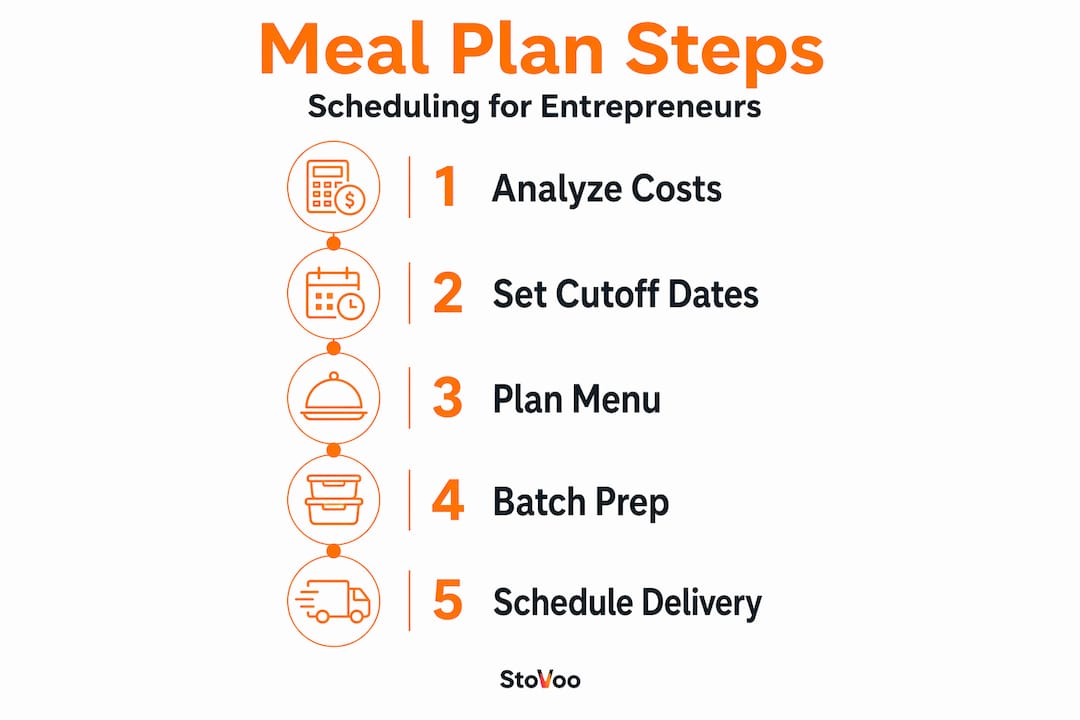
Food costs for meal prep businesses should represent 28 to 35% of the total meal price to maintain profitability. That means if you're selling a meal for $14, your ingredient cost should land between $3.92 and $4.90. Every scheduling decision you make, including portion sizes, batch quantities, and delivery frequency, flows from this ratio.
Beyond food cost, the full cost picture for a meal prep business includes:
- Packaging: Containers, labels, insulated liners, and cold packs
- Labor: Prep cooks, packers, and delivery staff hours
- Delivery: Fuel, driver wages, or third-party courier fees
- Overhead: Commercial kitchen rental, utilities, and insurance
- Marketing: Social media, referrals, and paid acquisition
Your pricing model also determines how you structure subscriptions. Meal subscription pricing models range from flat weekly plans to tiered bundles (for example, 5, 10, or 15 meals per week) and customizable add-on plans. Tiered models give customers flexibility and give you predictable volume forecasting. The more predictable your order volume, the tighter your scheduling can be. Subscription flexibility, things like pausing, skipping, or swapping meals, affects both retention and your ability to plan ahead. Build that flexibility into your pricing model from the start.
Setting up your scheduling system: tools and preparation
Manual scheduling works fine for ten customers. It collapses at fifty. The transition from spreadsheets to dedicated management software is the single most important structural advantage for scaling a meal prep business. Automation handles the repetitive billing cycles, flags inventory gaps before they become problems, and sends customers renewal reminders without you lifting a finger.
Here's how to set up your scheduling infrastructure step by step:
- Audit your current process. List every task you do manually: invoicing, order tracking, delivery scheduling, customer communication. This becomes your automation wishlist.
- Define your business model clearly. Are you running weekly meal plans, subscription boxes, or catering plus meal prep? Different models need different software features.
- Evaluate software options. Look for platforms that handle recurring billing, order management, customer portals, and inventory forecasting in one place.
- Integrate billing and order tracking. Your payment processor and order management system should talk to each other automatically, not through a manual export.
- Test before you launch. Run a two-week pilot with a small customer group before migrating your full subscriber list.
| Feature | Manual/Spreadsheet | Dedicated software |
|---|---|---|
| Subscription billing | Manual invoicing | Automated recurring billing |
| Inventory forecasting | Estimate-based | Data-driven projections |
| Customer self-service | Email or DM only | Self-service portal |
| Order error rate | High | Low |
| Scalability | Limited to ~20 customers | Hundreds of customers |
| Time cost per week | 8 to 15 hours | 1 to 3 hours |
Pro Tip: When evaluating platforms, check whether they support a mobile-first customer experience. A significant portion of your subscribers will manage their plans from a phone. If the interface is clunky on mobile, expect higher churn. The meal plan management software guide walks through what features matter most at different business stages, and customer management strategies offers a deeper look at reducing churn through better tooling.
Executing efficient meal prep scheduling and kitchen workflows
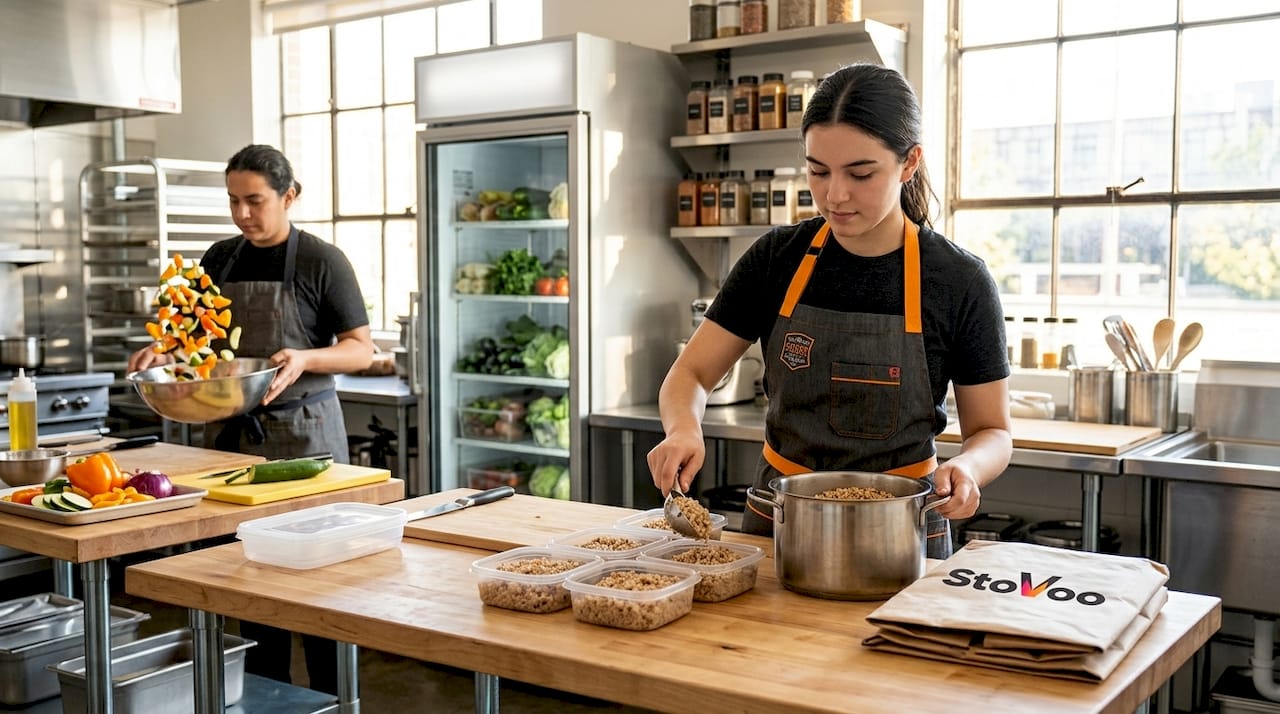
A well-run meal prep kitchen follows a predictable sequence. Knowing the order of operations lets you time-block stations, assign staff more accurately, and identify where slowdowns occur. The standard workflow runs through six phases: prep, cooking, portioning, packing, labeling, and boxing for delivery.
Here's a sample daily schedule structure for a mid-size kitchen producing 80 to 120 meals per day:
- 6:00 am to 7:00 am: Receive and inspect ingredients; assign prep stations
- 7:00 am to 9:30 am: Cold prep (chopping, marinating, sauce prep)
- 9:30 am to 12:00 pm: Hot cooking (proteins, grains, roasted vegetables)
- 12:00 pm to 1:30 pm: Portioning and quality checks
- 1:30 pm to 2:30 pm: Packing, sealing, and labeling
- 2:30 pm to 3:30 pm: Boxing by delivery zone and route assignment
The biggest scheduling gains come from overlapping phases smartly. While proteins cook, your team should be portioning yesterday's refrigerated items. Nothing should sit idle, including your staff and your equipment.
Constraint optimization algorithms can generate an optimal production schedule in seconds, factoring in equipment availability, labor, batch sizes, and deadlines. This is no longer a tool reserved for large facilities. Several affordable scheduling platforms now include AI-assisted production planning that adjusts in real time when an order changes or a staff member calls out sick.
Common workflow bottlenecks and how to fix them:
- Equipment conflicts: Two recipes need the oven at the same time. Fix by sequencing dishes by cook time and temperature.
- Labeling delays: Labels aren't printed until packing starts. Fix by generating labels at order confirmation.
- Inconsistent portioning: Different staff portion differently. Fix with standardized scales and portion guides at every station.
- Late delivery pickups: Driver arrives before boxing is complete. Fix by building a 30-minute buffer into your pickup window.
Pro Tip: Cold-chain integrity is non-negotiable. Meals should go from cooking to refrigeration within two hours and stay below 40°F until delivery. Your labels should include the pack date, eat-by date, reheating instructions, and allergen information. This protects your customers and reduces liability. Check out streamlined meal prep operations for a deeper look at production workflows built for weekly subscription models.
Managing menu variety with meal rotation and subscription flexibility
There is a meaningful difference between a static meal plan and a meal rotation system. A static plan assigns specific meals to specific days for a fixed period. A rotation system pulls from a pool of pre-approved meals and cycles them based on availability, season, and customer history. For most meal prep businesses, rotation is far more practical.
The key is building a pool large enough to feel varied but small enough to manage. Maintaining a pool of 12 to 16 reliable meals and rotating them absorbs schedule disruptions without requiring a complete plan rebuild every time an ingredient is unavailable. For a healthy meal schedule, organize your rotation pool by category: high-protein, low-carb, family-friendly, vegetarian, and so on.
| Meal plan | Meal rotation | |
|---|---|---|
| Structure | Fixed meals per week | Rotating pool of approved meals |
| Flexibility | Low | High |
| Kitchen complexity | Moderate | Lower (familiar recipes) |
| Customer experience | Predictable | Fresh and varied |
| Best for | Short-term programs | Ongoing weekly subscriptions |
Subscription flexibility features your customers expect:
- Skip a week without penalty
- Swap individual meals before the cutoff date
- Pause for travel or vacation
- Increase or decrease meal quantity week to week
- Update dietary preferences at any time
Theme nights are underused in the meal prep world. "Taco Tuesday" or a rotating "Global Kitchen" night gives your weekly meal planning tips a narrative structure customers look forward to. It also simplifies your kitchen planning because you are building variations around a consistent format rather than reinventing every meal from scratch.
Pro Tip: When adding a new meal to your rotation, test it during a low-volume week. Introduce it to 20% of your subscriber base first and track meal ratings and leftover reports before rolling it out broadly. This is how you build variety without overwhelming your kitchen. To see how other food entrepreneurs manage meal subscriptions effectively, there's a detailed breakdown of what flexible subscription systems look like in practice.
Verifying results and optimizing your meal plan schedule
Building a schedule is one thing. Knowing whether it is working is another. The food entrepreneurs who grow consistently are the ones who review their numbers weekly, not quarterly.
The KPIs that matter most for scheduling performance:
- Schedule adherence rate: What percentage of orders were fulfilled on time?
- Food cost percentage: Is it staying within your 28 to 35% target?
- Subscription retention rate: How many subscribers renewed last month versus churned?
- Delivery accuracy: How often are the wrong meals shipped?
- Waste rate per week: How much prepped food goes unused?
Structured meal planning calendars save businesses an average of $200 per month on ingredient costs and reduce food waste by 40%. That number comes from disciplined forecasting. When you know exactly how many subscribers ordered which meals before you shop, you buy only what you need.
Common scheduling mistakes and how to avoid them:
- Over-ordering ingredients because orders weren't confirmed before shopping. Fix: set a hard order cutoff 48 hours before prep day.
- Under-scheduling labor for peak weeks. Fix: build a demand forecast that accounts for seasonal spikes and promotional periods.
- Ignoring subscription modification deadlines. Fix: automate cutoff notifications via email or SMS.
- Skipping post-delivery reviews. Fix: send a one-question survey after every delivery to catch quality issues early.
Pro Tip: Run an A/B test on your pricing every quarter. Offer a small group of new subscribers a slightly different tier structure and track their conversion and retention over 60 days. Even small pricing experiments give you data that improves margins over time. Revisiting your meal plan management optimization strategy regularly is what separates food businesses that plateau from those that compound.
Why most meal plan scheduling guides miss the real challenges
Most guides on how to create a meal plan for a food business focus on the obvious: pick your meals, set your prices, build a calendar. What they consistently skip is the operational infrastructure that actually determines whether your business survives at scale.
Cold-chain logistics is the clearest example. Successful operators must know meal temperature hold times, box heat tolerance, and fulfillment zone limits to avoid shipping costs that exceed 50% of meal margins. That is not a minor detail. It is the difference between a profitable delivery business and one that loses money on every order it ships.
"Most meal prep businesses do not fail because of bad food. They fail because shipping and cold-chain costs were never modeled into the unit economics before the first order went out."
The second blind spot is delivery zone expansion. Scaling your delivery radius sounds like growth, but it often destroys efficiency. Tighter delivery zones mean shorter routes, lower fuel costs, fewer driver hours, and better meal quality at arrival. Expand only after your current zone is profitable, not before.
The third overlooked factor is the subscription portal itself. If a customer cannot pause their subscription in under 30 seconds, they will cancel instead. Usability is a retention strategy. Food entrepreneurs who invest in clean, mobile-friendly subscription interfaces consistently see lower churn than those who handle modifications through DMs or email chains.
None of this is glamorous. But it is where meal planning for families and solo customers actually breaks down in practice, and where the food businesses that last separate themselves from those that burn out at year two.
Streamline your meal plan scheduling with Stovoo
If you have been managing subscriptions through spreadsheets, WhatsApp threads, or patched-together tools, you already know the ceiling that creates. Stovoo is built specifically for food entrepreneurs who want to move past that ceiling without hiring a developer or rebuilding their entire operation.
Stovoo brings subscription management, automated billing, customer portals, and your professional storefront into one place. You can launch a meal prep calendar, set flexible subscription tiers, and give customers the ability to skip, swap, or pause meals from their phones. Real food creators are already doing it: check out ggg meal plans and Ami's meal plans to see what a live Stovoo storefront looks like in action. When you are ready to build yours, start selling on Stovoo and get your meal plan scheduling running the way it should.
Frequently asked questions
What is the ideal number of meals to include in a meal rotation?
For most meal prep businesses and households, 12 to 16 meals hit the sweet spot, offering enough variety to avoid repetition while keeping kitchen operations predictable and manageable.
How can I reduce food waste with meal plan scheduling?
Fixing your order cutoff date before you shop is the fastest win. Structured meal planning reduces food waste by 40% on average by aligning ingredient purchasing precisely with confirmed orders.
What are common scheduling bottlenecks in meal prep kitchens?
Equipment conflicts, inconsistent portioning, late label generation, and poor batch planning are the biggest culprits. Constraint optimization algorithms can cut production time by 20 to 30% by resolving these conflicts automatically.
Why is subscription flexibility important in meal plan scheduling?
Customers whose lives change need their meal plan to change with them. A customer who can skip or edit meals in under 30 seconds is far more likely to stay subscribed than one who has to send an email and wait for a reply.
How do I know if I need to upgrade from spreadsheets to management software?
If you are spending more than five hours per week on manual order management or your error rate is climbing, that is the sign. Transitioning to dedicated software reduces churn, cuts waste, and gives you the automation headroom to scale.