
TL;DR:
- Effective catering booking management uses automation to increase capacity and reduce errors. It involves integrated tools for inquiries, quotes, BEOs, and real-time updates, ensuring smooth operations. Tracking key metrics and following best practices help build client loyalty and grow the business steadily.
Catering booking management is defined as the end-to-end process of capturing inquiries, generating quotes, creating Banquet Event Orders (BEOs), and triggering the operational steps that get food to the table on time. When you manage catering bookings well, you protect your revenue, reduce last-minute chaos, and build the kind of client trust that drives repeat business. Automation is now central to this process. Implementing catering automation can process 40% more bookings with the same staff and reduce quoting errors by 85%. Those numbers represent the gap between a catering business that grows and one that stays stuck firefighting every event.
How to manage catering bookings with the right tools
The right tools are the foundation of any reliable booking process. Without them, inquiries fall through the cracks, quotes take too long, and your kitchen never gets the full picture until it's almost too late.
Every professional catering operation needs these core systems in place:
- Dedicated inquiry forms. A structured web form captures event type, guest count, dietary needs, and service style upfront. Clear initial order details prevent inaccuracies later in the process.
- Multi-channel routing. Route email and phone inquiries into a single inbox with automatic CRM tagging. Voicemail transcription tools convert missed calls into text records instantly.
- Automated response workflows. Set up instant acknowledgment emails so no lead goes cold while you're busy with an event.
- BEO generation software. Your booking system should auto-generate a BEO from the confirmed event details and push it to kitchen and staffing teams.
- Kitchen and inventory integration. Booking to kitchen production integration triggers purchase orders and labor schedules automatically, making scalable event execution possible.
| System | Core function | Impact |
|---|---|---|
| Inquiry form | Captures structured event data | Fewer missing details at quoting stage |
| CRM with auto-tagging | Organizes leads by event type and date | Faster follow-up and less manual sorting |
| BEO generator | Creates live operational documents | Aligns sales with kitchen and staffing |
| Inventory integration | Links bookings to procurement | Reduces over-ordering and food waste |
Pro Tip: Set your CRM to flag any inquiry that has not received a response within 90 minutes. That single rule prevents the most common reason catering leads go cold.

Booking software can also block event dates, reduce scheduling conflicts, and integrate client data to improve accuracy across your entire calendar. That means fewer double-bookings and a cleaner view of your capacity at any given time.
What does the catering booking process look like step by step?
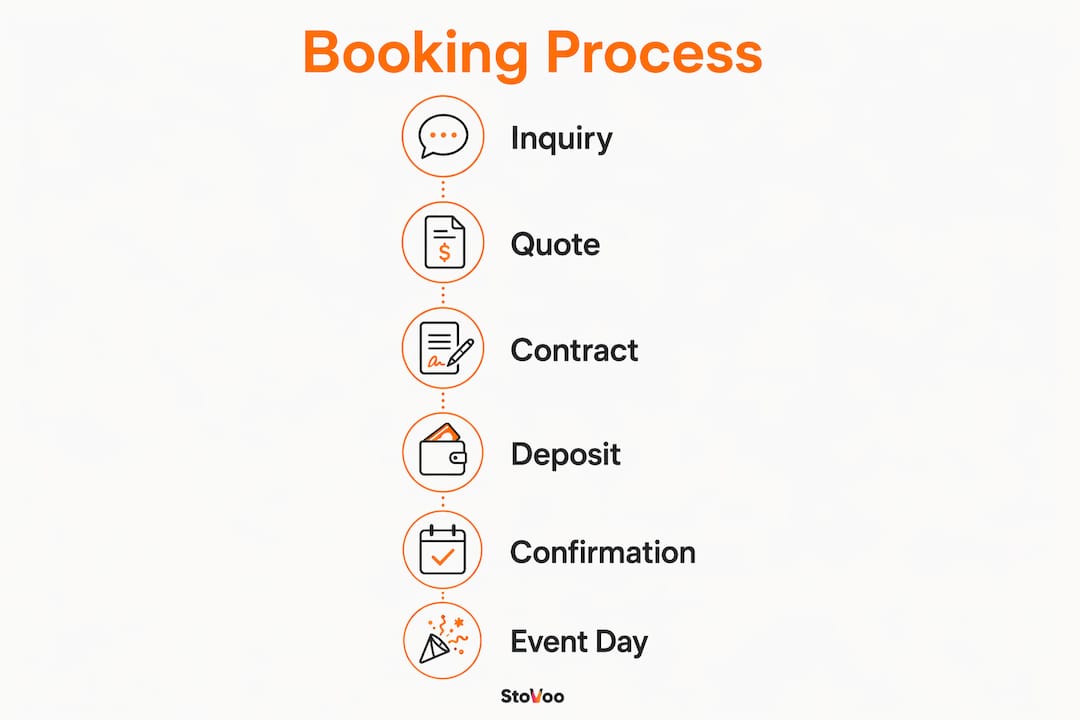
The catering booking process is the sequence of steps that moves a lead from first contact to a fully executed event. Each stage has a specific job, and skipping one creates problems downstream.
- Immediate auto-response. The moment an inquiry arrives, an automated reply confirms receipt and sets expectations for next steps. Professional caterers prioritize swift first contact to keep leads engaged without overwhelming them with details.
- Lead qualification within 2 hours. A team member reviews the inquiry, confirms feasibility, and schedules a follow-up call or sends a preliminary quote. Responding within 2 hours doubles booking conversion, pushing your close rate to 78% compared to 34% when you wait 24 hours.
- Package selection and deposit. Once the client selects a package, you collect a deposit and lock the event date in your system. Standard lead time for catering is 3 working days minimum, with 2–3 weeks recommended for large or complex events.
- Menu confirmation (60–90 days out). The client confirms specific dishes and substitutions. Catering menus lock in three stages: package selection at booking, dish confirmation 60–90 days before the event, and final headcount 14 days prior.
- Final headcount guarantee (14 days out). The client submits a guaranteed guest count. After this point, all changes require a signed change order.
- BEO distribution. Your system auto-generates the BEO and sends it to the kitchen, purchasing, and event staff. Any post-guarantee changes update the live BEO automatically.
- Event execution and post-event follow-up. The team executes against the BEO. After the event, an automated nurture sequence goes out to encourage repeat bookings.
Pro Tip: Build a signed change order requirement into your booking contract before the event. Clients who understand the process upfront rarely push back on it later.
The deposit and payment schedule varies by operation, but most caterers collect 25–50% at booking and the balance 7–14 days before the event. Whatever schedule you use, automate the payment reminders so you never have to chase a client manually.
What are the most common catering booking challenges?
Even well-organized catering businesses run into the same recurring problems. Knowing what they are puts you ahead of them.
BEO drift is the top cause of execution failure. BEO drift happens when the sales team updates event details but the kitchen and staffing teams are working from an older version of the document. Treating the BEO as a living document tied to your CRM eliminates this. Every confirmed change updates the BEO in real time, and every team member sees the same version.
Slow inquiry response is the second biggest conversion killer. The data is clear: a 2-hour response window produces a 78% booking conversion rate. Waiting 24 hours drops that rate to 34%. That gap represents real revenue lost to competitors who simply replied faster.
"The initial inquiry is a critical opening move. Confirm feasibility and schedule the next interaction quickly. Exhaustive data gathering at first contact slows momentum and loses leads." — Wedding Catering Booking Process Insight
Additional challenges caterers face regularly include:
- Disconnected sales and kitchen workflows. When bookings live in one system and kitchen prep lives in another, errors multiply. Integration between your booking platform and your kitchen operations is not optional at scale.
- Menu locking discipline. Clients frequently request changes after the final guarantee. Without a formal change order process, those requests create confusion, waste ingredients, and stress your team.
- Manual quoting errors. Quoting by hand or through spreadsheets introduces pricing mistakes that erode margins. Automation reduces quoting errors by 85%, which compounds into significant savings across dozens of events per month.
The fix for most of these challenges is the same: a single connected system where the booking record drives every downstream action. When the booking updates, the BEO updates, the purchase order updates, and the staffing schedule updates. That is how you build a catering operation that scales without adding headcount. Learn more about automation in catering operations and how it reduces these exact failure points.
How do you track and grow catering bookings over time?
Tracking catering bookings means more than knowing which dates are filled. It means using your booking data to spot trends, improve margins, and build a client base that comes back.
- Monitor key booking metrics weekly. Track inquiry volume, conversion rate by event type, average booking value, and lead response time. These four numbers tell you where your process is strong and where it leaks.
- Review F&B minimums by event category. Your reporting should show which event types consistently hit your food and beverage minimums and which ones don't. Adjust your pricing or minimum requirements based on real data, not gut feel.
- Run post-event nurture sequences. Automated follow-up sequences re-engage clients who delay responses and improve booking closure rates. A three-email sequence sent 3 days, 10 days, and 30 days after an event captures a meaningful share of repeat bookings.
- Reactivate stale leads automatically. Set a trigger for any lead that has not responded in 14 days. A short, direct follow-up email asking if their plans have changed converts a surprising number of dormant inquiries.
- Close the feedback loop between sales and kitchen. After each event, your kitchen team should flag any ingredient shortfalls, over-orders, or timing issues. Feed that data back into your quoting and procurement process to tighten future events.
| Metric | Why it matters | Review frequency |
|---|---|---|
| Inquiry to booking conversion rate | Shows how effective your response and quoting process is | Weekly |
| Average booking value | Tracks revenue per event and upsell success | Monthly |
| Lead response time | Directly tied to conversion rate | Daily |
| Post-event repeat booking rate | Measures client satisfaction and loyalty | Quarterly |
| BEO change order frequency | Flags weak menu locking or client communication | Per event |
Pro Tip: Segment your post-event nurture by event type. A corporate lunch client needs a different follow-up message than a wedding client. Personalized sequences outperform generic ones every time.
Reviewing your catering business operations quarterly gives you the perspective to spot seasonal patterns, adjust staffing models, and set realistic growth targets for the next period.
Key Takeaways
Managing catering bookings well requires a connected system where inquiry capture, BEO generation, and kitchen workflows operate from the same live data.
| Point | Details |
|---|---|
| Speed wins leads | Responding within 2 hours produces a 78% conversion rate versus 34% after 24 hours. |
| Three-stage menu locking | Lock packages at booking, confirm dishes 60–90 days out, and finalize headcount 14 days prior. |
| BEO as a live document | Tie your BEO to your CRM so every change updates kitchen and staffing teams in real time. |
| Automation scales capacity | Catering automation can handle 40% more bookings with the same staff and cut quoting errors by 85%. |
| Track and nurture | Post-event follow-up sequences and weekly metric reviews drive repeat bookings and continuous improvement. |
The part most caterers get wrong
The biggest mistake I see catering businesses make is treating the booking and the production as two separate jobs. Sales closes the event, hands off a PDF, and considers the work done. The kitchen receives that PDF, interprets it differently, and the gap between those two interpretations is where events go wrong.
The BEO is not a handoff document. It is a shared operational record that both teams own. When it lives in a connected system, every update is visible to everyone. When it lives in someone's email, you are one missed message away from a disaster.
Speed matters more than most caterers admit. I have watched businesses with better menus and better pricing lose bookings to competitors who simply replied faster. The 2-hour response window is not a nice-to-have. It is a revenue decision. Automate your acknowledgment emails and your lead qualification triggers so that speed is built into your process, not dependent on who happens to be at their desk.
The caterers who grow consistently are the ones who treat their booking data as a business asset. They review their conversion rates, they track their average booking values, and they run post-event sequences that turn one-time clients into regulars. That discipline, combined with a connected booking system, is what separates a busy catering business from a growing one.
— freeman
Stovoo makes catering booking management simpler
Running a catering business through WhatsApp threads and spreadsheets costs you time, clients, and money. Stovoo gives food entrepreneurs a centralized platform to capture catering inquiries, manage bookings, collect deposits, and keep client records organized in one place.
Stovoo's mobile-first shopfront lets you share your booking link across social media and messaging apps so clients can submit inquiries directly. The platform handles automated billing and customer management so you spend less time on admin and more time on the food. Caterers using Stovoo report a cleaner, more professional client experience from the first inquiry to the final invoice. Set up your catering shopfront on Stovoo and start accepting bookings today.
FAQ
What is catering booking management?
Catering booking management is the process of capturing client inquiries, generating quotes, creating BEOs, collecting deposits, and coordinating kitchen and staffing execution for each event.
How do I respond to catering inquiries faster?
Set up an automated acknowledgment email that fires the moment an inquiry is submitted. Then use a CRM alert to flag any lead that has not received a personal follow-up within 90 minutes.
What is a BEO in catering?
A BEO, or Banquet Event Order, is the master document that details every confirmed element of a catering event, including menu, guest count, timing, and staffing. It connects the sales booking to kitchen production and should update automatically when event details change.
How far in advance should catering be booked?
Standard catering requires a minimum of 3 working days' notice. Large or complex events need 2–3 weeks to allow for proper procurement, staffing, and menu preparation.
What metrics should caterers track to improve bookings?
The four most important metrics are inquiry to booking conversion rate, average booking value, lead response time, and post-event repeat booking rate. Reviewing these weekly and monthly reveals where your process needs adjustment.