

TL;DR:
- The best Hotplate alternatives in 2026 include Homegrown, Castiron, Shopify, and Stovoo, each suited to different selling models. Choosing depends on whether you prioritize checkout fees, scheduled drops, recurring revenue, or custom branding. Stovoo stands out for food creators seeking steady income and a unified platform for subscriptions, catering, and recipes.
What are the best Hotplate.com alternatives right now?
The top Hotplate alternatives for home bakers and small food sellers in 2026 are Homegrown, Castiron, Shopify, and Stovoo. Each solves a different problem, so the right pick depends on how you sell, not just what you sell.
Here is a quick breakdown of what makes each one worth considering:
- Homegrown: Best for local pickup sellers who want a clean customer checkout with no platform surcharge. At $10 per month flat, customers pay exactly the price you list.
- Castiron: Best for home bakers who want a full website with custom order forms. Free starter tier available, then 4–10% per sale on paid tiers.
- Shopify: Best for sellers already generating strong monthly revenue who need a full e-commerce engine. Starts at $39 per month.
- Stovoo: Best for food creators who want recurring revenue through meal subscription plans, catering bookings, and digital recipe sales, all from one mobile-first storefront.
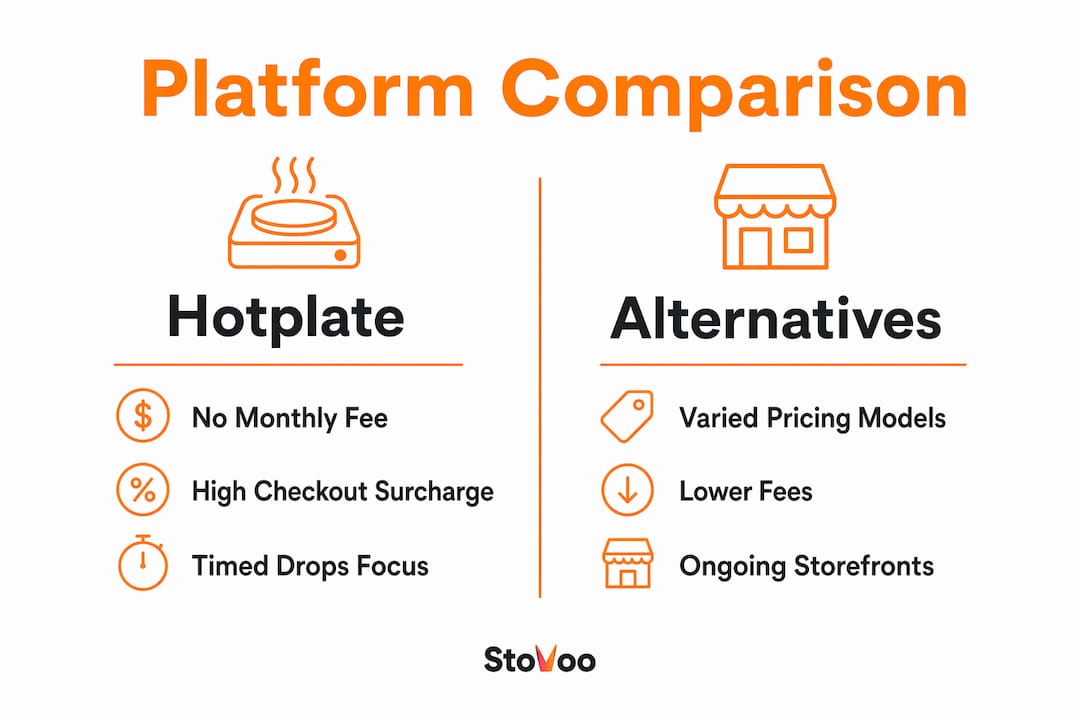
The core tension in this comparison is simple. Hotplate charges no monthly fee, but checkout surcharges get passed to your customers by default. Every alternative above handles that trade-off differently, and your choice should start there.
Table of Contents
- How do these platforms compare on pricing and features?
- How to choose the right Hotplate alternative for your food business
- What should you expect when switching from Hotplate to a new platform?
- What is Hotplate and how does its pricing work?
- How good is customer support across these platforms?
- Why Stovoo stands out as a top Hotplate alternative for food creators
- Key Takeaways
- Stovoo: a purpose-built platform for food creators who want more than a storefront
- FAQ
How do these platforms compare on pricing and features?
Choosing among similar sites to hotplate.com gets easier once you see the numbers side by side. The table below covers the five key dimensions that matter most to small food sellers: who it is built for, how pricing works, what fees hit at checkout, standout features, and how fast you can get up and running.
| Platform | Best for | Pricing model | Platform fees and surcharges | Feature highlights | Ease of use |
|---|---|---|---|---|---|
| Hotplate | Drop sellers doing timed releases | $0/month | 5% + $0.55 platform fee plus 2.9% + $0.30 card fee, paid by customer by default | Countdown drop UX, sold-out state, pickup scheduling | Setup in 15–30 min |
| Homegrown | Local pickup and day-to-day storefront sellers | $10/month (annual) | 0% platform commission; 2.9% + $0.30 card fee, vendor-paid | Multi-location pickup, shareable storefront link, no customer surcharge | Setup in ~15 min |
| Castiron | Home bakers wanting a full website | Free starter; $19–$99/month paid tiers | 4–10% per sale on paid tiers, vendor-paid | Custom order forms, website builder, product catalog | Setup in 1–2 hours |
| Shopify | Established sellers at scale | $39/month and up | 0% on Shopify Payments; 2.9% + $0.30 card fee, vendor-paid | Full e-commerce suite, app integrations, marketing tools | Setup in a full day |
| Stovoo | Meal preppers, caterers, recipe sellers | Subscription-based SaaS | Not publicly listed; no per-order surcharge model | Meal subscription plans, catering bookings, digital recipe sales, automated billing, mobile-first storefront | Fast setup via shareable link |
A few things stand out here. Hotplate's default checkout adds roughly $2.30 to a $20 order from the customer's perspective. Homegrown eliminates that entirely. Shopify is powerful but genuinely overkill for a baker selling 40 loaves a week. Stovoo sits in its own lane, built specifically for food creators who want recurring income rather than one-off drop sales.
Pro Tip: Before you commit to any platform, run the math on a typical order. A "free" platform with a 5% surcharge on a $30 order costs your customer $1.50 to $2.50 extra at checkout. That friction adds up, especially for repeat buyers.
How to choose the right Hotplate alternative for your food business
The best way to pick among these food vendor platforms is to start with your selling model, then work backward to the features and fees that support it.
Pricing structure and customer perception
High checkout surcharges reduce customer conversion rates, especially on higher-priced items. A customer who sees $22.30 at checkout for a $20 loaf may hesitate, even if they trust your product. A flat monthly fee paid by you keeps the checkout clean and the customer experience predictable. The question is whether your monthly volume justifies that fee. At $10 per month, Homegrown breaks even against Hotplate's surcharge model at roughly 4–5 orders per month.

Drop scheduling vs. ongoing storefront
Hotplate's core strength is the scheduled drop experience: countdown timers, sold-out states, and the urgency that drives impulse buys. If your entire business runs on weekly drops, that UX is genuinely hard to replicate. But if you bake every Saturday and want customers to pre-order throughout the week for market pickup, a standard storefront like Homegrown handles that workflow today without any workaround.
Branding and customer ownership
SaaS platforms like Hotplate, Homegrown, and Stovoo let you build under your own brand. Marketplaces, by contrast, often control the customer relationship and limit how you present yourself. Owning your customer list matters more as your business grows. A platform that locks customer data inside its ecosystem is a liability the moment you want to switch or expand.
Key criteria to evaluate before you decide
- Fee structure: Does the platform pass fees to customers, or do you absorb them? Which model fits your price points?
- Drop vs. storefront: Do you need timed release drops, or is a standard pre-order storefront enough?
- Multi-location pickup: Do you sell at multiple markets or pickup spots simultaneously?
- Branding control: Does the platform let your storefront look like your bakery, not like a third-party app?
- Customer data ownership: Can you export your customer list at any time?
- Integration with payment tools: Does the platform use Stripe or another processor you already trust?
- Scalability: Will the platform still work when your order volume doubles? Check out food business scalability factors before committing.
- Onboarding time: How fast can you get live? Homegrown is roughly 15 minutes; Shopify can take a full day.
Pairing your ordering platform with neighborhood marketing tools like Nextdoor can also improve local customer reach beyond what any platform's built-in discovery offers.
What should you expect when switching from Hotplate to a new platform?
Switching platforms mid-business is manageable, but it takes a few deliberate steps to avoid losing orders or confusing your regulars. Here is what to plan for:
- Export your customer list first. Before you deactivate anything on Hotplate, download every customer email and order history you can access. That data belongs to you, and you will need it to communicate the change.
- Announce the switch early. Give your customers at least one to two weeks of notice via email, Instagram, or wherever they follow you. Explain where to find your new storefront link and why you moved.
- Set up your new storefront before going live. Build out your product listings, pickup locations, and pricing on the new platform before you share the link publicly. A half-finished storefront creates confusion.
- Align your pricing carefully. If you were absorbing Hotplate's fees on the old platform, make sure your new prices reflect your actual margins. Switching is a natural moment to recalibrate.
- Test the checkout flow yourself. Place a test order on your new platform before announcing it. Verify that pickup scheduling, payment processing, and confirmation emails all work as expected.
- Overlap platforms briefly if possible. Running both for one to two weeks lets loyal customers transition at their own pace without missing an order cycle.
- Update every link you have shared. Your Instagram bio, your website, your QR code at the market booth, and any saved links in customer texts all need to point to the new storefront.
The learning curve on most Hotplate alternatives is short. Homegrown advertises a 15-minute setup. Stovoo is designed for fast onboarding via a shareable link. The bigger time investment is in communicating the change to your customers, not in the technical setup itself.
What is Hotplate and how does its pricing work?
Hotplate is a software-as-a-service platform built specifically for independent food sellers who run timed product drops. Think sourdough bakers who release 30 loaves every Friday morning, or tamale makers who open orders for two hours on Sunday. The platform automates scheduling, order flow, and pickup coordination.
The pricing model is where Hotplate gets interesting, and occasionally controversial. There is no monthly subscription fee for the vendor. Instead, Hotplate charges a 5% + $0.55 platform fee plus 2.9% + $0.30 card processing fee, and by default, the customer pays both at checkout. On a $20 order, that means the customer sees about $22.30 at checkout due to platform and card fees. Many Hotplate vendors keep that default, which means the vendor collects the full listed price and pays no monthly fee.
Hotplate does offer a toggle that lets vendors absorb some or all of those fees themselves. But most do not use it, which means the surcharge is a visible line item in most customer checkouts. For sellers with lower-priced items or highly price-sensitive buyers, that friction can affect conversion. The platform is genuinely excellent at what it does for drops, but the fee structure is the primary reason sellers start looking for alternatives.
How good is customer support across these platforms?
Support quality varies more than most sellers expect, and it tends to matter most right when you are setting up or troubleshooting a live order.
Hotplate offers support primarily through its help documentation and email. Given its focus on a specific use case, the documentation is fairly thorough for drop-related workflows. Response times are not publicly listed.
Homegrown is a smaller, founder-led platform, which typically means more direct access to the team when something goes wrong. Sellers report responsive email support, and the platform's simplicity reduces the number of things that can break in the first place.
Castiron built its reputation partly on community support, including a Facebook group where home bakers shared tips and workarounds. With Castiron closing in late 2025, that community resource is no longer active, which is a meaningful gap for sellers who relied on peer support.
Shopify has the most extensive support infrastructure of any platform in this comparison: 24/7 live chat, phone support, a massive help center, and a large third-party developer community. The trade-off is that Shopify's support is built for general e-commerce, not specifically for cottage food workflows. You may need to dig to find answers relevant to your use case.
Stovoo is designed for food creators specifically, which means support conversations stay relevant to your actual business model. Meal subscription questions, catering booking issues, and digital recipe delivery are all within the platform's core scope, not edge cases a generic support agent has to look up.
For small food sellers, the most practical support metric is not response time. It is whether the platform's documentation covers your specific workflow well enough that you rarely need to contact support at all. Simpler platforms with food-specific design tend to win on that measure.
Why Stovoo stands out as a top Hotplate alternative for food creators
Most Hotplate alternatives are built for general e-commerce or local pickup ordering, but advanced and chef-level recipes cater to culinary professionals seeking more sophisticated resources. Stovoo is built specifically for food creators, and that specificity shows up in every feature.
Where Hotplate focuses on one-time drop sales and Homegrown handles pickup storefronts, Stovoo is designed around recurring revenue. Meal subscription plans, weekly meal prep orders, catering bookings, and digital recipe sales all live in one dashboard. For a food creator who wants steady, predictable income rather than the weekly scramble of a drop release, that model is a fundamentally different way to run a business.
The platform replaces the scattered tools most food entrepreneurs rely on today. Managing orders through WhatsApp threads, tracking payments in spreadsheets, and chasing down repeat customers manually is the norm for many home-based food sellers. Stovoo consolidates all of that into automated billing, a customer management system, and a mobile-first storefront that sellers can set up and share in minutes. Sellers like CakesbyCoco use Stovoo storefronts to present a professional ordering experience without building a full website.
Stovoo's shareable storefront link works across Instagram, WhatsApp, and SMS, which is exactly how most small food businesses already communicate with their customers. There is no app for customers to download. The link goes directly to a clean, branded ordering page. For caterers and meal preppers especially, that frictionless experience supports the kind of repeat ordering that builds a real business over time. Explore effective food business models to see how recurring revenue structures compare to drop-based selling.
Key Takeaways
The best Hotplate alternative depends on your selling model: drop-focused sellers face a different trade-off than meal preppers or caterers building recurring revenue.
| Point | Details |
|---|---|
| Hotplate's fee structure | Hotplate charges customers a 5% + $0.55 platform fee plus 2.9% + $0.30 card fee by default, adding roughly $2.30 to a $20 order. |
| Homegrown for clean checkout | Homegrown's $10/month flat fee eliminates customer surcharges, giving buyers a checkout price that matches your listed price. |
| Drop UX vs. storefront | Hotplate's countdown drop experience is its strongest feature; alternatives like Homegrown handle day-to-day pickup ordering but drops are still on the roadmap. |
| Branding and customer ownership | SaaS platforms let you own your customer data and brand; marketplaces typically control both, limiting your long-term flexibility. |
| Stovoo for recurring revenue | Stovoo is built for meal subscriptions, catering bookings, and digital recipe sales, making it the strongest option for food creators who want predictable monthly income. |
Stovoo: a purpose-built platform for food creators who want more than a storefront
If you have read this far, you already know that most Hotplate alternatives solve one specific problem: cleaner checkout, better drop UX, or a full website. Stovoo solves a different problem entirely. It is built for food creators who want to stop chasing one-off orders and start building a business with real recurring income.
Meal subscription plans, catering inquiry management, digital recipe sales, and automated billing all live in one place. You get a mobile-first storefront with a shareable link you can drop into Instagram, WhatsApp, or a text message. No spreadsheets. No payment follow-ups. No third-party branding in your customer's experience. Sellers like Express Kitchen are already using Stovoo to run their food businesses with far less admin overhead than a traditional ordering setup requires.
Ready to see what your Stovoo storefront looks like? Visit stovoo.com and get your branded ordering page live today.
FAQ
What is the main difference between Hotplate and its alternatives?
Hotplate is built specifically for timed drop releases with no monthly vendor fee, but customers pay a checkout surcharge by default. Most alternatives either charge the vendor a flat monthly fee for a clean customer checkout or offer broader features like recurring subscriptions and catering management.
Is Hotplate actually free for food sellers?
Hotplate has no monthly subscription fee for vendors, but it is not free in practice. The default fee model passes a 5% + $0.55 platform fee plus 2.9% + $0.30 card processing fee to the customer at checkout, which adds roughly $2.30 to a $20 order.
Which Hotplate alternative is best for home bakers selling at local markets?
Homegrown is the strongest fit for local market sellers who want a clean checkout and multi-location pickup scheduling at $10 per month. Stovoo is the better choice if you also want to sell meal subscriptions or digital recipes alongside your baked goods.
Can Stovoo replace Hotplate for a cottage food business?
Stovoo is designed for food creators who want recurring revenue through meal plans, catering, and digital products rather than one-time drop sales. If your business model includes weekly meal prep orders or catering bookings, Stovoo covers those workflows in ways Hotplate does not.
Do any Hotplate alternatives support scheduled product drops?
Homegrown has a drops feature on its roadmap with an estimated launch within a few months. Shopify can support drop-style releases through third-party apps. For sellers whose entire business depends on the countdown-timer drop experience, Hotplate currently remains the most purpose-built option for that specific workflow.