

TL;DR:
- Building a food business requires a structured eight-step workflow from planning through retention, emphasizing operational tech. Automating procurement and establishing SOPs early help prevent delays that can push launch timelines back by months. Using a dedicated SaaS platform like Stovoo centralizes customer management, subscriptions, and compliance, reducing chaos and increasing scaling potential.
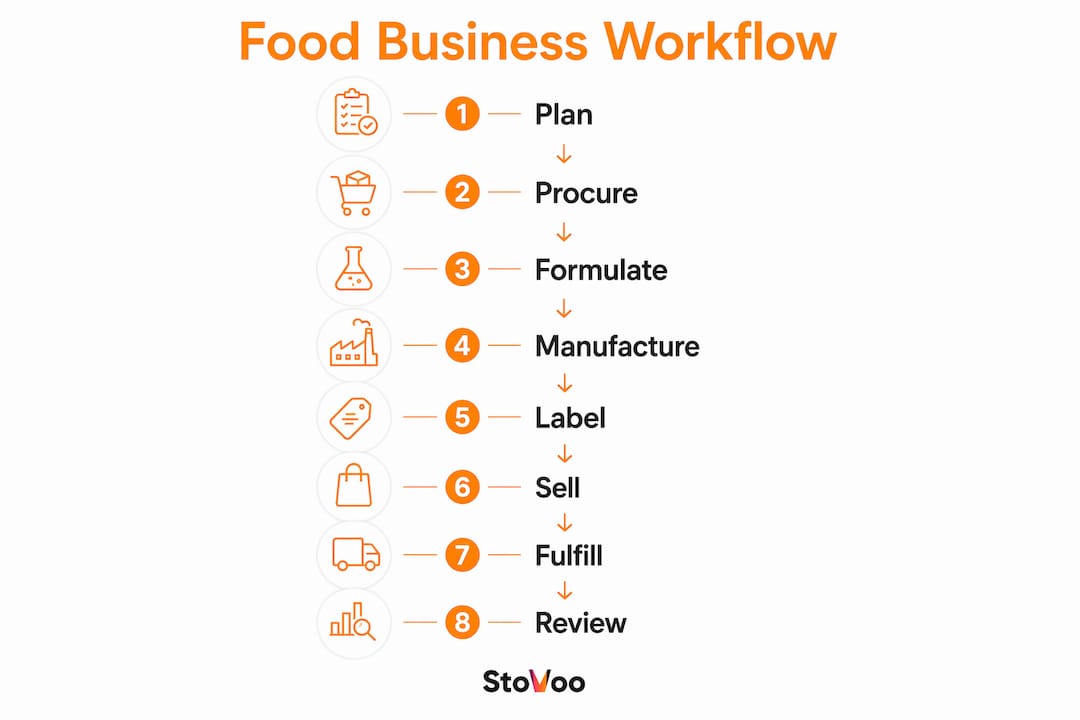
Run a SaaS-first workflow across eight stages: plan, procure, formulate, manufacture, label, sell, fulfill, and retain. Here are your next three moves right now:
- Publish a minimal storefront with payment and tax enabled (Stovoo gets this live in under an hour).
- Start a 30-day procurement document pilot with one supplier category, collecting certificates of analysis (COAs) and allergen statements via a simple intake form.
- Write your first Production Day SOP as a one-page checklist while you actually run the task.
Watch two metrics in your first 30 days: orders processed and subscription conversion rate. On timing, plan for 10–12 weeks for DTC and 16–20 weeks for retail. Retail launches typically require at least 16–20 weeks of advance planning, while DTC launches usually need 10–12 weeks. FDA facility registration under 21 CFR 1.226 applies the moment you manufacture packaged food for sale.
Table of Contents
- Why operational workflows are a competitive moat
- What does the full 8-step food business workflow look like?
- How do you stop chasing supplier documents?
- How do you scale production without losing quality?
- How do you automate orders, subscriptions, and billing?
- What does a realistic 30/60/90 implementation plan look like?
- What templates do you need on Day 1?
- How do you choose and pilot a SaaS platform?
- Key Takeaways
- The workflow gap most food founders never close
- Stovoo puts this workflow in one place
- Useful sources and Stovoo blog references
- FAQ
Why operational workflows are a competitive moat
Most food founders treat operations as backend work to fix after launch. That instinct is expensive. Building a scalable operating rhythm from sourcing through fulfillment is a defensible brand moat, not an afterthought.
The data backs this up hard. In many food brand implementations, missing or broken tech at launch was identified as the primary cause of failure. Your storefront must convert first-time buyers, retain subscribers, and handle compliance copy at scale. It is not just a sales page.
Sequencing errors compound fast. Founders who finalize packaging before completing allergen testing, or who skip EDI setup before approaching retail buyers, face delays that push entire launch windows back by months. Getting the order right matters more than moving fast.
What does the full 8-step food business workflow look like?
The workflow below runs sequentially. Each step has an owner, automation opportunities, and a short checklist.
- Demand and cost model (Weeks 1–2) — Build a landed cost model covering ingredients, co-packer fees, packaging, freight, and margin before touching a recipe. Add a ~20% buffer above your first-run forecast. Confirm co-packer MOQs early.
- Procurement and supplier documents (Weeks 2–4) — Collect COAs, allergen statements, insurance certificates, and any kosher or organic certs. Automate follow-up reminders; do not chase manually.
- Formulation and testing (Weeks 4–24) — Allocate up to 20 weeks for formulation and stability testing. Run sensory panels. Integrate label compliance review into each round.
- Co-packer or production plan (Weeks 8–20) — Vet co-packers for SQF Level 2 or BRC certification, allergen controls, and capacity to scale beyond your launch quantity.
- Packaging and labeling (Weeks 16–24) — US basics: FDA-compliant nutrition facts panel, allergen declarations, net weight, manufacturer name and address, and statement of identity. Packaging validation improves retailer acceptance.
- Storefront and order/subscription setup (Weeks 8–12 for DTC) — Publish your professional shopfront, enable subscription billing, and configure tax. This is where Stovoo centralizes everything.
- Fulfillment and logistics (Weeks 10–16) — Map your pick-pack-ship flow, set carrier rules, and connect your order feed to your inventory system.
- Retention and analytics (Ongoing) — Welcome series, lapsed-customer flows, and subscription renewal nudges. Track churn, lifetime value, and repeat order rate monthly.
Pro Tip: If retail is in your 12-month plan, start EDI setup and co-packer certification vetting at Step 2, not Step 7. Retail buyers will not wait while you catch up on prerequisites.
| Step | Owner | SaaS Automation | Timeline |
|---|---|---|---|
| Demand and cost model | Founder | Spreadsheet or ERP | Weeks 1–2 |
| Procurement documents | Founder/ops | Form + automated reminders | Weeks 2–4 |
| Formulation and testing | Food scientist | Lab management software | Weeks 4–24 |
| Co-packer vetting | Founder | Vendor portal | Weeks 8–20 |
| Packaging and labeling | Designer + founder | Label compliance tool | Weeks 16–24 |
| Storefront and subscriptions | Founder | Stovoo | Weeks 8–12 |
| Fulfillment | Ops | 3PL + order management | Weeks 10–16 |
| Retention and analytics | Founder | CRM/email platform | Ongoing |
How do you stop chasing supplier documents?
Exception-based procurement management is the answer: define required documents upfront, then automate follow-ups only for what is missing. You stop chasing everything and start managing exceptions.
Required supplier document checklist:
- Certificate of Analysis (COA) for each ingredient lot
- Allergen statement (signed, dated)
- Certificate of insurance (product liability minimum)
- Kosher, organic, or non-GMO certificates where applicable
- FSMA Preventive Controls compliance letter
30-day pilot plan: Pick one supplier category (e.g., your primary protein or sweetener supplier). Set up a Google Form or intake portal, send it to all suppliers in that category, and track completion rate weekly. Aim for 100% completion before placing your next purchase order.
Pro Tip: Build an escalation path into your document workflow: automated reminder at Day 7, a personal follow-up call at Day 14, and a purchase order hold at Day 21. Most suppliers respond before the hold.
How do you scale production without losing quality?
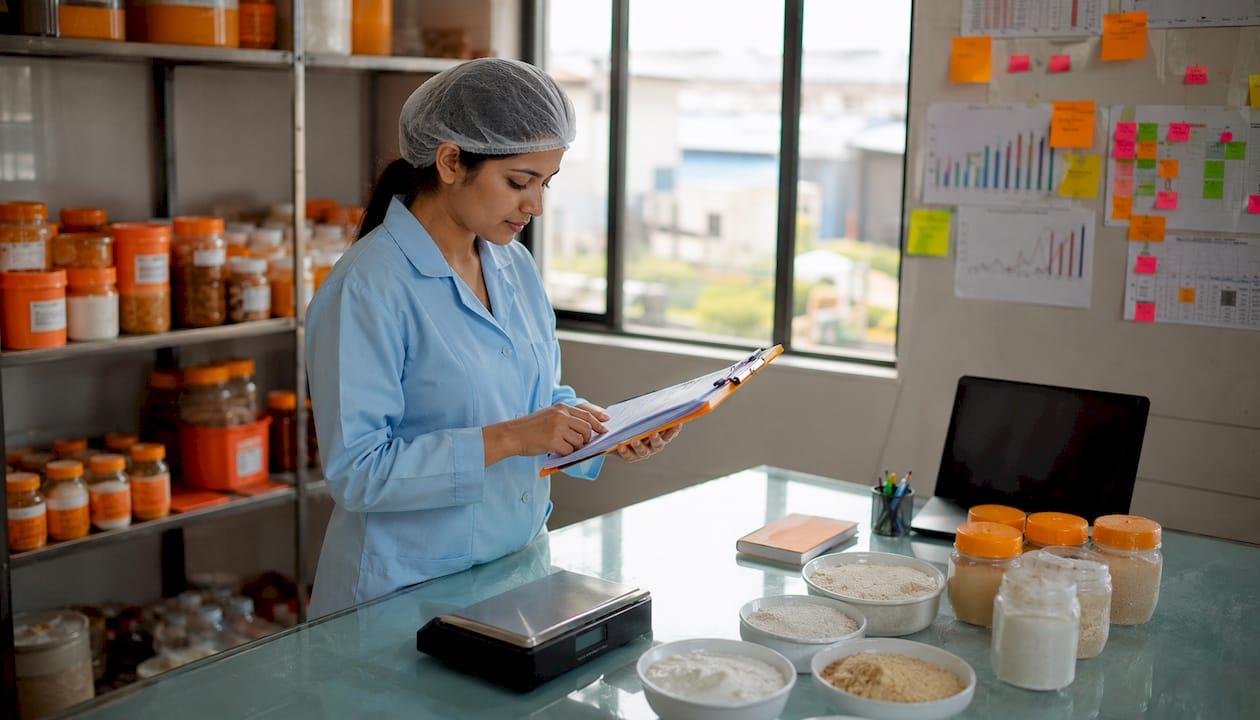
Sequence and documentation beat speed every time. Write SOPs as one-page, scannable checklists while you are actually performing the task. That is how they get used.
Production Day SOP structure:
- Pre-production: equipment sanitation check, ingredient lot numbers pulled, yield target noted
- Production: step-by-step process with critical control points flagged
- Post-production: actual yield recorded, deviations noted, equipment cleaned and signed off
Batch record minimum fields: lot number, production date, ingredient lot numbers, target yield, actual yield, any deviation, and QC sign-off.
QC checklist items: weight per unit, pH where relevant, seal integrity, visual appearance, and labeling accuracy. Log non-conformances in your inventory system immediately.
For traceability, enable lot and expiry tracking in your ERP or inventory tool before your first inbound shipment. FIFO enforcement and recall report capability are non-negotiable features for any food-grade system. Stovoo's meal prep operations guidance covers how to apply these principles at small-batch scale.
Pro Tip: Review every SOP quarterly or immediately after any failure event. A SOP that reflects last year's process is worse than no SOP.
How do you automate orders, subscriptions, and billing?
Automate payments, taxes, and subscription flows from Day 1. Manual order processing does not scale past a dozen weekly customers.
The standard automation flow runs: storefront → payment processor → tax engine → order feed to inventory/fulfillment → automated customer communications. Every handoff should be a data connection, not a copy-paste.
Retention automation checklist:
- Welcome series (3 emails over 7 days for new subscribers)
- Lapsed-customer flow triggered at 30 days of inactivity
- Subscription renewal reminder 5 days before billing date
- Post-delivery review request
Stovoo centralizes subscription billing, catering bookings, and meal plan scheduling in one dashboard, cutting the manual steps that typically pile up across WhatsApp threads and spreadsheets. Founders using the platform report fewer order errors and faster customer response times because everything lives in one place.
Pro Tip: Tie your loyalty mechanic to subscription renewal, not one-off purchases. Recurring customers are worth far more than repeat single orders.
What does a realistic 30/60/90 implementation plan look like?
A structured food brand launch can span several months from concept to first production run. The 30/60/90 plan below covers the tech and operational layer specifically.
Days 1–30: Register your business entity and EIN. Publish your storefront with payment and tax enabled. Start your procurement document pilot. Write Production Day and Order Processing SOPs. Set up basic inventory tracking with lot numbers.
Days 31–60: Complete formulation round one. Finalize supplier document collection for your primary category. Connect your order feed to fulfillment. Launch a welcome email series. Run a soft launch with a small customer group.
Days 61–90: Complete packaging and label compliance review. Activate subscription billing. Set up lapsed-customer and renewal automation. Review your first 30-day KPIs and adjust.
| Inventory/ERP basics | — | — |
| Testing and compliance | — | — |
| Packaging (first run) | — | — |
| Marketing launch funds | — | — |
One warning worth repeating: founders who spend heavily on branding while underfunding tech often experience backend collapse early on. Fund your operational stack before your creative assets.
What templates do you need on Day 1?
These four templates are the minimum. Build them before you take your first order.
- Procurement tracker: Spreadsheet with columns for supplier name, document type, date requested, date received, and expiry date. Store in Google Sheets or Notion. Owner: founder. Review: monthly.
- Batch record template: One-page Google Doc or Sheets tab per production run. Fields: lot number, date, ingredients used (with lot numbers), yield, deviations, QC sign-off. Owner: production lead. Update: every run.
- Production Day SOP: One-page checklist covering pre-production, production, and post-production steps. Owner: founder or head of production. Review: quarterly.
- Labeling checklist: Covers FDA-required elements: product name, net weight, nutrition facts, allergen statement, manufacturer info, and any claim substantiation. Owner: founder. Review: every label revision.
Store all four in a shared folder your team can access from any device. The food business admin guide on the Stovoo blog has additional template frameworks you can adapt.
How do you choose and pilot a SaaS platform?
Pilot early, instrument KPIs, and prefer platforms with food-specific features: lot tracking, subscription support, and compliance copy handling. A generic e-commerce tool will leave gaps.
Questions to ask every vendor:
- Does the platform support lot and expiry tracking natively?
- How does subscription billing handle failed payments and renewals?
- What is the tax engine, and does it handle US state-level sales tax automatically?
- What are your data export options if you leave?
- What is the onboarding timeline, and is there live support?
Pilot KPIs to track (Days 1–30):
- Order processing time (target: under 2 minutes per order)
- Error rate on wrong items shipped
- Subscription conversion rate from storefront visitors
- Supplier document completion rate
- Integration uptime between storefront and inventory
Red flags to walk away from:
- Manual CSV-only data workflows with no API
- No expiry or lot number support
- Unclear data ownership or export restrictions
- No onboarding support beyond a help center article
Stovoo is built specifically for food creators and covers the storefront, subscription billing, catering bookings, and customer management layer in one place. The automation in catering operations guide walks through how the platform handles multi-channel food businesses.
Key Takeaways
A SaaS-first food business workflow built across eight sequential stages, with procurement automation and a 30/60/90 pilot plan, gives food entrepreneurs the operating rhythm they need to launch without backend collapse.
| Point | Details |
|---|---|
| Eight-stage workflow | Run plan → procure → formulate → manufacture → label → sell → fulfill → retain in sequence. |
| Tech budget first | Underfunding operational tech while overspending on branding is a primary cause of launch failure. |
| Exception-based procurement | Define required documents, automate follow-ups, and pilot with one supplier category in 30 days. |
| 30/60/90 launch timing | DTC launches generally require several weeks of preparation; retail launches need a longer lead time of multiple additional weeks. |
| Stovoo for the SaaS layer | Stovoo centralizes subscriptions, billing, bookings, and storefront in one food-specific dashboard. |
The workflow gap most food founders never close
The most underrated insight in this entire guide is the one about sequencing. Founders spend months perfecting a recipe and days setting up the operational layer. That ratio is backward.
A food business that launches with a beautiful brand and a broken order flow will lose customers in the first two weeks. Those customers rarely come back. The food business scalability research is clear: the brands that build operating rhythms from Day 1 outperform those that bolt them on later. Not because they are more disciplined, but because every early customer interaction either builds or erodes trust.
The 30/60/90 plan in this guide is not a luxury for well-funded startups. It is the minimum viable operational structure for any food creator who wants to still be running 12 months from now. Start with the storefront and the SOP. Everything else follows from there.
Stovoo puts this workflow in one place
Running a food business across WhatsApp, spreadsheets, and three different payment apps is a full-time job before you have sold a single meal plan. Stovoo replaces that chaos with a single mobile-first dashboard built for food creators, meal preppers, catering chefs, and small food businesses.
Three things Stovoo handles that most generic platforms do not:
- Recurring billing without the manual work: subscription plans renew automatically, failed payments retry, and customers manage their own accounts.
- Catering and booking management in one place: no more back-and-forth DMs to confirm orders and dates, similar to how Sofnade handles corporate and bulk bubble tea orders.
- Customer ownership: your customer data stays with you, not locked inside a marketplace.
See what a live Stovoo shopfront looks like and start your own storefront today.
Useful sources and Stovoo blog references
- FDA facility registration (21 CFR 1.226) — mandatory for packaged food manufacturers in the US
- Food brand launch checklist: your 2026 guide — retail and DTC timing benchmarks, formulation timelines
- Complete D2C Food Brand Tech Checklist — tech stack priorities and spend benchmarks
- Supplier procurement operations workflow — exception-based document management
- How to Create SOPs for a One-Person Food Business — one-page SOP methodology
- Food Brand Operations: Build and Scale — operating rhythm as competitive moat
- Best Practices for Food Entrepreneurs: 2026 Guide — freeman's operational guide on the Stovoo blog
- Why Simplify Food Business Admin — admin automation workflows on the Stovoo blog
- Downloadable template placeholders (procurement tracker, batch record, labeling checklist, Production Day SOP) are available on the Stovoo blog
FAQ
How long does it take to launch a food business in the US?
DTC food brands typically need 10–12 weeks of preparation; retail launches require 16–20 weeks. A full structured launch from concept to first production run spans several months.
What documents do I need from suppliers before production?
At minimum: a Certificate of Analysis for each ingredient lot, a signed allergen statement, and a certificate of insurance. Add kosher, organic, or non-GMO certificates where your product claims require them.
What SaaS features should a food business prioritize?
Look for lot and expiry tracking, subscription billing with automatic renewals, US state-level tax handling, and data export options. Stovoo covers the storefront, subscription, and customer management layer in one food-specific platform.
What is the biggest financial mistake food founders make at launch?
Overspending on branding while underfunding operational tech. Founders who put under $1,000 into their tech stack while spending tens of thousands on creative assets frequently face backend collapse within months of launch.
Do I need FDA registration to sell packaged food in the US?
Yes. FDA facility registration under 21 CFR 1.226 is mandatory for any food manufacturer selling packaged products. Requirements vary by product category; confirm your specific obligations with the FDA or a qualified food regulatory consultant.