
TL;DR:
- Food business scalability involves growing revenue faster than costs without increasing labor or waste. It depends on building systems and infrastructure that support higher volume without breaking, ensuring profitability as demand increases.
Food business scalability is the ability to grow revenue and output faster than costs, so profit increases without a proportional rise in labor, waste, or overhead. Most food entrepreneurs think scaling means cooking more or hiring extra staff. The real definition is sharper: you build systems that let your operation handle more volume without breaking. Understanding what is food business scalability separates businesses that grow profitably from those that just get busier. This guide covers the infrastructure, common pitfalls, and practical strategies that make the difference between growth and scalable growth.
What is food business scalability and why does it matter?
Food business scalability is defined as growing demand and revenue while increasing output faster than costs, improving profit without proportional rises in labor, waste, or overhead. The key metric is throughput: the number of units or meals your operation produces per hour. When throughput rises faster than your cost base, you are scaling. When costs rise in lockstep with revenue, you are just growing.

The distinction matters enormously for food entrepreneurs. A meal prep chef who doubles orders but also doubles their hours and ingredient waste has not scaled anything. A catering business that adds a second client tier using the same kitchen setup, the same prep schedule, and the same ordering system has scaled. The goal is repeatability at volume, not just volume.
Scalability also depends on infrastructure and systems, not just effort. A business built on WhatsApp orders and handwritten invoices hits a ceiling fast. The food industry growth potential for any operation is directly tied to how well its back-end processes can absorb demand without the founder becoming the bottleneck.
What operational systems and infrastructure enable scalability?
Documented, repeatable operating procedures are the foundation of any scalable food business model. Without written SOPs, every new order depends on the founder's memory. With them, a new hire can follow the same prep sequence, portioning standard, and packaging checklist from day one. That consistency is what lets volume increase without chaos.
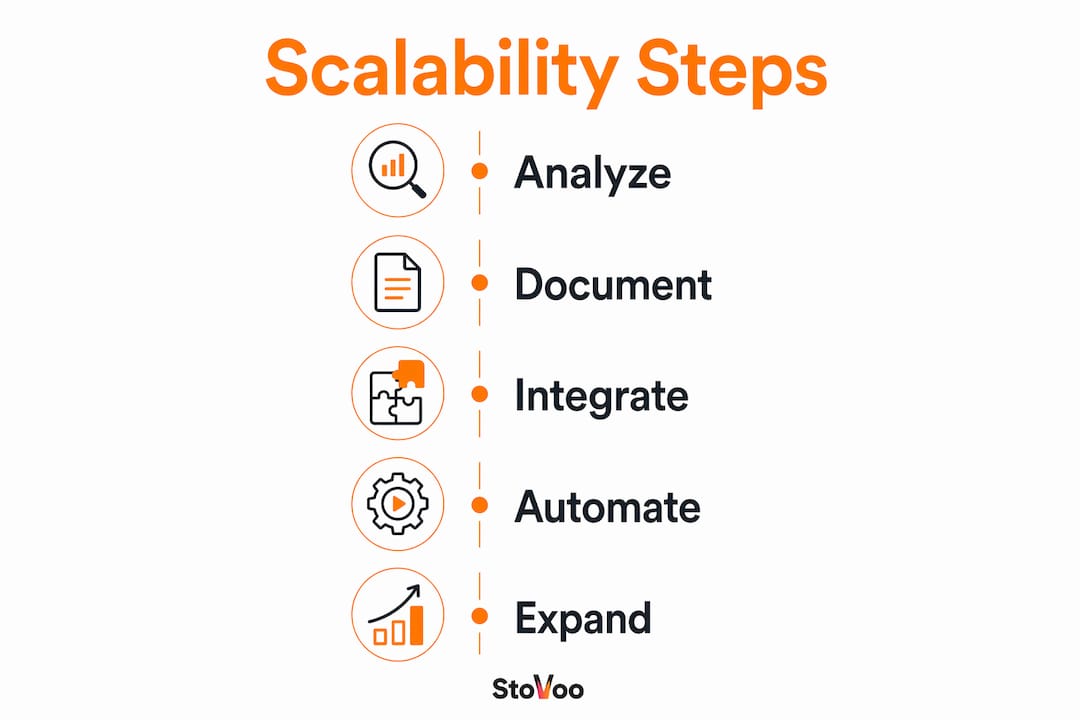
Operations form the scalability mechanism in food businesses. Consistent sourcing, production, quality control, packaging, compliance, and traceability all need to work together. A brand selling 100 units per month can manage with manual systems. At 10,000 units, those same manual systems collapse. The jump from informal to formal operations is not optional at volume; it is the prerequisite.
Key systems that support higher volume include:
- Inventory control: Real-time tracking of ingredients prevents over-ordering and waste, which directly protects margins.
- Quality control checkpoints: Standardized checks at each production stage catch errors before they reach customers.
- Traceability records: Documenting batch numbers, supplier details, and production dates protects the business during recalls or audits.
- Kitchen layout and workflow design: Efficient physical flow reduces prep time per unit and cuts labor cost per meal.
- Scheduling and capacity planning: Knowing your maximum output per shift lets you accept orders confidently and avoid overcommitting.
Integrated tech stacks connecting point-of-sale systems, inventory control, kitchen efficiency tools, and analytics are core enablers for scalable food operations. These systems link data across the business so decisions are based on facts, not guesswork. You can learn more about putting this into practice with food business analytics that connect production data to growth decisions.
Pro Tip: Document your three most repeated kitchen tasks as SOPs before you take on your next big order. If a process only lives in your head, it cannot scale.
How to identify and overcome scalability debt before expanding
Scalability debt is the gap between where your operation is today and where it needs to be to handle higher volume. Identifying scalability debt early is critical to smooth growth. The debt accumulates across four areas: infrastructure, systems, management capacity, and working capital. Each gap is a future crisis waiting to happen.
Signs that scalability debt is holding your food business back:
- Orders regularly arrive late or incomplete. Your fulfillment process cannot absorb demand spikes without errors.
- The founder handles every exception. No one else knows how to resolve a supplier issue or a customer complaint.
- Cash runs short before the next revenue cycle. Working capital gaps mean you cannot buy ingredients to fulfill confirmed orders.
- Quality varies batch to batch. Without documented standards, output depends on who is in the kitchen that day.
- Adding one new client requires hiring one new person. Labor scales linearly with revenue, which kills margins.
Addressing scalability debt before expanding is far cheaper than fixing it mid-growth. Failing to address scalability debt early often results in growth slowdowns or outright failure. Conduct a readiness audit: map every process, identify the steps that depend on a single person, and calculate your true cost per unit at double your current volume.
Cash flow management is a non-negotiable part of this audit. Scaling into larger markets demands consideration of incremental costs like facilities, labor, insurance, and risk transfer. Underestimating total cost-to-serve can compress margins despite sales increases. Build a financial model that shows what happens to profit at 2x and 3x your current volume before you commit to growth.
Pro Tip: Run a "pre-mortem" on your next growth phase. Ask: if this expansion fails in six months, what was the most likely cause? That answer tells you exactly where your scalability debt is.
Common challenges and misconceptions when scaling a food business
The most persistent misconception in food business scaling is that growth and scalability are the same thing. Scaling is not simply doing more work or hiring more staff. Real scalability means revenue grows faster than costs. Hiring one person per new client is growth. Building a system that lets one person serve three clients is scaling.
Food entrepreneurs also frequently scale marketing before fixing operations. Driving more demand into a broken fulfillment process accelerates failure, not success. Operational readiness, including process discipline and systemization, matters more than brand size for maintaining margins and service levels at scale.
Common operational challenges include:
- Production bottlenecks: The slowest step in prep or dispatch limits total throughput. Adding staff upstream of a bottleneck does not fix it.
- Margin compression: New input costs from higher volume, such as bulk packaging, additional insurance, and delivery logistics, can erode profit if pricing does not account for them.
- Inconsistent quality at volume: Without SOPs, quality degrades as output increases, leading to customer churn at the worst possible moment.
- Founder dependency: When the business cannot operate without the owner present, it cannot scale beyond the owner's personal capacity.
- Manual process limits: Spreadsheets and messaging apps work at low volume. They create errors, delays, and blind spots at higher volume.
Scaling bottlenecks relate to the slowest step in production or fulfillment. Measuring time consumed per process identifies constraints before you commit to expansion. Fix the bottleneck first. Then scale.
Practical strategies and technologies to grow a scalable food business
Building a scalable food business requires layered capability growth across infrastructure, partnerships, technology, and funding. Multiple pillars must develop together to support increasing volumes. Investing in one area while neglecting others creates new bottlenecks. The table below compares approaches across key scaling dimensions.
| Scaling dimension | Early-stage approach | Growth-stage approach |
|---|---|---|
| Order management | WhatsApp and spreadsheets | Integrated platform with automated billing |
| Inventory control | Manual counts and memory | Real-time tracking software linked to production |
| Quality assurance | Informal checks by founder | Written SOPs with documented checkpoints |
| Customer management | Personal contacts and notes | CRM with order history and recurring billing |
| Distribution | Self-delivery or ad hoc couriers | Logistics partnerships with volume agreements |
| Financial controls | Monthly bank review | Weekly cash flow tracking with cost-per-unit metrics |
Technology is the fastest lever for food business expansion strategies at the small business level. Connecting your point-of-sale data to inventory and production scheduling removes the manual reconciliation that eats founder time. Platforms that automate recurring orders, billing, and customer communication free you to focus on production quality and new market development.
Partnerships accelerate distribution without proportional capital investment. A catering business that partners with a corporate office building gains predictable weekly volume. A meal prep operation that partners with a local gym gains a recurring customer base. These relationships build volume without requiring new facilities immediately. You can find practical guidance on sustainable cooking business growth that covers how operational readiness supports these partnerships.
Phased scaling is the most reliable approach for small food businesses. Prove the model at current volume, document every process, then expand to the next tier. Scaling up adds business needs and costs, and new input costs must be covered by pricing. Adjust prices before scaling, not after margins compress.
The operational truth about food business scalability
The food entrepreneurs I have seen succeed at scale share one trait: they treated their kitchen like a factory before they needed to. They wrote down every recipe, every prep sequence, every supplier contact, and every quality check before demand forced them to. That discipline felt unnecessary at 50 orders a week. At 500 orders, it was the only reason they survived.
The uncomfortable reality is that most food businesses are not operationally ready to scale when they think they are. Brand recognition, social media following, and strong demand are not scalability. They are pressure. Pressure on a system that is not ready breaks the business, not builds it.
I have watched talented chefs lose loyal customers because they took on more volume than their kitchen could handle consistently. The food was still good. The delivery was late, the portions were inconsistent, and the communication was chaotic. Customers left. The brand recovered, but it took a year.
My honest advice: audit your processes before you pitch to a new client or launch a new product. Find the one step in your operation that would break first under double the volume. Fix that step. Then grow. Incremental, deliberate scaling beats ambitious, chaotic expansion every time. The goal is not to be the biggest food business in your city. The goal is to be the most profitable one at your chosen volume.
— freeman
How Stovoo helps food businesses build for growth
Food entrepreneurs who are ready to move beyond spreadsheets and scattered messaging apps have a clear path forward with Stovoo. Stovoo is built specifically for meal preppers, catering chefs, and small food businesses that want recurring revenue without the administrative chaos.
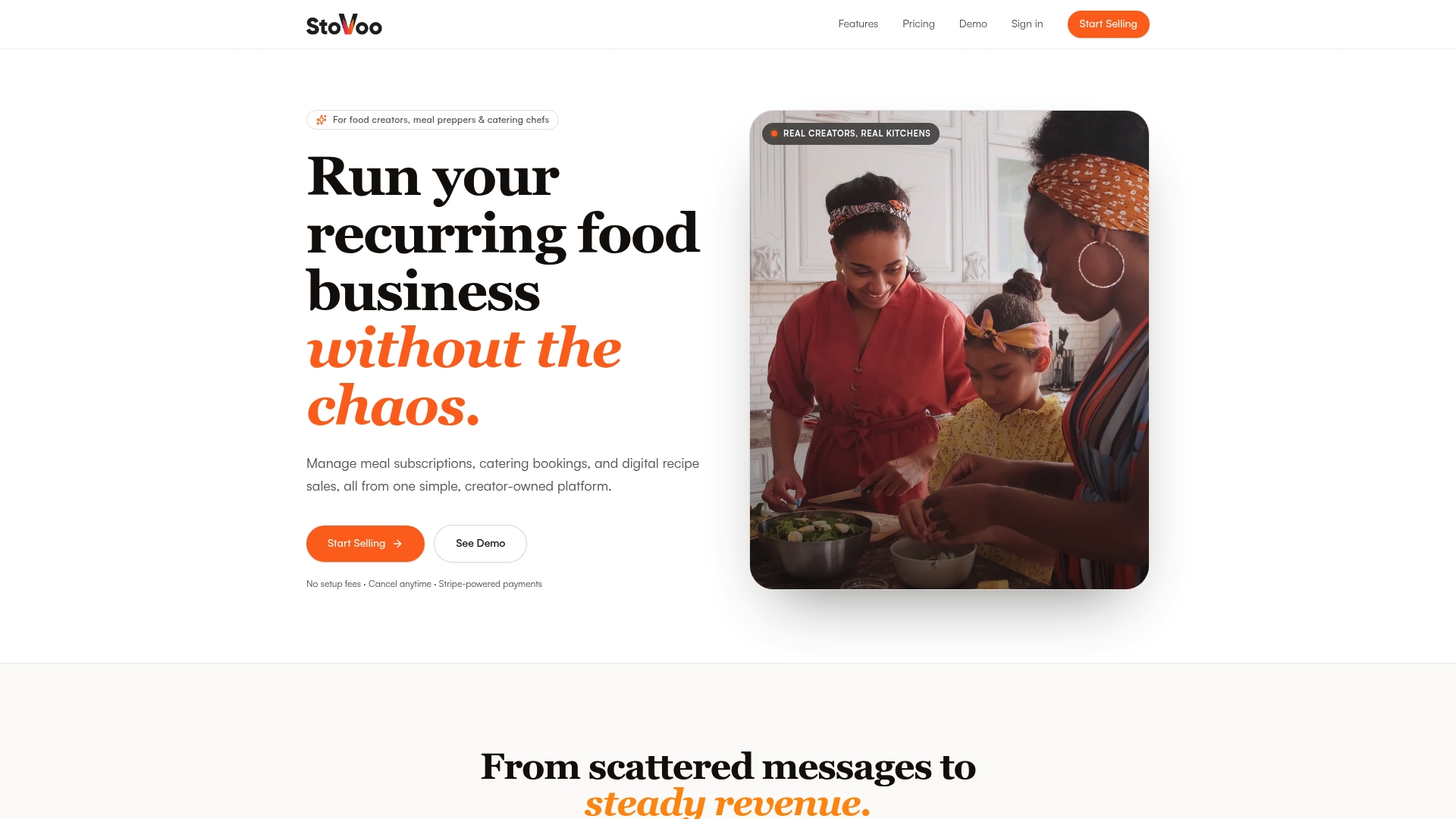
The platform gives you a centralized dashboard to manage meal subscription plans, catering bookings, digital recipe sales, and customer relationships in one place. Automated billing and a mobile-first shopfront mean you spend less time chasing payments and more time in the kitchen. Food businesses on Stovoo, like Radish Chef Food in Lagos and Munawarah Catering in Accra, are already using the platform to build repeatable, recurring operations. Create your account on Stovoo and set up your shopfront today.
Key takeaways
Food business scalability requires building repeatable systems so revenue grows faster than costs, not just adding volume or staff.
| Point | Details |
|---|---|
| Scalability vs. growth | Scalability means revenue outpaces costs; growth alone does not guarantee profit improvement. |
| SOPs are non-negotiable | Documented operating procedures let your business run at volume without depending on the founder. |
| Address scalability debt first | Audit infrastructure, systems, and cash flow gaps before committing to expansion. |
| Fix bottlenecks before scaling | The slowest production step limits total throughput; resolve it before adding demand. |
| Technology connects the operation | Integrated platforms linking orders, inventory, and billing make higher volume manageable. |
FAQ
What is food business scalability?
Food business scalability is the ability to grow revenue and output faster than costs, improving profit without proportional increases in labor or overhead. It is measured by throughput: units or meals produced per hour relative to cost.
How is scaling different from just growing a food business?
Growth means doing more of the same, often with proportionally more cost. Scaling means building systems so each additional unit of output costs less to produce than the last, improving margins as volume increases.
What is scalability debt in a food business?
Scalability debt refers to gaps in infrastructure, systems, management capacity, and working capital that prevent a business from handling higher volume. Addressing these gaps before expanding is critical to avoiding growth failure.
What technology helps food businesses scale?
Integrated platforms connecting order management, inventory control, and customer billing are the most practical tools for small food businesses. Stovoo, for example, centralizes meal plans, catering bookings, and recurring billing in one mobile-first dashboard.
How do I know if my food business is ready to scale?
Your business is ready to scale when your core processes are documented, your cost per unit is stable, your cash flow covers new input costs, and your operation can run without you present for at least one full production cycle.