
TL;DR:
- Effective food marketing involves understanding customer triggers, setting a clear budget before opening, and optimizing local digital profiles. Consistent short-form video content and partnerships with local influencers significantly increase visibility and trust. Regular measurement and adjustment every 30 days sustain growth and ensure marketing efforts yield optimal results.
Food business marketing tips are the specific, repeatable tactics that turn a great product into a growing customer base by combining smart budget use, local digital presence, and content that builds trust. In 2026, integrated marketing systems that connect brand, digital shelf, and measurement outperform scattered ad spend every time. Platforms like Google Business Profile, Instagram, and TikTok are now the primary discovery channels for food buyers. This guide gives you a practical, step-by-step food business marketing checklist built on current data and real-world results.
1. apply the best food business marketing tips before you spend a dollar
The single biggest mistake food startups make is spending on ads before they know why customers buy. Conducting a SWOT analysis and identifying your customer's buying trigger is the required first step. Without that clarity, every dollar you spend on Facebook ads or influencer posts is a guess.

Your buying trigger is the specific moment a customer decides to order. For a meal prep business, it might be Sunday evening when someone dreads cooking for the week. For a catering service, it's the moment someone books a venue. Knowing that trigger tells you exactly where to show up, what to say, and when to say it.
Pro Tip: Before writing a single ad, write one sentence that completes this prompt: "My customer buys when they feel ___." That sentence is your entire marketing strategy in its simplest form.
2. set your marketing budget before you open
Food businesses should allocate 3–5% of projected first-year revenue toward grand opening marketing. That percentage sounds small, but on a $200,000 projected first year, it means $6,000–$10,000 dedicated to getting your name out before you serve your first paying customer.
The timeline matters as much as the amount. Start marketing eight weeks before your opening date. That window gives you time to build awareness, grow a social following, and collect email contacts before you need them to show up and spend money.
Here is how to distribute that budget across channels:
- Weeks 8–5 before opening: Social media setup, Google Business Profile, and teaser content. Cost: mostly time.
- Weeks 4–3 before opening: Paid local ads on Meta or Google, influencer outreach, and email list building.
- Weeks 2–1 before opening: Soft opening invitations, press outreach, and final social push.
- Opening week: Full paid campaign, Google review requests, and user-generated content push.
Pro Tip: Run a 4-night soft opening before your public launch. Use it to test your operations, collect customer contacts, and generate your first Google reviews. Social proof before launch day is worth more than any paid ad.
3. optimize your google business profile for local discovery
Over 80% of restaurant searches in 2026 happen on mobile devices. That single fact means your Google Business Profile is your most important marketing asset, not your website. An optimized Google Business Profile generates twice as many bookings as an incomplete one.
Completing your profile goes beyond adding your address and phone number. Fill in every AI-ready field: popular dishes, highlights, accessibility features, and service options. Add geo-tagged photos of your food and location. Post weekly updates with your current menu or specials. These signals tell Google's local algorithm that your business is active and relevant.
| GBP Element | Why It Matters |
|---|---|
| Geo-tagged photos | Boosts local search visibility |
| Popular dishes listed | Feeds AI and voice search results |
| Weekly posts | Signals active business to Google |
| Consistent NAP data | Builds local search trust |
| Customer review responses | Increases engagement signals |
Your website needs to be mobile-first, not just mobile-friendly. Load time under three seconds, click-to-call buttons, and a menu that does not require zooming are the baseline. For street food vendors and food trucks, real-time location updates on your Google profile and Instagram Stories keep customers from showing up to an empty spot.
Pro Tip: Use Google's "Products" section to list your top menu items with photos and prices. This content feeds directly into Google's AI-generated search summaries, giving you free visibility in the new AI search results.
4. build a social media strategy around short-form video
Short-form video is the top food discovery channel for younger buyers. 40% of Gen Z consumers use TikTok and Instagram Reels to find local food options. That number makes video content a non-negotiable part of any food business growth plan, not a nice-to-have.
The most effective food videos share three traits: they show the food being made or plated, they include a clear local call to action ("Order in Austin, link in bio"), and they feel personal rather than produced. You do not need a camera crew. A phone, good natural light, and a consistent posting schedule beat expensive production every time.
- Show the process, not just the product. A video of dough being stretched or sauce being stirred outperforms a static plate photo every time.
- Post at least three times per week. Consistency builds the algorithm's trust in your account.
- Use location tags on every post. This is how local customers find you.
- Respond to every comment in the first hour after posting. Early engagement signals boost reach.
- Repurpose your best TikTok videos directly to Instagram Reels and YouTube Shorts.
"Mobile food businesses win by leveraging mobility and personality through high-quality, local short-form video rather than outspending larger competitors." — Food Truck Marketing Guide 2026
5. partner with local influencers for trusted reach
63% of consumers trust local influencer recommendations over traditional advertising. That trust gap is the reason a food blogger with 8,000 local followers often drives more real orders than a $500 Facebook ad campaign.
Local micro-influencers, those with 1,000–50,000 followers in your city or neighborhood, are the sweet spot for food businesses. They have high engagement rates, their audiences are geographically relevant, and they typically charge far less than national influencers. Many will work for a free meal or a small fee in exchange for a genuine post.
When you reach out, be specific. Tell them exactly what you want: one Instagram Reel, two Stories, and a saved highlight. Agree on the call to action before the visit. After the post goes live, track the results by monitoring your profile visits, follower growth, and direct messages in the 48 hours following the post.
6. write messaging that converts, not just impresses
Clear, simple menu descriptions drive higher sales than creative or jargon-heavy naming. "Slow-cooked beef stew with roasted carrots" outperforms "Braised Boeuf Bourguignon" for most food business audiences. Your menu is a sales tool, not a culinary thesis.
Build your messaging from four product truths: taste, ingredients, convenience, and value. Every product name, description, and social caption should connect to at least one of those four. Customers buy food for emotional and practical reasons. Your copy needs to speak to both.
- Email marketing: Use it for reorder reminders, new menu announcements, and short stories about your food's origin. A weekly email to 500 subscribers costs nothing and keeps you top of mind.
- SMS marketing: Reserve it for time-sensitive offers. "Today only: 20% off meal prep orders placed before noon" works because it creates urgency without feeling spammy.
- Lifecycle messaging: Send a welcome message when someone orders for the first time. Follow up after their third order with a loyalty offer. These automated touchpoints retain customers without requiring daily manual effort.
Pro Tip: Write your menu descriptions for the person who has never heard of your business. If a stranger can read the name and immediately understand what they are getting and why they would want it, the name works.
7. choose the right marketing channels for your business stage
Not every channel works for every food business. The right mix depends on your business model, your audience's age and habits, and where you are in your growth. Here is a practical comparison to help you decide where to focus first.
| Channel | Best For | Typical ROI | Cost | Best Stage |
|---|---|---|---|---|
| Google Business Profile | All food businesses | Very High | Free | Launch and beyond |
| Instagram/TikTok | Visual food, younger audience | High | Low to Medium | Early growth |
| Email/SMS | Repeat customers, meal plans | Very High | Low | Growth and retention |
| Local influencers | New market entry | High | Low to Medium | Launch |
| Paid search ads | High-intent buyers | Medium to High | Medium | Established |
| Offline flyers/events | Hyper-local, street food | Medium | Low | Launch |
Meal prep businesses and subscription-based food models get the highest return from email and SMS because their customers reorder regularly. Street food vendors and food trucks get the highest return from Google Business Profile updates and short-form video because their customers are searching in real time. Match the channel to the buying behavior, not to what is trending.
8. track results and adjust every 30 days
Effective food marketing requires measurement, not just execution. Integrated marketing systems that include brand, digital shelf, and measurement disciplines consistently outperform fragmented efforts. Measurement is what separates food entrepreneurs who grow from those who stay stuck.
Track three numbers every month: cost per new customer, repeat order rate, and top traffic source. Cost per new customer tells you which channel is working. Repeat order rate tells you whether your product and experience are strong enough to earn loyalty. Top traffic source tells you where to double down.
Set a 30-day review on your calendar. Look at what drove the most orders, cut what did not, and reinvest in what did. This cycle is the actual engine of food business growth tips that compound over time.
Key takeaways
The most effective food business marketing strategy combines a pre-launch budget plan, an optimized local digital presence, and consistent short-form video content to drive discovery and repeat orders.
| Point | Details |
|---|---|
| Budget before you launch | Allocate 3–5% of projected revenue and start marketing eight weeks before opening. |
| Google Business Profile first | Optimize every field and post weekly; it doubles bookings versus incomplete profiles. |
| Short-form video is non-negotiable | 40% of Gen Z finds local food on TikTok and Instagram Reels. |
| Local influencers beat big ads | 63% of consumers trust local influencer picks over traditional advertising. |
| Measure every 30 days | Track cost per customer, repeat rate, and top traffic source to guide reinvestment. |
What i've learned about food marketing that most guides skip
Most food business marketing content focuses on tactics. Very few talk about the order in which those tactics work. After watching dozens of food entrepreneurs launch, the pattern is clear: the ones who struggle spent money before they had clarity. The ones who grew spent time first, then money.
The discipline that matters most is not which platform you use. It is whether you know exactly who you are selling to, what triggers their purchase, and whether your operations can handle the demand your marketing creates. A viral TikTok video that sends 500 people to a website that crashes, or a DM inbox that goes unanswered for two days, destroys the trust you just built.
I have also seen food businesses grow sustainably by doing three things consistently: posting location-specific video twice a week, keeping their Google Business Profile updated in real time, and sending a short email to their list every Sunday. No paid ads. No influencer budget. Just consistency and clarity. That combination builds a customer base that sticks around.
The food marketing strategies that work in 2026 are not complicated. They are just disciplined.
— freeman
How Stovoo helps you focus on marketing, not admin
Running a food business means you are constantly pulled between cooking, managing orders, and chasing payments. Stovoo is built specifically for food creators, meal preppers, and catering chefs who want to spend more time growing their business and less time managing chaos.
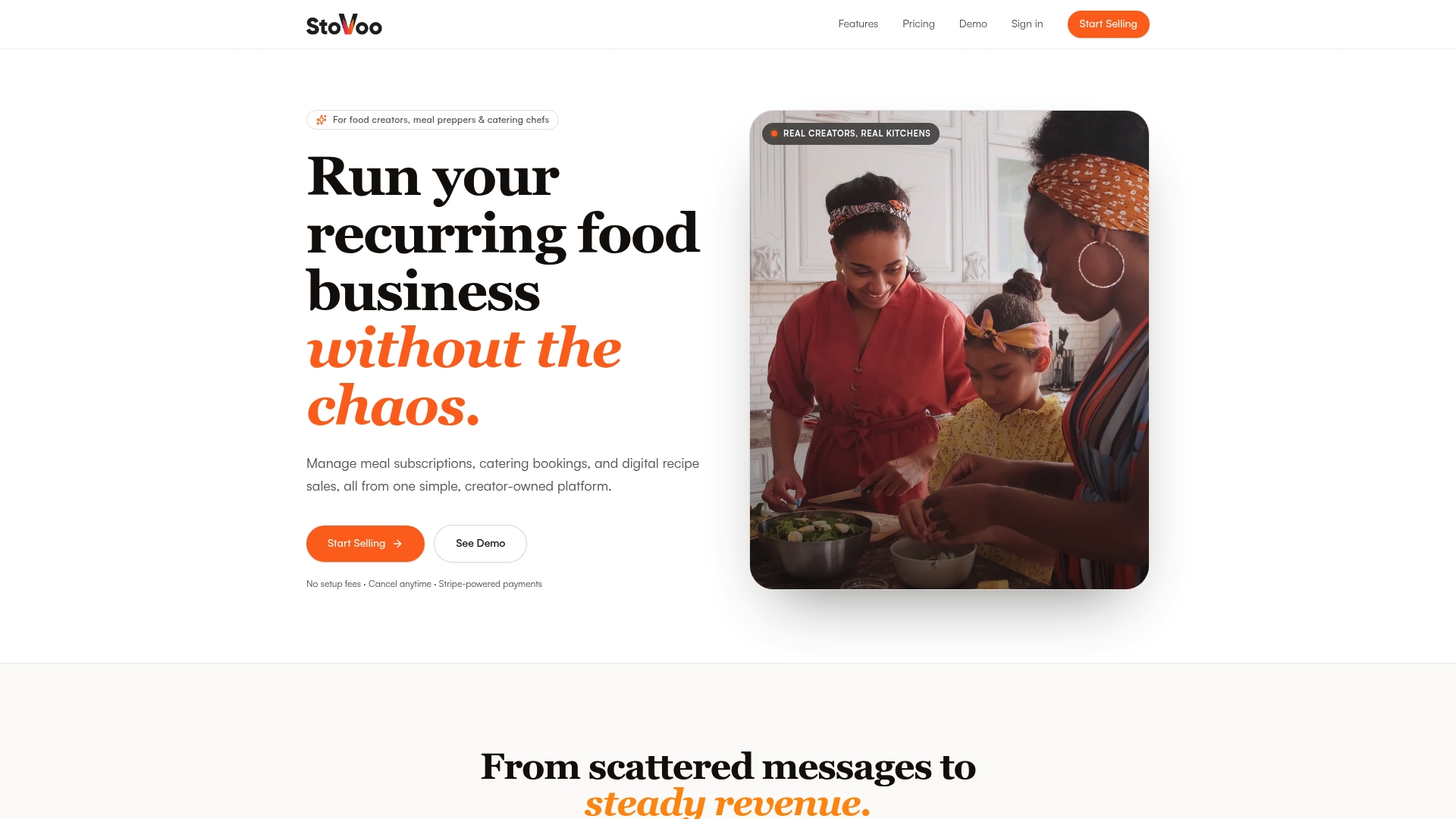
With Stovoo, you get a mobile-first shopfront you can share across Instagram, TikTok, and WhatsApp in minutes. Customers can browse your meal plans and catering options, place recurring orders, and pay automatically, without a single spreadsheet or follow-up message from you. That means every marketing effort you make sends customers to a professional, conversion-ready page. Start building your food business on Stovoo and put your marketing energy where it actually grows revenue.
FAQ
What is the best first step in food business marketing?
Identify your customer's buying trigger before spending on any channel. Conduct a SWOT analysis and define your positioning so every dollar you spend reaches the right person at the right moment.
How much should a food business spend on marketing?
Allocate 3–5% of your projected first-year revenue toward marketing, starting eight weeks before your launch date. This budget covers both free and paid channels across your grand opening period.
Which social media platform works best for food businesses?
TikTok and Instagram Reels are the top platforms for food discovery in 2026, with 40% of Gen Z using them to find local food options. Post consistently with location tags and a clear call to action on every video.
How do i get more local customers to find my food business online?
Complete and actively maintain your Google Business Profile with geo-tagged photos, popular dishes, and weekly posts. Optimized profiles generate twice as many bookings as incomplete ones, making it the highest-ROI free tool available.
What is the fastest way to build trust with new food customers?
Partner with local micro-influencers in your area. Because 63% of consumers trust local influencer recommendations over traditional ads, a single genuine post from a trusted local voice drives more orders than most paid campaigns.