

TL;DR:
- Food business digitalization replaces manual workflows with connected digital systems to improve efficiency. It offers small operators practical tools for inventory management, customer engagement, and process automation. Building a unified digital backbone enables growth and reduces complexity rather than adding isolated tools.
Food business digitalization is defined as the integration of digital technologies into food operations to improve process efficiency, product traceability, and customer engagement. The industry term for this shift is "digital transformation," and explaining food business digitalization means understanding how tools like cloud software, automation, and data systems replace manual, fragmented workflows. A systematic review of 73 studies from 2020 to 2025 confirms that digital solutions play a critical role in food industry margin improvement. For small food business owners, this is not a distant corporate trend. It is a practical path to running a more profitable, organized, and customer-focused operation right now.
What does food business digitalization actually mean?
Food business digitalization means replacing paper records, WhatsApp threads, and spreadsheets with connected digital systems that handle orders, payments, inventory, and customer data automatically. The goal is not technology for its own sake. Digital transformation requires clear operational goals tied to real business outcomes like waste reduction, faster order fulfillment, and better demand forecasting. That distinction matters enormously for small food entrepreneurs who have limited time and budget.
The role of tech in the food industry has expanded well beyond point-of-sale systems. Today it covers the full arc of a food business: from taking a customer's first order to managing recurring subscriptions, tracking inventory levels, and sending automated payment reminders. When these functions connect, you spend less time on admin and more time cooking and growing.
What digital technologies are transforming food business operations?
The core technologies reshaping food businesses fall into four categories. Each one solves a specific operational problem.
- Cloud ERP (Enterprise Resource Planning): A cloud ERP centralizes inventory, finance, and order data in one place. You can check stock levels, outstanding invoices, and sales trends from any device, at any time.
- IoT sensors: Internet of Things sensors monitor temperature, humidity, and storage conditions in real time. For meal preppers and catering businesses, this protects food safety and reduces spoilage losses.
- AI and predictive analytics: Enterprise-wide AI, including digital twins, lets food companies simulate warehousing and production scenarios before committing capital. That saves both time and money.
- Automation platforms: Automated billing, subscription management, and customer communication tools remove repetitive manual tasks from your daily routine.
The critical distinction is between isolated tools and integrated systems. A standalone invoicing app is useful. A platform where invoicing, customer records, and order history all connect is transformational. Fragmented digital modernization increases complexity rather than reducing it. The goal is a unified digital backbone where data flows automatically across your core business functions.
Pro Tip: Before buying any new software, map out which three tasks consume the most time in your week. Choose tools that directly eliminate those tasks first.
How do small food businesses benefit economically and operationally?
The economic case for digitalization is strongest in finance and inventory. Automating invoicing and payment reconciliation delivers among the fastest returns on investment for food businesses. You reduce labor hours, cut payment delays, and get immediate visibility into your cash position.

Operationally, the gains compound quickly. Real-time inventory oversight prevents over-ordering and reduces food waste. Demand forecasting based on actual sales data helps you prep the right quantities each week. Integrated customer management means you know which clients order regularly, which ones lapsed, and what they prefer.
| Benefit area | What changes with digitalization |
|---|---|
| Invoicing and payments | Automated billing replaces manual follow-up and reduces late payments |
| Inventory control | Real-time data prevents over-ordering and cuts spoilage costs |
| Customer management | Centralized records replace scattered WhatsApp messages and spreadsheets |
| Demand forecasting | Sales history drives smarter prep quantities and reduces waste |
| Revenue consistency | Subscription and recurring order tools build predictable weekly income |
Pro Tip: Start with automated billing before anything else. It is the single change that frees the most time and shows the clearest financial return within the first month.
Platforms like Stovoo are built specifically for this transition. Stovoo gives food creators and small catering businesses a single dashboard for meal subscription plans, catering bookings, digital recipe sales, and customer management. You can learn more about simplifying food business admin to see how these gains apply directly to your operation.
What challenges must food entrepreneurs watch out for when digitalizing?
Digitalization carries real risks when approached without a clear plan. The most common pitfall is adopting multiple disconnected tools that do not share data. You end up with more software and more confusion, not less.
- Fragmented tool adoption: Using separate apps for orders, payments, and customer communication creates data silos. You spend time manually transferring information between systems, which defeats the purpose.
- Complexity mismatch: SMEs face unequal access to enterprise-grade AI tools. Software built for large corporations often overwhelms small teams and requires expensive implementation support.
- Technology without strategy: Buying software without defining what operational problem it solves wastes money. The technology must serve a specific goal, not signal modernity.
- Data governance gaps: When customer data lives across WhatsApp, email, and a spreadsheet, you do not truly own your customer relationships. A breach, a lost phone, or a platform policy change can wipe out years of contact history.
- Resistance to change: Even the best platform fails if your team does not adopt it. Training and buy-in matter as much as the software itself.
The solution is to prioritize interoperability and simplicity. Choose platforms designed for food businesses at your scale, not enterprise tools retrofitted for small operators.
How can food business owners successfully implement digital transformation?
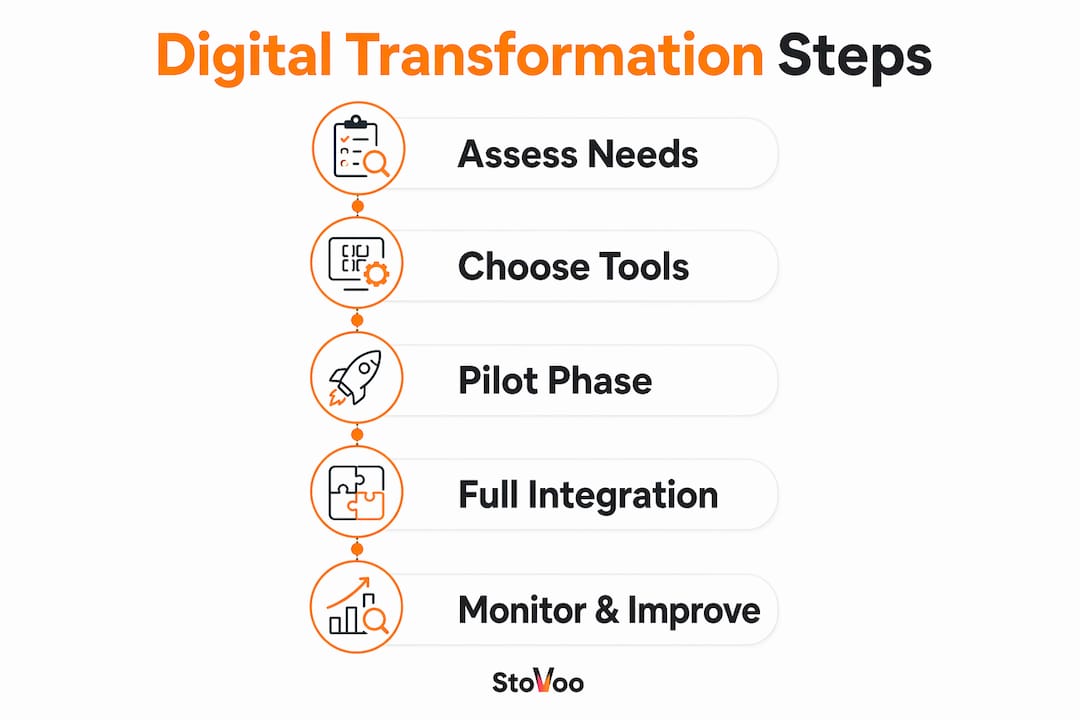
A successful implementation follows a clear sequence. Skipping steps creates the fragmentation problem described above.
- Define your operational goals first. Write down the three biggest inefficiencies in your business. Every digital tool you adopt must directly address at least one of them.
- Build a unified digital backbone. Connect your order management, customer records, and payment systems so data flows between them automatically. Integrated data platforms enable faster, smarter decisions across production, CRM, and finance.
- Automate the highest-impact repetitive tasks first. Billing, order confirmations, and subscription renewals are strong starting points. These tasks happen frequently and consume disproportionate time.
- Choose interfaces your team can actually use. Natural language interfaces are emerging to let employees query operational data by asking plain questions rather than navigating complex menus. This lowers training barriers significantly.
- Plan for scale from the start. A platform that handles 20 weekly meal plan customers should also handle 200 without requiring a system overhaul. Confirm scalability before committing.
- Manage the human side. Communicate the "why" to anyone involved in your operations. People adopt tools faster when they understand the direct benefit to their own workload.
For meal prep businesses specifically, ways to improve meal prep operations in 2026 center on connecting order intake with kitchen scheduling and delivery logistics. When those three functions share data, you eliminate the back-and-forth that eats up hours each week.
Pro Tip: Run a 30-day pilot on one digital tool before rolling out multiple platforms. Measure time saved and errors reduced. Use that data to justify the next investment.
What future trends in food tech should small food businesses watch?
The next phase of food industry digital transformation is already taking shape. Small food business owners who track these trends now will be better positioned to act when the tools become accessible.
- AI-driven value chains: Leading food companies are embedding AI across the full operational chain, from supply forecasting to customer personalization. 83 to 89 percent of studies report positive trends for food safety and waste reduction using digital methods. That evidence base will accelerate adoption.
- Predictive analytics for demand: Sales pattern analysis will move from spreadsheet guesswork to automated weekly forecasts. Small operators will access tools that previously required data science teams.
- Digital traceability and compliance: Regulatory pressure on food traceability is increasing. Digital records that track ingredients from supplier to customer will shift from a competitive advantage to a legal requirement.
- Voice and natural language interfaces: Asking your business software a question in plain English, rather than clicking through menus, will become standard. This makes digital tools accessible to operators with no technical background.
- Personalized customer engagement: Data on order history, preferences, and frequency will power personalized offers and loyalty programs. Food business analytics will move from reporting to active revenue generation.
The businesses that build good data habits now, clean customer records, accurate inventory logs, and consistent order tracking, will have the foundation to use these tools the moment they become affordable at the small business scale.
Key takeaways
Food business digitalization delivers the greatest returns when it connects operations through a unified system rather than adding isolated tools.
| Point | Details |
|---|---|
| Define goals before buying tools | Every platform you adopt must solve a named operational problem, not just add features. |
| Automate billing first | Automated invoicing and payments deliver the fastest ROI for small food businesses. |
| Build a connected backbone | Linking orders, customer data, and finance in one system removes manual data transfer. |
| Match tools to your scale | Enterprise software built for large corporations creates complexity for small operators. |
| Track trends in traceability | Digital traceability is moving from a competitive edge to a regulatory requirement. |
Why the "digital backbone" idea changed how I think about food tech
Most food entrepreneurs I talk to approach digitalization the same way: they find a problem, search for an app, and add it to the pile. After a while, they are running five tools that do not talk to each other, and the admin load is actually heavier than before. I spent a long time thinking the answer was better tools. The real answer is better architecture.
The concept of a digital backbone, where your orders, customers, and money all flow through one connected system, sounds obvious once you hear it. But true success depends on how data-driven insights translate into operational changes that serve customers better, not just on efficiency gains. That reframe matters. You are not digitalizing to save time. You are digitalizing to serve more people, more consistently, with less chaos.
The other thing I would push back on is the idea that small food businesses need to wait until they are "big enough" for digital tools. The opposite is true. A meal prepper with 15 weekly clients who builds clean digital systems now will scale to 150 clients without hiring extra admin staff. The business that waits until it is overwhelmed will spend twice as much fixing the mess. Start simple, start connected, and let the data compound.
— freeman
How Stovoo supports your food business digital transformation
Running a food business on scattered messages and manual invoices costs you hours every week. Stovoo is built specifically for food creators, meal preppers, and catering chefs who want a professional, connected operation without the technical complexity.
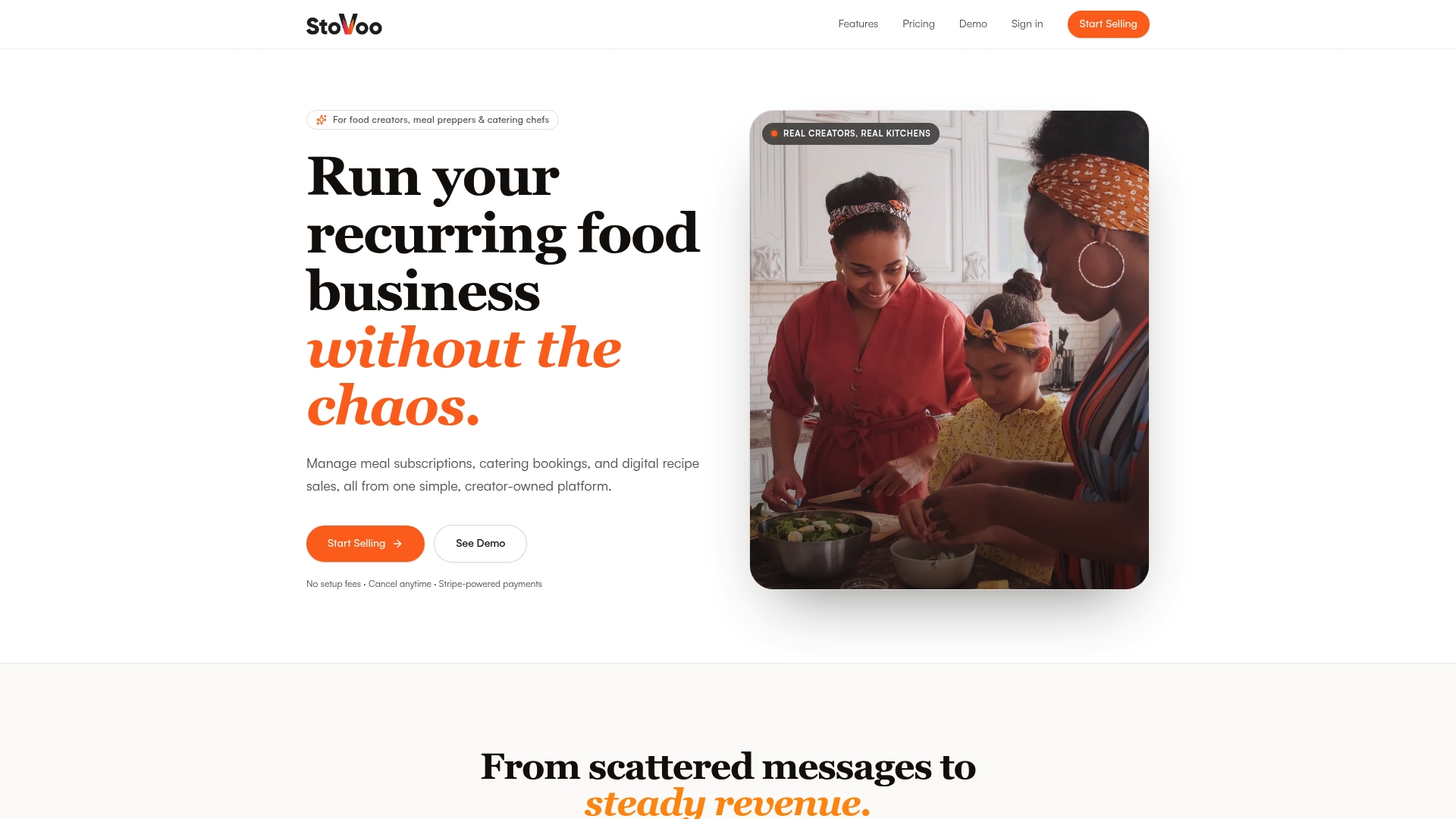
Stovoo gives you a single dashboard to manage meal subscription plans, catering bookings, digital recipe sales, and customer records. Automated billing replaces manual follow-up. A mobile-first shopfront for your food business lets customers order directly, so you own the relationship. You can set up your shopfront, share the link across social media and messaging apps, and start accepting recurring orders the same day. No developer needed, no enterprise budget required.
FAQ
What is food business digitalization?
Food business digitalization is the process of replacing manual, paper-based, or fragmented workflows with connected digital systems that manage orders, payments, inventory, and customer data automatically. The broader industry term for this process is digital transformation.
What are the biggest benefits of digitalization for small food businesses?
The fastest benefits are automated invoicing, reduced manual labor, and real-time inventory visibility. These changes lower operating costs and give business owners immediate clarity on cash flow and stock levels.
What is the most common mistake when digitalizing a food business?
The most common mistake is adopting multiple disconnected tools without a plan for integration. Fragmented systems increase complexity rather than reducing it, and they prevent data from flowing where it is needed.
How do I start digitalizing my food business with a limited budget?
Start by automating one high-frequency task, such as billing or order confirmations. Choose a platform built specifically for food businesses at your scale, and confirm it can connect with other tools you may add later.
What future digital trends matter most for small food businesses?
Predictive demand analytics, digital traceability compliance, and natural language interfaces are the three trends most likely to affect small food operators in the near term. Building clean data habits now prepares you to use these tools as they become accessible.