

TL;DR:
- Effective food business management involves structured routines for finances, safety compliance, staffing, inventory, and customer communication. Implementing digital tools and consistent processes enhances operational control, reduces errors, and promotes business growth. Treating administration as an integral part of service fosters scalability and long-term success.
Food business administration is the full set of daily and periodic management activities that keep a food venture financially sound, legally compliant, and operationally consistent. These duties span financial controls, food safety record-keeping, staff coordination, inventory management, and customer communication. Tools like QuickBooks for accounting, HACCP logs for compliance, and point-of-sale (POS) systems for daily reconciliation are all part of this work. Owners who treat these responsibilities as a structured system rather than scattered paperwork build businesses that scale. Neglecting even one area, such as skipping daily cash reconciliation or ignoring supplier invoice tracking, creates problems that compound fast.
What are the essential financial admin tasks in a food business?
Financial administration is the backbone of any profitable food operation. Stratifying financial tasks across daily, weekly, and quarterly timeframes prevents missed tax deadlines and costly errors. Each tier has a distinct purpose, and skipping any one of them creates gaps that are expensive to fix.
Daily tasks form the foundation:
- Reconcile your POS system against cash on hand. This takes roughly 10 minutes but prevents discrepancies from snowballing into major accounting problems.
- Verify cash flow by checking your bank balance against expected deposits.
- Log any petty cash transactions with receipts attached.
Weekly tasks keep your margins in check:
- Monitor your food cost percentage. A food cost above 35% signals waste, over-portioning, or supplier pricing issues that need immediate attention.
- Process and code all supplier invoices so your accounts payable stays current.
- Review labor costs against revenue to catch scheduling inefficiencies early.
Quarterly tasks protect your business long-term:
- Review menu pricing to reflect ingredient cost changes.
- File sales tax returns and prepare for income tax obligations.
- Audit your profit and loss statement to identify underperforming menu items or service lines.
Tools like QuickBooks, Xero, and Wave handle automated payroll, invoice tracking, and tax preparation for small food businesses. Using one of these platforms removes the manual burden and reduces human error significantly.
Pro Tip: Set a recurring 10-minute calendar block every morning for POS reconciliation. Doing it at the same time each day builds the habit and catches errors before they affect your weekly reports.

How to handle food safety compliance and record-keeping
Food safety compliance is not optional. It is a legal requirement, and the documentation you maintain is proof of due diligence if an inspector visits or a recall occurs.
HACCP (Hazard Analysis and Critical Control Points) is the standard framework food businesses use to identify and control biological, chemical, and physical hazards. Every food business operating under HACCP must document its hazard analysis and monitor its Critical Control Points (CCPs) consistently. The Food Standards Agency recommends retaining food safety records for at least 2 years, with a minimum of 12 months past the shelf life of any perishable product. That retention window exists because inspectors and legal proceedings can surface long after a product leaves your kitchen.
Here is a practical compliance record-keeping process to follow:
- Document your HACCP plan. Record every identified hazard, its CCP, and the corrective action taken when a limit is breached.
- Log temperature checks daily. Use a digital logging system rather than paper to reduce transcription errors and enable real-time alerts.
- Record cleaning and sanitation schedules. Date, time, and staff member responsible should all be captured.
- Maintain supplier and ingredient traceability records. You must be able to produce supply chain documents within four hours for a product recall. That is the "one step up, one step down" traceability standard.
- Review and update your HACCP plan annually or whenever your menu, suppliers, or processes change significantly.
| Record Type | Minimum Retention | Format Recommended |
|---|---|---|
| HACCP hazard analysis | 2 years | Digital log |
| Temperature monitoring | 12 months past shelf life | Digital with timestamps |
| Cleaning schedules | 12 months | Digital or paper |
| Supplier invoices and delivery notes | 2 years | Digital with traceability tags |
| Corrective action reports | 2 years | Digital log |
Pro Tip: Replace paper sign-off sheets with a digital logging app. Photo evidence and timestamped entries are far harder to dispute than a handwritten signature, and they protect you in any compliance review.
What are daily operational admin tasks for staff and service?
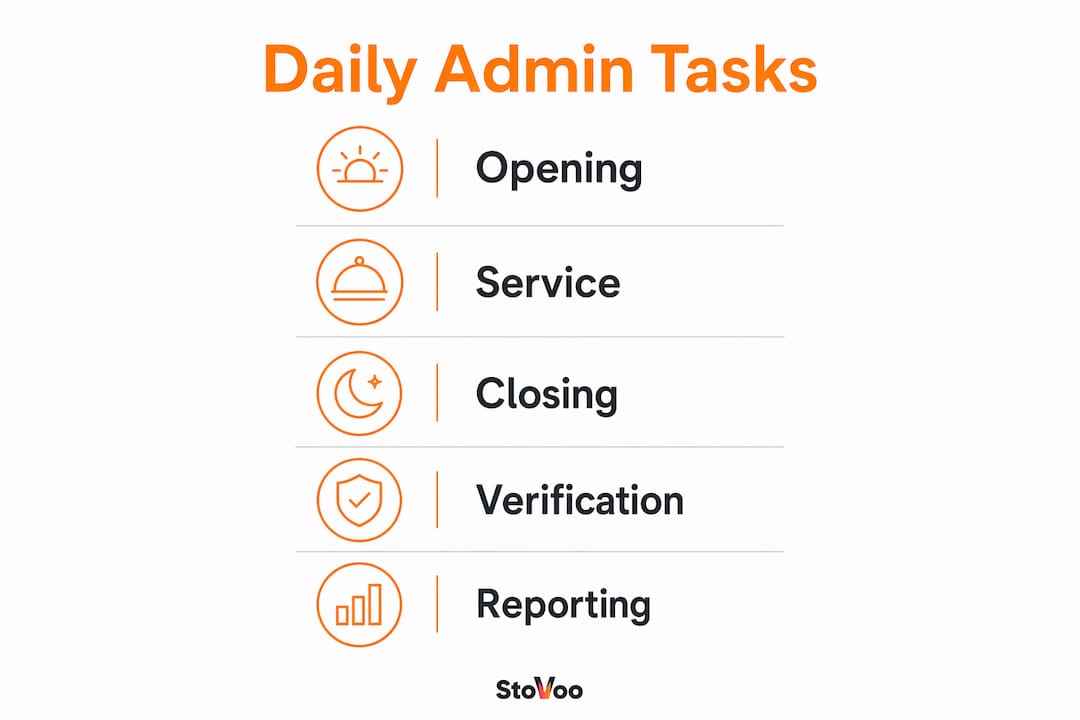
Staff and service management generates the highest volume of daily administrative work in a food business. Getting this right keeps your team productive and your customers happy.
The core responsibilities in food service admin tasks for staff management include:
- Scheduling: Build weekly rosters that match your forecasted covers or order volume. Factor in leave requests, peak hours, and cross-training needs.
- Pre-shift huddles: A 5-minute briefing before each service communicates daily specials, staffing changes, and priority tasks. This is a low-cost way to reduce mid-service confusion.
- Payroll processing: Accurate time tracking feeds directly into payroll. Tools like Deputy and 7shifts automate time capture and integrate with payroll platforms.
- Hiring administration: Writing job listings, screening applicants, scheduling interviews, and onboarding new hires all fall under your administrative responsibilities in the food business.
- Front-of-house and back-of-house communication: Shift handoff notes, prep lists, and closing checklists keep both teams aligned across service periods.
Structuring tasks by service tier makes the workload manageable. Think of it as four tiers: opening tasks, service tasks, closing tasks, and handoff tasks. Each tier has a defined owner and a defined checklist.
| Task Tier | Examples | Verification Method |
|---|---|---|
| Opening | Temp checks, prep verification, cash drawer setup | Photo evidence or digital log |
| Service | Order accuracy, station restocking, customer issue resolution | Real-time dashboard |
| Closing | Cleaning completion, cash reconciliation, waste log | Signed digital checklist |
| Handoff | Prep notes, inventory flags, next-day schedule confirmation | Written shift report |
Digital task management tools allow managers to flag issues in real time and reduce task completion gaps across locations. The shift away from paper checklists to photo-verified task confirmation is one of the most impactful operational changes a food business can make. It eliminates "pencil whipping," where staff sign off on tasks they have not actually completed.
How to manage inventory and supplier coordination
Inventory management is where food businesses lose money silently. Overstock spoils. Understock kills service. Neither shows up immediately on your income statement, but both erode your margins every week.
The core inventory admin duties include:
- Set par levels for every ingredient. A par level is the minimum quantity you need on hand before placing a reorder. Review and adjust these weekly based on actual sales data.
- Match inventory usage to recipe sales. Large discrepancies between what your recipes require and what your stock shows signal over-portioning, theft, or receiving errors.
- Organize supplier invoices and delivery notes. Every delivery should be checked against the purchase order before the driver leaves. Discrepancies logged at delivery are far easier to dispute than those flagged a week later.
- Track supplier performance. Note late deliveries, quality issues, and pricing changes. This data supports renegotiation conversations and helps you identify when to switch suppliers.
- Use software to automate ordering. Platforms like MarketMan and BlueCart connect your inventory counts to automatic reorder triggers, reducing the chance of running out of critical ingredients during a busy service.
Effective meal plan management for food entrepreneurs also depends on tight inventory control. If you run weekly meal prep or subscription boxes, your prep quantities must align precisely with confirmed orders to avoid both waste and shortfalls.
Pro Tip: Conduct a full inventory count on the same day and time each week. Consistency in timing removes variables like mid-week deliveries or prep activity that can skew your numbers.
What communication and customer service admin duties drive success?
Customer communication is a food business administration duty that directly affects your reputation and repeat revenue. Handled well, it builds loyalty. Handled poorly, it generates public negative reviews that cost you new customers.
The key responsibilities here include:
- Monitoring and responding to online reviews. Google, Yelp, and social media platforms require timely, professional responses. A reply to a negative review within 24 hours signals that you take feedback seriously.
- Managing social media interactions. Responding to comments, DMs, and tagged posts keeps your brand visible and builds community. Scheduling tools like Buffer and Later reduce the time this takes.
- Tracking customer feedback systematically. Log complaints and compliments in a shared document or CRM. Patterns in feedback reveal operational issues you might not see from inside the kitchen.
- Coordinating with vendors and partners. Scheduling meetings, confirming delivery windows, and following up on quotes all require consistent communication habits.
- Internal team communication. Shared messaging apps like Slack or WhatsApp groups keep your team connected, but a dedicated platform prevents important operational updates from getting buried in casual conversation.
Strong customer management strategies for meal prep businesses show that owners who respond to feedback within a day and integrate it into their menus see measurably higher retention. Customer communication is not a soft skill. It is a revenue-protecting admin function.
Key takeaways
Effective food business administration requires organizing financial, compliance, staffing, inventory, and communication duties into consistent, repeatable systems rather than treating them as isolated tasks.
| Point | Details |
|---|---|
| Financial tasks need a tiered schedule | Run daily POS checks, weekly cost reviews, and quarterly tax prep to stay on top of your numbers. |
| HACCP records are a legal requirement | Retain food safety documentation for at least 2 years and be ready to produce traceability records within 4 hours. |
| Staff admin runs on structured tiers | Use opening, service, closing, and handoff checklists with photo verification to close accountability gaps. |
| Inventory discrepancies signal real problems | Match stock usage to recipe sales weekly to catch over-portioning, theft, or supplier errors early. |
| Customer communication protects revenue | Respond to reviews and feedback within 24 hours and log patterns to drive operational improvements. |
Why most food owners get admin backwards
Most food entrepreneurs I have worked with treat administration as the thing they do after the real work is done. That mindset is the single biggest reason otherwise talented operators stay stuck at a certain revenue ceiling.
The food businesses that grow consistently are the ones where admin is woven into the service rhythm itself. Pre-service checks, mid-service flags, and post-service reconciliation are not paperwork. They are the operating system of the business. When you skip daily reconciliation because service was busy, you are not saving time. You are borrowing trouble.
The other mistake I see constantly is relying on manual checklists long after the business has outgrown them. A paper sign-off sheet works when you have two staff members and one location. It fails when you have five people, three service windows, and a catering order running simultaneously. Digital tools are not a luxury at that point. They are the only way to maintain visibility without being physically present for every task.
The owners who build real operational control are the ones who stop viewing admin as separate from cooking and start treating it as part of the craft. Your HACCP log is as important as your knife skills. Your weekly cost review is as important as your menu development. Get both right, and the business takes care of itself.
— freeman
How Stovoo takes the chaos out of food business admin
Running a food business means juggling orders, customer messages, billing, and scheduling all at once. Stovoo is built specifically for food creators, meal preppers, and catering chefs who want to manage all of that from one place without the spreadsheet chaos.

With Stovoo, you get a mobile-first shopfront, automated billing for recurring meal plans, and a centralized dashboard for managing customer orders and catering bookings. You own your customer relationships directly, without relying on third-party marketplaces. Whether you run weekly meal plans or a full catering operation, Stovoo gives you the structure to grow without drowning in admin. Start managing your food business the smart way today.
FAQ
What does food business administration include?
Food business administration covers financial management, food safety compliance, staff scheduling, inventory control, and customer communication. These are the core operational duties that keep a food venture running and profitable.
How often should i review food cost percentage?
Review your food cost percentage weekly. A figure above 35% is a signal that waste, over-portioning, or supplier pricing issues need immediate attention.
How long do i need to keep food safety records?
The Food Standards Agency recommends retaining HACCP and food safety records for at least 2 years. For perishable products, records should be kept for a minimum of 12 months past the product's shelf life.
What is the best way to verify staff task completion?
Replace paper sign-off sheets with digital tools that require photo evidence or logged measurements. This eliminates the risk of staff signing off on tasks they have not completed, which is a common compliance gap in food operations.
How can i manage catering admin more efficiently?
Use a dedicated platform to centralize catering bookings, invoicing, and customer communication. Reviewing catering business tips focused on operational structure can also help you build repeatable systems that reduce the time spent on each event.