
Recover more failed payments with a three-layer approach: stop declines before they happen with card updaters, run smart retries only on soft declines, then close the gap with a three-email dunning sequence and CS escalation for high-value accounts. Layered programs like this lift recovery from roughly 50% to 70 to 85%, and most of that recovery happens within the first few days after a decline.
TL;DR:
- Prevents most failures by enabling card updaters and sending pre-expiry reminders, reducing the need for recovery efforts altogether.
- Utilizes staggered, decline-code-aware retries over fixed schedules to recover more soft declines while avoiding ineffective retries on hard declines.
- Implements a short, three-email dunning sequence combined with customer service escalation for high-value accounts to boost recovery rates to up to 85%.
- Regularly tests and monitors webhook delivery and key metrics like recovery rate and involuntary churn to maintain an effective payment recovery system.
- Treats failed payment recovery as an operations discipline, emphasizing automation and proper wiring over manual processes to maximize revenue recovery.
Table of Contents
- The Three-Step Payment Recovery Checklist
- Why Do Payments Fail? Soft vs. Hard Declines Explained
- Preventing Failures Before They Happen
- When Should You Retry a Failed Payment?
- What Should a Dunning Email Sequence Look Like?
- Which Webhooks and Metrics Actually Matter?
- When Should Customer Success Step In?
- A 7-Day Rollout Schedule for Ops Teams
- Why Recovery Works Better as an Operations Discipline
- Sources
- FAQ
The Three-Step Payment Recovery Checklist
Every subscription business should be able to answer three questions: are we preventing failures, are we retrying smart, and are we communicating well? Here's the checklist worth pinning to your ops wiki.
- Prevent: Turn on your processor's card account updater and send pre-expiry reminders before the card even fails.
- Retry: Configure staggered, decline-code-aware retries instead of a single fixed schedule.
- Communicate: Send a Day 1, Day 4, and Day 7 dunning message, each with one clear action.
Prevention alone eliminates a meaningful slice of failures before they ever hit your dashboard. Smart retries pick up the soft-decline stragglers, and dunning closes out whatever's left. Layered recovery programs that stack all three consistently outperform any single tactic run alone. For a small ops team, the priority order is prevention first, retries second, and dunning third, as each layer is generally more cost-effective than the following one.
Why Do Payments Fail? Soft vs. Hard Declines Explained
Not every failed charge is the same problem, and treating them all identically is how recovery programs waste effort. A soft decline is temporary: insufficient funds, a network timeout, or a bank flagging the transaction for extra review. These are worth retrying. A hard decline means the card is dead: stolen, closed, or reported lost. Retrying a hard decline just burns processor goodwill and can trigger fraud flags.
Then there's the murkier middle ground. Expired cards and failed authentication (3D Secure hiccups, for example) sit somewhere between the two. And sometimes a customer sees money leave their account while your system logs a failure. Zoho Payments advises reconciling gateway and settlement records before touching a retry button in these ambiguous cases, since the charge may have actually gone through on the bank's side even though your webhook says otherwise.
Preventing Failures Before They Happen
Prevention is the cheapest layer in the entire playbook, because a payment that never fails never needs recovering. Card account updaters sit at the top of the priority list: they automatically refresh expired or reissued card numbers behind the scenes, often before the customer notices anything changed. Enable this first, before you touch retry logic or email copy.
Pair updaters with pre-expiry messaging. A note at 30 days and another at 7 days before a card's expiration date, each carrying a tokenized update link, catches the cards your updater misses.
A tight checklist for this layer:
- Enable your processor's card updater and confirm it's actually running (many go live but never fire).
- Send 30-day and 7-day pre-expiry emails with a one-click tokenized update link.
- Audit AVS and CVV handling so declines aren't happening due to checkout friction rather than the card itself.
- Monitor webhook delivery so a missed
customer.updatedevent doesn't silently break your update flow.
Pro Tip: Test your tokenized update links quarterly. A broken link in a dunning email is worse than no email at all, because it tells the customer you tried and failed.
When Should You Retry a Failed Payment?
Fixed retry schedules fail for a predictable reason: if a card declines at 2 p.m. because the issuer's fraud system is busy, retrying at 2 p.m. the next day hits the same congestion. Recurly's documentation recommends staggered or machine-learning-based retry timing instead, varying both the day and the hour based on card type and geography.
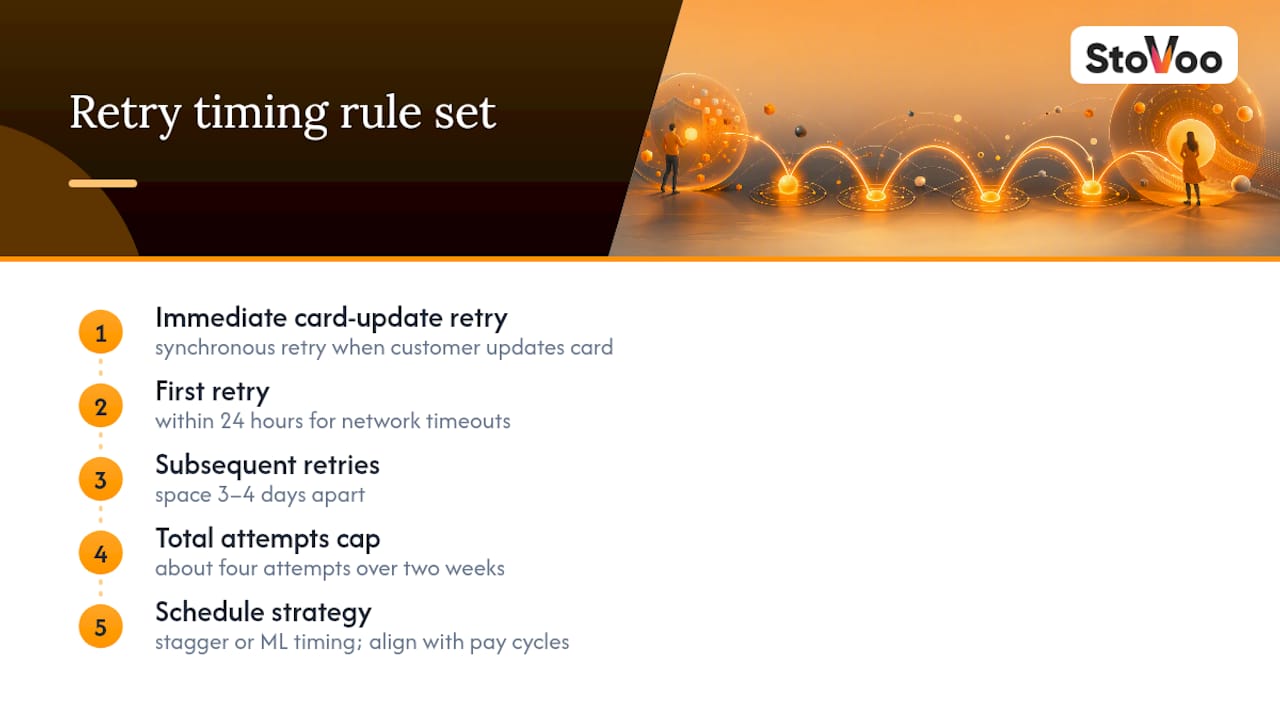
Pay-cycle alignment matters too. A retry scheduled for the days after a typical payday recovers more insufficient-funds declines than one fired on a random weekday. A workable rule set looks like this: attempt one retry within 24 hours for network timeouts, space subsequent attempts three to four days apart, and cap total attempts around four over two weeks.
Decline codes should route the whole decision. Retry soft declines like insufficient_funds, processing_error, and try_again_later. Never retry hard declines like stolen_card, card_not_supported, or do_not_honor — these need a new payment method, not persistence. One high-impact wiring detail: trigger an immediate synchronous retry the moment a customer updates their card, rather than waiting for the next scheduled window.
What Should a Dunning Email Sequence Look Like?
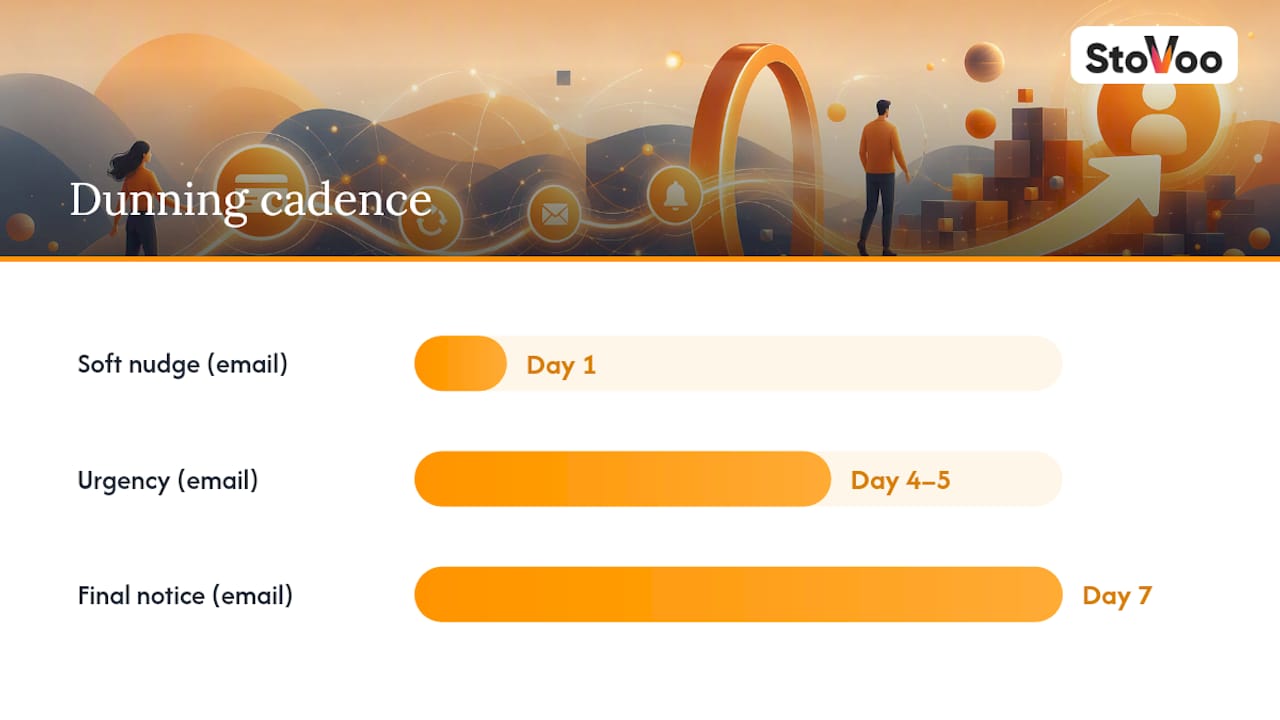
The cadence that works best is short and front-loaded: a soft nudge on Day 1, an urgency message on Day 4 or 5, and a final notice on Day 7. Stripe warns that sending more than three emails within seven days tends to increase churn without notably improving recovery, so resist the urge to add a fourth "just in case" message.
Channel choice should match the customer's engagement level:
- Email stays the default first touch for every failed payment.
- SMS or in-app banners work for customers who are actively using your product, catching them where they already are.
- A human phone call or CS message is reserved for escalations on high-value accounts, not the general dunning flow.
Every message needs one sender name, one clear reason for the failure, one tokenized update link, and exactly one call to action. Combining a staggered retry schedule with this kind of three-email sequence is what regularly pushes recovery into the 70 to 80% range for subscription businesses.
Which Webhooks and Metrics Actually Matter?
Your recovery program is only as good as the events feeding it. Wire payment_failed, payment_succeeded, and customer.updated at minimum, and route each into whatever CRM or billing tag drives your dunning sequence. Without reliable webhook delivery, retries fire against stale data and customers get emails for problems that were already fixed.
Four metrics tell you whether the program is working: recovery rate by channel, time to recovery, involuntary churn as a share of total churn, and attempts to recovery. Involuntary churn typically accounts for 20 to 40% of subscription losses, so tracking that share separately from voluntary cancellations tells you how much of your churn is actually solvable through better plumbing.
For debited-but-unconfirmed transactions, verify settlement status before messaging the customer. A safe line reads: "We're confirming your recent payment. No action is needed yet. We'll follow up within 24 hours."
When Should Customer Success Step In?
Automated retries and email sequences handle most cases, but not the ones that matter most to your revenue. A practical rule: trigger a named CS outreach for accounts above a set MRR threshold on Day 5 or 6, if two dunning messages and automated retries haven't recovered the payment.
The outreach note should include the customer's plan, the failed amount, their payment history, and every automated touch already attempted, so the CS rep isn't repeating a message the customer already ignored.
Not every failure ends in recovery, and that's fine. Build a graceful offboarding path: pause access after repeated failures rather than canceling outright, and only cancel once a customer has ignored the full sequence, including a human touch for high-tenure accounts.
A 7-Day Rollout Schedule for Ops Teams
- Day 1: Enable card account updater and confirm webhook delivery for
payment_failedandcustomer.updated. - Day 2: Configure staggered retry windows and decline-code routing rules.
- Day 3: Draft and schedule the Day 1, Day 4, and Day 7 dunning emails.
- Day 4: Add tokenized update links and test them end to end.
- Day 5: Set the CS escalation threshold and draft the outreach note template.
- Day 6: Run a test failure through the full flow, from webhook to final email.
- Day 7: Review recovery rate and attempts-to-recovery from the test cohort.
Pro Tip: If a test payment doesn't trigger the Day 1 email within an hour, check your webhook queue before touching the email template. Most first-week bugs are wiring issues, not copy problems.
Why Recovery Works Better as an Operations Discipline
Most teams treat failed payment recovery as a support ticket problem instead of an operations system, which is exactly why so much recoverable revenue slips through. The businesses that get this right build the sequencing once, wire the webhooks properly, and let the system run. Stovoo built automated billing and shopfront tools around this same principle for food creators and small food businesses, because a missed weekly meal-plan payment shouldn't require a manual chase every time; learn more about the role of online food ordering for restaurants and customers in streamlining these workflows at Wild Foodz by Hotel Entree Brugge. Treat your retry and dunning logic like plumbing, not paperwork, and the recovery rate takes care of itself.
— freeman
Sources
For implementation details beyond this playbook, go straight to the vendor documentation: Stripe's guide to failed payments, Zoho Payments' recovery steps, Recurly's intelligent retries documentation, and the 2026 dunning playbook from Digital Applied. Food business owners running their own subscription plans can see how automated billing looks in practice by exploring how to create a Stovoo storefront and manage recurring orders directly.
- Failed payments? Here’s what to do | Stripe
- Payment failed: reasons and recovery steps | Zoho Payments
- Intelligent retries | Recurly docs
- Failed-Payment Recovery: The 2026 Dunning Playbook
- Failed Payment Recovery: The Complete Guide for SaaS (2026) | Rezoki
FAQ
What Should I Do if a Payment Fails?
Check the decline code first to see if it's a soft decline worth retrying or a hard decline that needs a new card. Then trigger your dunning sequence so the customer knows what happened and how to fix it.
What's the Best Way to Automatically Retry Failed Payments?
Use staggered retry timing tied to pay cycles rather than a fixed daily schedule, and only retry soft declines like insufficient funds or processing errors. Intelligent retry systems that vary timing by card type and geography recover more than fixed schedules.
What Is Failed Payment Recovery?
Failed payment recovery is the combined process of preventing card declines, retrying recoverable failures, and messaging customers to update their payment details. Layered programs combining all three can lift recovery rates from around 50% to 70 to 85%.
How Do I Fix a Failed Payment as a Customer?
Update your card details through the tokenized link in the dunning email or log into your account to refresh your payment method. Most billing systems trigger an immediate retry the moment the new card is saved, so there's no need to wait for the next scheduled attempt.