

TL;DR:
- Catering revenue streams include corporate contracts, social events, retail products, subscriptions, and experiential setups. Building multiple income sources ensures year-round cash flow stability and supports growth. Focusing on corporate clients first provides reliable revenue that can fund expansion into retail and subscriptions.
Catering revenue streams are the distinct income channels a food business uses to generate profit beyond a single service type. The best examples of catering revenue streams include corporate event contracts, social and family event catering, branded retail products, subscription meal kits, and experiential dining services. Each channel carries its own margin profile, customer base, and operational demands. Caterers who build across multiple income sources protect themselves from seasonal dips and create the kind of cash flow stability that lets them grow with confidence.
1. Examples of catering revenue streams: corporate event contracts
Corporate and office catering is the highest-margin segment in the catering market, accounting for 40–45% of total industry revenue. That share exists because businesses order food repeatedly, not just once. The predictability alone makes corporate accounts worth pursuing above almost every other channel.

The numbers back this up clearly. Corporate decision-makers order at least monthly 78% of the time, and average order values run $200–$350 per event compared to $10–$15 for a single consumer transaction. That gap in order size means one good corporate account can outperform dozens of individual customers.
The most effective sales approach is direct B2B outreach. Targeting 20 recurring corporate accounts can yield $15,000–$50,000 in annual revenue per account. That is not passive income. It requires consistent follow-up, personalized menus, and reliable delivery timing to keep accounts renewing.
Corporate catering covers a wide range of event types:
- Office lunches and daily meal programs
- Training sessions and all-day workshops
- Executive offsites and leadership retreats
- Product launches and client entertainment events
Pro Tip: Build a dedicated corporate sales contact list by industry vertical. Tech companies, law firms, and financial services offices order frequently and value reliability over price. A short pitch email with a sample menu and a clear ordering process closes more accounts than a generic brochure.
2. Social and family event catering as a revenue source
Social event catering covers weddings, birthday parties, anniversaries, and milestone celebrations. This segment represents 35–40% of the catering market and delivers large per-event revenue. The trade-off is complexity. Each event requires heavy customization, and the emotional stakes for clients run high.
Weddings generate large one-off revenue but carry real risk. Corporate lunches and milestone events offer higher repeat potential and lower operational complexity by comparison. A wedding client books you once. A company that hosts quarterly team lunches books you four times a year.
Margin variability is the core challenge in social catering. Last-minute guest count changes, custom dietary requests, and venue logistics all compress profit if you do not price them in from the start. Smart caterers build package tiers that include a base menu, a premium upgrade, and a full-service add-on. That structure makes upselling natural rather than pushy.
Key revenue opportunities in social event catering include:
- Tiered wedding packages with bar service and dessert add-ons
- Birthday and anniversary buffet packages priced per head
- Milestone event bundles covering setup, service, and cleanup
- Referral programs that turn one family event into three bookings
Repeat business in social catering comes from referrals, not from the original client returning. Delivering a flawless experience at one wedding generates bookings from guests who attended. That word-of-mouth effect makes quality execution a direct sales strategy.
3. Branded retail products and private labeling
Retail products are one of the most underused catering business income sources. Branded sauces, spice blends, and meal kits stabilize cash flow during off-peak seasons when event bookings slow down. They also generate revenue without requiring your team to be physically present at an event.
The margin on retail products is typically higher than on catered meals because labor costs are lower per unit. A signature hot sauce bottled in small batches and sold at $12–$18 per unit carries a very different cost structure than a plated dinner. Once the recipe and packaging are set, production scales without adding proportional labor.
Starting small and local is the right move. Sell at farmers markets, through your existing catering clients, or directly from your website. Build demand before investing in commercial production runs. Many successful food entrepreneurs test retail products with their existing catering customer base before expanding to retail shelves.
Retail product ideas that work well alongside catering operations:
- Signature sauces and marinades in branded bottles
- Spice blends and dry rubs packaged for home cooks
- Meal kits with pre-portioned ingredients and recipe cards
- Branded condiment sets sold as corporate gifts
Pro Tip: Offer your retail products as add-ons at catering events. A client who loves your jerk seasoning at their office lunch is a natural buyer for a branded jar to take home. That moment of delight converts a catering customer into a retail customer with zero extra marketing cost.
4. Subscription-based models and recurring revenue
Subscription services give catering businesses what most food entrepreneurs want most: predictable income. A weekly meal plan subscription or a monthly sauce club converts one-time buyers into recurring customers. Subscription programs targeting 50 or more consistent customers reduce seasonal revenue swings significantly.
The mechanics are straightforward. Customers pay upfront or on a billing cycle for regular deliveries. You know your production volume in advance, which reduces food waste and simplifies purchasing. That operational clarity is a genuine financial advantage, not just a convenience.
Platforms like Stovoo make subscription management accessible without requiring technical expertise. Stovoo's centralized dashboard handles automated billing, recurring order tracking, and customer communication. Food entrepreneurs using Stovoo can set up a meal subscription plan and share it directly through social media or messaging apps, removing the friction that kills most subscription launches.
Subscription models that work for catering businesses:
- Weekly meal prep boxes for health-focused households
- Monthly sauce or spice blend clubs for home cooks
- Corporate lunch subscriptions for office teams
- Seasonal recipe and ingredient kits tied to menu themes
The retention benefit compounds over time. A customer who subscribes for three months becomes familiar with your brand, trusts your quality, and is far more likely to book you for a private event. Subscriptions build the relationship that makes upselling easy.
5. Experiential dining and event-based catering
Experiential dining covers private full-buyout events, live food stations, pop-up dinners, and mobile catering setups. These formats command premium pricing because they offer something a standard catering package does not: an experience the guest remembers. Full buyouts should be priced to include not only direct revenue but also a 25–40% exclusivity premium to account for the business turned away.
Live food stations are particularly effective at corporate events. A carving station, a made-to-order pasta bar, or a sushi rolling station creates a focal point that guests engage with directly. That interactivity increases perceived value and justifies a higher price per head than a standard buffet.
Mobile catering vans and pop-up setups add brand exposure as a secondary benefit. Every event becomes a marketing moment. Guests photograph the setup, tag the location, and share the experience. That organic reach builds a pipeline of future bookings without paid advertising.
| Experiential format | Pricing model | Key advantage |
|---|---|---|
| Full venue buyout | Base rate plus 25–40% exclusivity premium | Maximum revenue per event |
| Live food station | Per-head rate with station fee | High perceived value |
| Mobile catering van | Day rate plus travel and setup | Brand visibility and flexibility |
| Private pop-up dinner | Fixed ticket price per guest | Controlled costs and premium positioning |
Bundling multiple meal services for corporate retreats or multi-day conferences is one of the highest-value revenue options for catering businesses. A two-day offsite with breakfast, lunch, and a dinner reception can generate more revenue from a single client than a month of individual lunch orders.
Key takeaways
Diversifying across corporate contracts, social events, retail products, subscriptions, and experiential formats is the most reliable way to build a catering business that generates consistent profit year-round.
| Point | Details |
|---|---|
| Corporate accounts anchor revenue | Target 20 recurring corporate clients for $15,000–$50,000 annual revenue each. |
| Social events need package structure | Tiered packages with upsell options protect margins and simplify client decisions. |
| Retail products extend income off-peak | Branded sauces and meal kits generate revenue without requiring event-day labor. |
| Subscriptions reduce seasonal swings | Recurring billing programs with 50-plus customers stabilize cash flow throughout the year. |
| Experiential pricing commands premiums | Full buyouts and live stations justify 25–40% above standard catering rates. |
What I've learned about balancing multiple catering income sources
The biggest mistake I see catering entrepreneurs make is treating every revenue channel as equally urgent. They chase weddings, launch a sauce line, pitch corporate accounts, and start a subscription box all at once. The result is a business that does half-decent work across five channels instead of excellent work across two.
My honest recommendation: build catering as its own business unit before adding retail or subscriptions. Operators who run catering deliberately with dedicated logistics and account management consistently outperform those who treat it as a side project. Get the corporate pipeline producing reliable monthly revenue first. Then layer in retail and subscriptions as cash flow stabilizers.
Packaging is where I see caterers lose repeat business silently. High-quality, branded packaging is not a luxury expense. It is a customer retention cost that pays back within the first few repeat orders. Cold food and soggy containers kill referrals faster than any pricing mistake.
The caterers who build durable businesses treat direct sales as their primary growth engine. They call corporate contacts, show up at office parks, and follow up after every event. Passive marketing through social media alone does not fill a catering calendar. Relationships do.
— freeman
How Stovoo helps you build multiple catering income sources
Running multiple revenue channels gets complicated fast. Stovoo gives catering entrepreneurs a single platform to manage meal subscriptions, catering bookings, and digital recipe sales without juggling spreadsheets or WhatsApp threads.
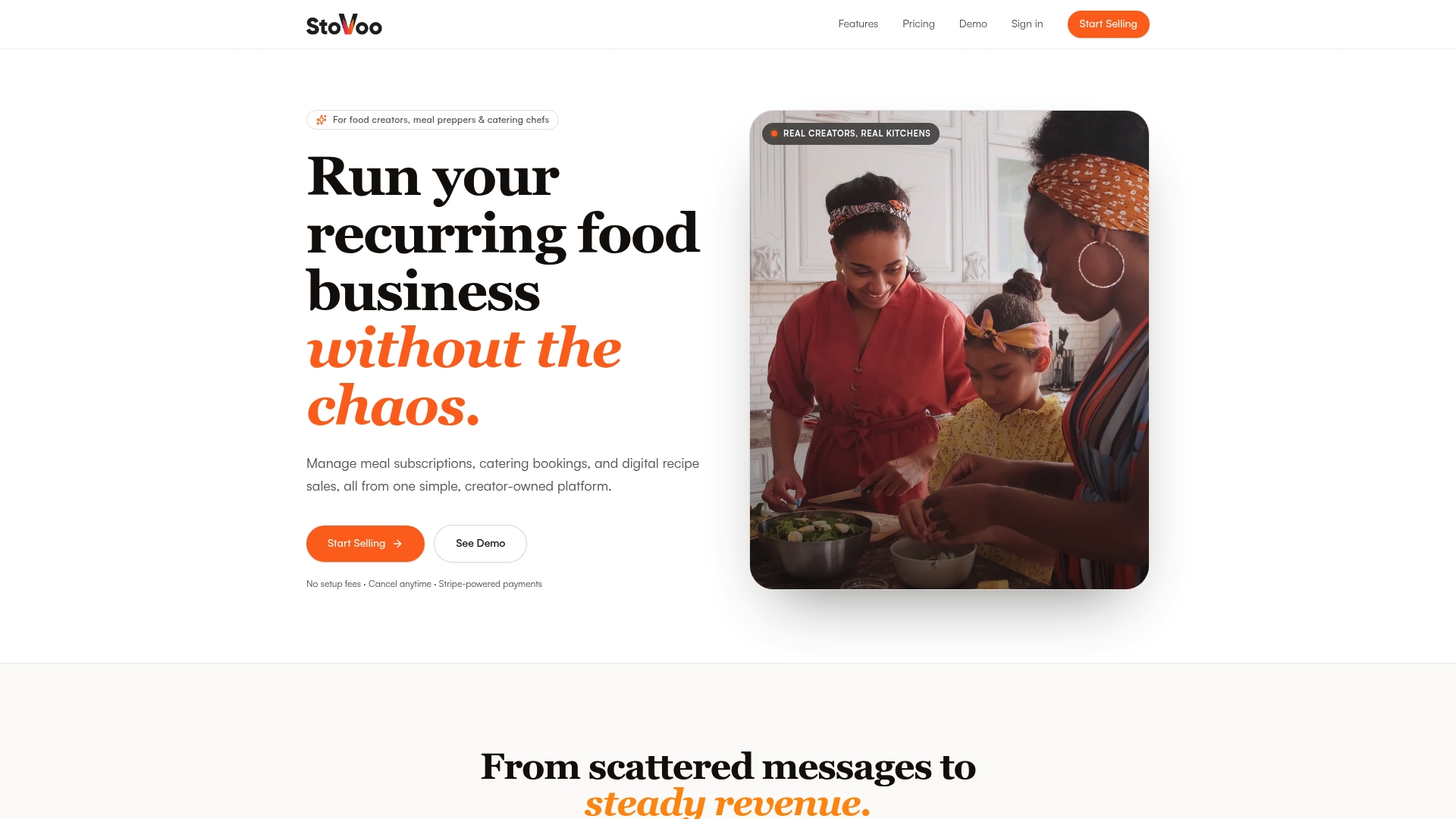
Stovoo's mobile-first shopfront lets you publish your catering menu, subscription plans, and retail products in one place. Customers can browse, book, and pay directly through your personalized link. Automated billing handles recurring orders so you focus on cooking, not chasing payments. Whether you are running weekly meal prep boxes or corporate lunch programs, Stovoo keeps the admin side clean. See how food businesses are already managing catering and meal plans through the platform.
FAQ
What are the most profitable catering revenue streams?
Corporate event catering delivers the highest repeat margins, with average order values of $200–$350 and monthly ordering frequency from most clients. Subscription meal plans and branded retail products add steady income between events.
How do I start a subscription model for my catering business?
Set up a recurring billing plan through a platform like Stovoo, define your weekly or monthly menu, and promote it to your existing catering clients first. Targeting 50 or more consistent subscribers significantly reduces seasonal revenue gaps.
Is social event catering worth the complexity?
Social events like weddings generate large one-off revenue but require more customization and carry higher operational risk than corporate catering. Structuring tiered packages with clear pricing protects your margins and simplifies client decisions.
How should I price a full venue buyout?
Price full buyouts to cover your standard revenue plus a 25–40% exclusivity premium to account for the business you turn away. That premium reflects the real cost of closing your calendar to other clients.
Can retail products really supplement catering income?
Branded sauces, spice blends, and meal kits generate high-margin revenue without requiring event-day labor. Selling them as add-ons at catering events is the fastest way to build a retail customer base from your existing clients.