
Direct response copywriting is persuasive writing engineered to get one specific, measurable action right now. Not brand awareness. Not goodwill. A click, a sign-up, a purchase. Every word earns its place by moving the reader closer to that action, and the copy lives or dies by the numbers it produces.
Use direct response copy when:
- You need a measurable outcome from a specific asset (ad, email, landing page, SMS)
- You're driving paid traffic and every dollar of ad spend must justify itself
- You want to test and iterate based on conversion data, not sentiment
Here's what it looks like in practice. A brand headline reads: "Nourishing meals, crafted with care." A direct-response headline for the same product reads: "Get 5 chef-prepped meals delivered this week. Order by Thursday." The second one uses a clear CTA, a deadline, and a specific benefit. That's the AIDA framework at work: Attention, Interest, Desire, Action, compressed into two sentences.
Key Takeaways
Direct response copywriting converts when the copy leads with the reader's problem, matches the framework to the audience's awareness level, and tests every major element before scaling.
| Point | Details |
|---|---|
| Framework to audience fit | Match PAS or BAB to cold traffic; use AIDPPC for long-form pages with complex offers. |
| Proof placement | Cold audiences need testimonials and guarantees early; warm audiences can move faster to the offer. |
| Conversion benchmark | Landing pages often have a median conversion rate which focused CTAs and A/B testing can help surpass. |
| Specificity wins | Concrete outcomes, real deadlines, and named benefits outperform vague claims in every format. |
| Research before drafting | Voice-of-customer language from reviews and interviews produces copy that converts faster than guessing. |
Table of Contents
- What does direct response copywriting actually cover?
- Which persuasion frameworks should you use?
- What formats does direct response copy appear in?
- Techniques every direct response asset needs
- Ready-to-use templates and a mini swipe file
- How do you measure and test direct response copy?
- How do you become a direct response copywriter?
- What are the legal and ethical rules for direct response copy?
- How do you research your audience before writing?
- How do you integrate direct response copy across multiple channels?
- What are the most common mistakes in direct response copy?
- A practitioner's perspective on direct response briefs
- Sources
- FAQ
What does direct response copywriting actually cover?
Direct response copy spans every channel where a reader can take an immediate action: paid ads, email sequences, landing pages, product pages, SMS, video sales letters, pop-ups, and direct mail. The unifying thread is measurability. As Rob Palmer's guide puts it, this copy is judged by conversion rate, CPA, and ROAS, not by awards or long-term brand recall.
Brand and awareness copy builds identity over months. It's the billboard, the brand film, the tagline that lives in culture. Direct response operates on a different clock entirely. A cold ad runs, traffic hits a landing page, and within days you know whether the copy converted. The feedback loop is tight, and that's the point.
The practical scope covers three common scenarios. A cold paid-traffic ad pre-sells a product before the click, warming the reader enough to land on a page and convert. An email funnel takes warm leads from opt-in through to purchase over a sequence of days. A DTC product page written for paid traffic must do the full persuasion job in a single scroll, because the reader arrived skeptical and will leave in seconds if the opening line doesn't hold them.
The contrast between brand and direct response is sharpest at the headline level. "Taste the difference" is brand copy. "Lose 10 lbs in 30 days or your money back" is direct response. One creates a feeling; the other makes a promise and demands a response.
Pro Tip: When you're unsure whether your copy is direct response or brand copy, ask: "What specific action does this ask the reader to take, and can I measure whether they took it?" If the answer is vague, rewrite the CTA first.
Which persuasion frameworks should you use?
The framework you choose should match where your reader sits on the awareness spectrum, from cold and skeptical to warm and nearly ready to buy.
- AIDA (Attention, Interest, Desire, Action): The workhorse. Works across most formats. Best for readers who are problem-aware but not yet solution-aware. Grab attention with a sharp headline, build interest with the problem or opportunity, create desire with benefits and proof, then close with a direct CTA.
- PAS (Problem, Agitate, Solve): Ideal for cold paid traffic. Open with the reader's pain, amplify the cost of inaction, then present your offer as the relief. Short, punchy, and effective for ads and email openers.
- AIDPPC (Attention, Interest, Description, Persuasion, Proof, Close): Built for long-form sales pages. The added Description and Proof stages give you room to handle objections and stack evidence before the close. Use it when the offer is complex or the price point is high.
- BAB (Before, After, Bridge): Paints a vivid contrast between the reader's current state and their desired future, then positions your offer as the bridge. Excellent for testimonials, email sequences, and video scripts.
- FAB (Features, Advantages, Benefits): A translation tool more than a full framework. Use it to convert product specs into reader-relevant outcomes. A meal-prep service doesn't offer "vacuum-sealed containers"; it offers "meals that stay fresh all week so you never open the fridge to a disappointment."
Cold audiences need more belief-building before you can ask for the sale. That means front-loading proof, testimonials, and risk reversal. Landra's guide to DTC copywriting makes the case clearly: cold readers require stronger guarantees and more social proof than warm audiences, and the pacing of your copy should reflect that. A warm email list can move faster to the offer because trust is already banked.
Offer stacking is a technique that works inside any framework. Instead of presenting a single product, you layer the core offer with bonuses, guarantees, and urgency triggers so the perceived value climbs while the perceived risk drops. It's especially effective on long-form sales pages and webinar closes.
What formats does direct response copy appear in?
Direct response copy shows up across ten core formats, each with its own conversion constraint and common failure mode.
Short ads (social and search): The headline carries almost all the weight. You have one second to stop the scroll. Lead with the problem or the outcome, never the brand name. A weak opening line is the single most common reason short ads fail.
Long-form ads: Used for cold traffic on Facebook and YouTube pre-roll. The opening 3–5 seconds must hook hard enough to earn the next 30. Structure mirrors PAS or BAB: problem, stakes, solution teaser, CTA. Proof comes early because cold readers are skeptical.
Landing pages: The most tested format in direct response. WordStream's copywriting guide notes that direct response copy drives immediate engagement in ecommerce and is measured by short-term conversions. Keep the headline aligned with the ad that sent the traffic, place the primary CTA above the fold, and repeat it at the bottom. One page, one goal.
Lead magnet opt-in pages: Short and specific. The headline names the exact outcome the reader gets. "Download the 5-Day Meal Prep Template" outperforms "Get Our Free Guide" every time. The CTA button should echo the headline: "Send Me the Template."
Email welcome sequences: The first email sets the relationship. Open with a personal, direct line that confirms the reader made the right choice opting in. Deliver the promised value immediately, then introduce the next step. Neil Patel's copywriting guide emphasizes that email copy must respect the opted-in relationship and speak directly to "you."
Promotional emails: Subject line is the headline. Open rates live and die by it. The body should have one offer, one CTA, and a reason to act today. Urgency must be real: a genuine deadline or limited quantity, not a fake countdown.
Product pages (DTC): Written for paid traffic, these pages must handle the full persuasion job. Lead with the outcome, stack proof (reviews, ratings, before/after), address the top objection inline, and close with a clear add-to-cart CTA. For food businesses using a platform like Stovoo, the product page copy directly influences whether a visitor places their first order.
SMS: The most constrained format. Under 160 characters, one link, one action. The message must feel personal, not broadcast. "Your Thursday meal box is ready. Claim it here: [link]" works. "Check out our latest offers!" does not.
"The job of every line of copy is to get the reader to read the next line. The job of the last line is to get them to act." This is the oldest rule in direct response, and it still governs every format from a two-line SMS to a 10,000-word sales letter.
VSL / long-form video scripts: The hook in the first 10 seconds determines whether anyone watches. Script the opening as a bold claim or a provocative question, then follow the AIDPPC structure. Proof and testimonials belong in the middle third, not the end.
Webinar pre-sell pages: Registrants need a reason to show up live. The copy must sell the experience, not just the topic. Name the specific insight or technique they'll walk away with, and use a countdown to the live date as a natural urgency trigger.
Techniques every direct response asset needs
The difference between copy that converts and copy that sits there comes down to a handful of specific techniques applied consistently.
Headline first, always. CXL's principles of effective sales copy confirm that clear, benefit-led headlines materially improve engagement. Write 10 headlines before you commit to one. The best headline usually names the outcome, the audience, or the enemy.

Benefits over features. Features describe the product. Benefits describe the reader's life after the product. "Automated billing" is a feature. "Stop chasing payments every Friday" is a benefit.
"You" language throughout. Writing to "you" keeps the reader in the frame. Every sentence should feel like it was written for one specific person.
Specific CTAs. "Click here" is dead. "Start my free trial," "Get the recipe pack," and "Reserve my spot" are specific, first-person, and action-oriented. According to Neil Patel, personalized CTA language consistently outperforms generic alternatives.
Urgency and scarcity. Real deadlines and genuine limits work. Fake ones erode trust fast. If you have a Thursday cutoff for meal prep orders, say so. If you don't have a real limit, use a reason-why instead: "Prices increase when the beta closes."
Social proof. Reviews, ratings, and customer results placed near the CTA reduce the perceived risk of acting. For hospitality and food businesses, customer reviews carry significant weight in converting skeptical first-time buyers.
Guarantees and risk reversal. A money-back guarantee doesn't just reduce risk; it signals confidence. Place it near the price and the CTA, not buried in the footer.
Formatting for scanners. Short paragraphs, subheads every 200–300 words, and bold key phrases. Readers scan before they read. If the scan doesn't hook them, they leave.
The "even if" technique. Copyhackers identifies this as one of the most effective inline objection-neutralizers. "Lose weight even if you've tried every diet and failed" names the objection and dissolves it inside the benefit statement.
Pre-launch self-edit checklist
- Does the headline name a specific outcome, audience, or problem?
- Is the primary CTA above the fold and repeated at the bottom?
- Have you replaced every feature with its corresponding benefit?
- Does every paragraph use "you" at least once?
- Is there at least one piece of social proof near the CTA?
- Is the urgency trigger real and verifiable?
- Are paragraphs 3 sentences or fewer for mobile readability?
- Have you removed every sentence that doesn't move the reader toward the action?
- Does the guarantee appear near the price?
- Have you read the copy aloud to catch awkward phrasing?
Pro Tip: Run your draft through the Hemingway Editor before publishing. Aim for Grade 8 readability. If a sentence flags as "very hard to read," split it. Simpler copy almost always converts better.
Ready-to-use templates and a mini swipe file
These templates are starting points. Swap in your offer, your audience's specific language, and your proof.
Headline templates
- Benefit angle: "Get [specific outcome] in [timeframe] without [common obstacle]"
- Curiosity angle: "The [unusual thing] that [surprising result] for [audience]"
- Speed angle: "[Outcome] in [short timeframe]. Here's exactly how."
- Social proof angle: "[Number] [audience] already [achieved outcome]. You're next."
Email subject lines
- Welcome: "Here's what you just unlocked, [first name]"
- Cart abandon: "You left something behind"
- Promo: "Ends Thursday: [specific offer]"
- Re-engagement: "Still interested in [outcome]?"
Landing page opening lines
Lead with the reader's problem or desired outcome, not your company name. A strong opener for a meal-prep landing page might read: "You spend Sunday cooking. You spend the week eating the same thing. There's a better way." The structure is: current pain, cost of inaction, implied solution. The next line introduces the offer.
The Copyhackers "even if" technique works especially well in opening lines: "Build a profitable meal-prep business even if you've never sold online before."
CTA micro-templates
- Button copy: "Start my [free trial / order / plan]" / "Get [specific thing] now" / "Reserve my spot"
- Surrounding micro-copy: "No contracts. Cancel anytime." / "Join [number] [audience] already inside." / "30-day money-back guarantee."
How do you measure and test direct response copy?
Every direct response asset produces data. The question is which metrics to watch and what they tell you.
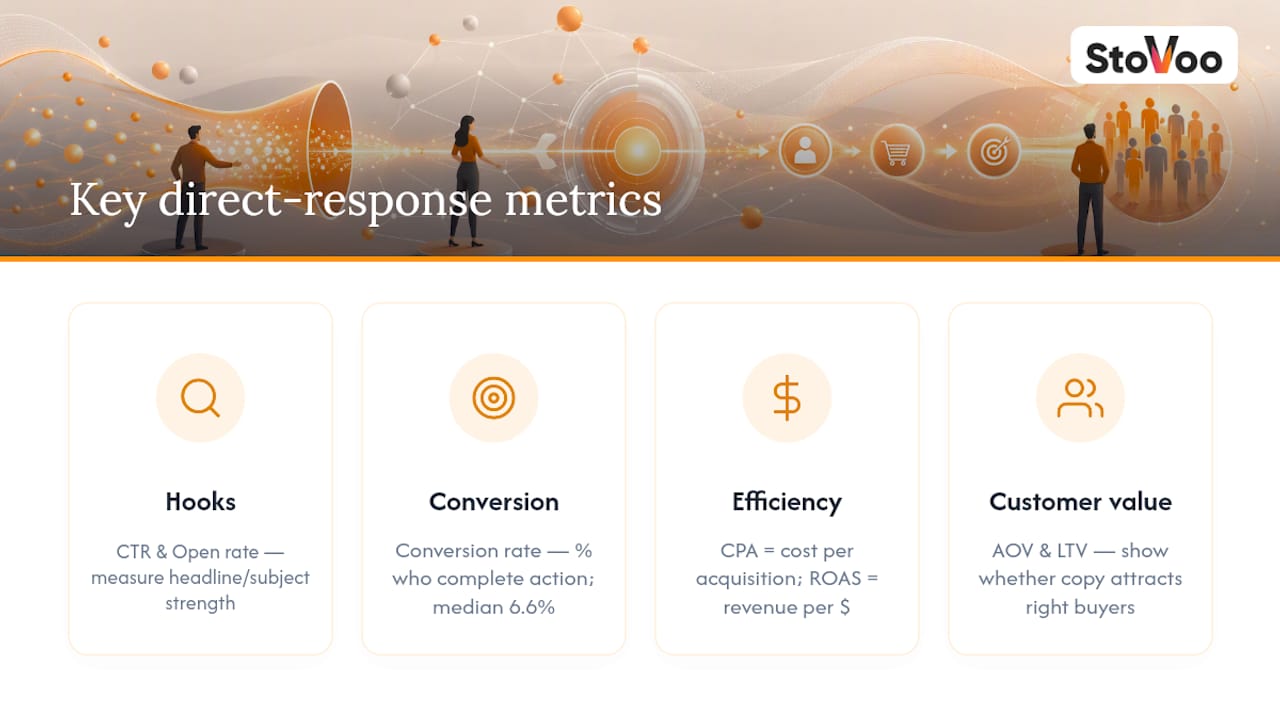
CTR (click-through rate): Measures headline and creative strength. A low CTR on an ad means the hook isn't working, not the landing page.
Open rate (email): Measures subject line performance. If open rates drop, test the subject line before touching the body copy.
Conversion rate: The core metric. Percentage of visitors who complete the desired action. The Unbounce conversion benchmark puts the median landing page conversion rate at 6.6%. Direct response pages that are well-optimized aim to beat that through focused CTAs and iterative testing.
CPA (cost per acquisition): What you pay to get one customer. Drives budget decisions and tells you whether the copy is profitable at scale.
ROAS (return on ad spend): Revenue generated per dollar of ad spend. The ultimate efficiency metric for paid campaigns.
AOV and LTV: Average order value and lifetime value tell you whether the copy is attracting the right buyers, not just any buyers.
A/B test examples
Test 1: Headline vs. headline. Hypothesis: "A benefit-led headline ('Get 5 meals prepped by Thursday') will outperform a feature-led headline ('Weekly meal prep service') by increasing landing page conversion rate." Run with equal traffic split until each variant reaches at least 500 visitors. Expect 2–4 weeks for statistically meaningful results on moderate traffic.
Test 2: CTA button copy. Hypothesis: "First-person CTA copy ('Start my plan') will outperform second-person copy ('Start your plan') by increasing button click rate." This is a fast test; meaningful signal often appears within 1–2 weeks on a high-traffic page.
HubSpot cites an IDC finding that roughly half of abandoned purchases are tied to missing information. That's a direct argument for testing information density: add a FAQ section or an objection-handling paragraph near the CTA and measure whether abandonment drops.
| Metric | Benchmark / Reference |
|---|---|
| Median landing page conversion rate | 6.6% (Unbounce, via WordsmithDirect) |
| Purchases abandoned due to missing info | A significant share of purchases are abandoned due to missing information, according to an IDC study cited by HubSpot. |
Timeline and cost signals: A landing page typically takes 8–16 hours to write and 1–2 weeks to test meaningfully. An email sequence of 5 emails runs 6–10 hours of writing time. A VSL script (2,000–4,000 words) takes 12–20 hours. Production costs for freelance copy in the US range widely by experience level, covered in the next section.
How do you become a direct response copywriter?
The path is more practical than academic. You build a portfolio by writing, not by waiting for clients.
Portfolio essentials to show:
- One landing page (real or spec) with a clear offer, headline, and CTA
- A 3–5 email welcome or nurture sequence
- Two to three ad creatives (short-form and long-form versions)
- A VSL outline or script excerpt
- If possible, performance data: even a mock A/B test with a hypothesis and projected outcome shows analytical thinking
Where to find clients:
- Freelance marketplaces (Upwork, Contra) for early traction and reviews
- Cold outreach to DTC brands, info-product creators, and food businesses running paid ads
- Content marketing: publish one strong article on a direct response topic and let inbound do the work
- Referrals: one happy client in a niche often leads to three more
US rate ranges (2026 estimates, freelance market):
- Single email: $150–$500 depending on complexity and list size
- 5-email welcome sequence: $750–$2,500
- Landing page: $500–$3,000
- Long-form sales letter (5,000+ words): $2,500–$10,000+
- VSL script: $1,500–$6,000
These ranges reflect the broad US freelance market. Rates at the high end require a track record of measurable results, not just polished samples.
Packaging your offers: Project pricing works for one-off assets. Retainers (monthly email copy, ongoing ad creative) create predictable income. Revenue share arrangements, where you earn a percentage of sales your copy generates, are possible once you have a strong track record and a client willing to share data. Start with project pricing, move to retainers as relationships deepen.
The income ceiling for direct response copywriters is genuinely high. Reaching $10,000 per month is achievable with 3–5 solid retainer clients or a combination of project work and performance deals, but it typically takes 12–24 months of consistent client work and portfolio building to get there.
What are the legal and ethical rules for direct response copy?
Direct response copy operates under real legal constraints in the United States, and ignoring them is expensive.
The FTC Act prohibits deceptive advertising. Any claim in your copy must be truthful, substantiated, and not misleading. "Lose 30 lbs in 30 days" requires clinical evidence. "Customers report losing weight" requires that those customers actually exist and said that. The FTC's endorsement guidelines require clear disclosure when a testimonial is paid or incentivized.
CAN-SPAM governs commercial email. Every promotional email must include a physical mailing address, a clear unsubscribe mechanism, and an honest subject line. Misleading subject lines are a violation, not just a bad practice.
TCPA governs SMS marketing. You need explicit written consent before sending promotional texts. Violations carry per-message fines that add up fast.
Ethically, the line between persuasion and manipulation runs through honesty. Urgency is ethical when the deadline is real. Scarcity is ethical when the limit is genuine. Fabricated countdown timers and invented stock limits are deceptive and, in some contexts, legally actionable.
For food businesses specifically, health claims on product pages and emails are regulated by the FDA. "Supports gut health" requires substantiation. "Cures digestive issues" is a drug claim and is prohibited for food products.
This article provides general information about copywriting practices and is not legal advice. Confirm current FTC, CAN-SPAM, and TCPA requirements with a qualified attorney before launching campaigns.
How do you research your audience before writing?
The copy that converts is written in the reader's own language, not yours. Audience research is where that language comes from.
Customer avatar development starts with demographics (age, location, income, role) but the real work is psychographic: what does this person fear, want, and believe? What have they already tried? What objection will they raise before they buy?
Practical research methods that work:
Amazon reviews for products in your category. Read the 3-star reviews. They tell you exactly what buyers wanted and didn't get, which is your copy's job to address.
Reddit and Facebook groups where your audience hangs out. Search for threads about the problem your product solves. Copy the exact phrases people use. "I'm so tired of spending Sunday cooking just to eat the same bland meal all week" is a headline waiting to happen.
Customer interviews. Ten 20-minute calls with existing customers will surface more usable copy than a month of guessing. Ask: "What were you struggling with before you found us?" and "How would you describe what we do to a friend?"
Survey tools like Typeform or Google Forms sent to your email list. One open-ended question: "What's the biggest challenge you face with [problem]?" generates raw voice-of-customer language.
Review mining from your own product page, Trustpilot, or Google reviews. The specific words customers use to describe results are your most credible copy.
Once you have the research, build a one-page customer avatar: name, situation, top 3 fears, top 3 desires, biggest objection, and the exact phrase they'd use to describe their problem. Every piece of copy you write gets checked against that avatar before it goes live.
How do you integrate direct response copy across multiple channels?
A multi-channel campaign works when every touchpoint speaks the same language and moves the reader toward the same action. The failure mode is treating each channel as a separate campaign with its own message.
Start with a single big idea: one core claim, one mechanism, one promise. That idea should be expressible in one sentence. Everything else, the ad, the email, the landing page, the SMS, is a different angle on the same idea.
Message sequencing matters. A cold Facebook ad introduces the problem. A retargeting ad introduces the solution. A landing page closes the argument. A follow-up email handles the objection the reader had when they left without buying. Each channel picks up where the last one left off.
Traffic source alignment is non-negotiable. The headline on your landing page must match the promise in the ad that sent the traffic. A mismatch between ad copy and landing page copy is one of the fastest ways to kill conversion rates. For food businesses driving traffic to a Stovoo shopfront, the copy on the ad and the copy on the product page need to speak the same language.
Email as the conversion engine. Paid ads bring cold traffic to a landing page. The landing page captures an email. The email sequence converts. This is the standard direct-response funnel, and email is where most of the persuasion work actually happens. Food business marketing strategies that treat email as an afterthought leave significant revenue on the table.
For food creators and meal preppers, online ordering behavior is shifting fast. Trends in online food ordering show that customers increasingly expect a frictionless digital experience from discovery to checkout, which means the copy at every touchpoint needs to reduce hesitation, not add steps.
Consistency across channels doesn't mean identical copy. It means the same tone, the same promise, and the same CTA logic. A reader who sees your Facebook ad, visits your landing page, and opens your welcome email should feel like they're talking to the same person throughout.
What are the most common mistakes in direct response copy?
Most copy that underperforms makes the same handful of errors.
Leading with the product, not the reader. The most frequent mistake is opening with "We are a meal prep company that..." Nobody cares about you yet. Open with the reader's problem or desired outcome, then introduce the offer as the solution. Landra's DTC guide frames this clearly: effective direct response starts with the reader's problem, stakes, and after-state in their language.
Weak or vague CTAs. "Learn more" and "Click here" tell the reader nothing about what happens next. Specific CTAs convert better because they reduce uncertainty. "Get my weekly meal plan" is better than "Sign up."
Burying the offer. In long-form copy, writers sometimes spend so much time building context that the offer doesn't appear until the reader has already left. The offer should be visible early, even if the full argument comes later.
Fake urgency. A countdown timer that resets every time the page loads destroys trust. Readers notice. Use real deadlines tied to real events: order cutoffs, cohort start dates, limited inventory.
Ignoring mobile. More than half of email opens happen on mobile. Long paragraphs, tiny fonts, and single-column layouts that don't reflow kill readability. Write and preview every asset on a phone before publishing.
Skipping the proof. A bold claim without evidence is just noise. Every major claim needs a testimonial, a data point, or a case result near it. CXL's research on sales copy confirms that customer-focused language and credible proof materially improve engagement.
Matching the wrong framework to the audience. Using a fast-paced BAB structure on cold traffic that needs belief-building is a common mismatch. Cold audiences need more proof and more pacing before the offer lands.
A practitioner's perspective on direct response briefs
The most useful thing I've learned writing direct response copy is that the research phase is where the copy actually gets written. By the time you sit down to draft, you should already know the reader's exact words for their problem, the objection that kills the most sales, and the one result that made your best customers loyal. The draft is just organizing what you already know.
My brief workflow runs like this: research first (reviews, interviews, competitor ads), then a single "big idea" sentence that names the villain or the hidden cause, then a draft that follows the chosen framework, then a proof stack (testimonials, data, guarantee), then a test plan with at least two headline variants. The copy doesn't go live without a test hypothesis attached.
One small case insight: a food creator running a weekly meal subscription rewrote their landing page opener from "Fresh, healthy meals delivered to your door" to "Stop spending Sunday in the kitchen. Your week's meals are ready Wednesday." Conversion rate on the page improved meaningfully. The change wasn't the offer or the price. It was specificity: a concrete day, a concrete problem, a concrete relief. The offer was strong all along; the copy just hadn't made it feel inevitable.
For cold paid traffic specifically, the rule I always apply is: assume the reader has been burned before. They've tried the thing you're selling, or something like it, and it didn't work. Your copy's job is to explain why this time is different, with proof, before you ask for anything.
Sources
- Ultimate Guide to Copywriting | Neil Patel
- Copywriting 101 | WordStream
- 7 Principles of Effective Sales Copy | CXL
- 3 essential copy techniques | Copyhackers
FAQ
What is a direct response copywriter?
A direct response copywriter writes persuasive copy designed to generate a specific, measurable action, such as a purchase, sign-up, or click, rather than building general brand awareness. They work across ads, emails, landing pages, and sales pages, and their results are judged by conversion rate, CPA, and ROAS.
What are direct response copywriting examples?
Common examples include a Facebook ad that drives clicks to a landing page, a 5-email welcome sequence that converts new subscribers into buyers, a product page written for paid traffic, and an SMS with a single offer and a direct link. Each one asks for one specific action and can be measured immediately.
How do you become a direct response copywriter?
Build a portfolio with at least one landing page, a short email sequence, and two or three ad creatives, then find early clients through freelance marketplaces or cold outreach to DTC brands. Rates for US freelancers range from $150–$500 for a single email to $2,500–$10,000+ for a long-form sales letter, depending on experience and results.
Can you make $10,000 a month with copywriting?
Reaching $10,000 per month is achievable with 3–5 retainer clients or a mix of project work and performance deals, but it typically takes 12–24 months of consistent client work and a portfolio that demonstrates measurable results.
What is the difference between direct response and brand copywriting?
Brand copy builds identity and awareness over time with no immediate measurable action required. Direct response copy asks for a specific action right now and is evaluated by conversion metrics like CTR, conversion rate, and CPA, not by sentiment or recall scores.