
TL;DR:
- Recurring income in food includes subscriptions, CSA boxes, catering retainers, wholesale contracts, and digital products. Pricing should follow a 3x ingredient cost rule and ensure an hourly wage of at least $25; legal compliance requires understanding state cottage food laws and permits. Stovoo automates billing, order management, and customer ownership, simplifying the launch and growth of sustainable food revenue streams.
Steady income in food means revenue that arrives on a predictable schedule without requiring you to resell from scratch every week. Think weekly meal-plan subscriptions, CSA boxes, catering retainers, recurring wholesale contracts, and digital recipe sales. Before you build any of it, do three things: confirm your state's cottage food rules and annual revenue cap, set a pricing floor using the 3x ingredient-cost rule with a $25/hr labor check, and collect customer contact details at every point of sale so you can convert one-time buyers into subscribers.
What this guide covers:
- The main recurring-income models and when each fits your business
- A pricing formula with a worked example
- U.S. legal and compliance basics
- The operational tech you need to run subscriptions without chaos
- Key metrics (MRR, churn, LTV, AOV) and how to move them
- A 90-day launch plan from market test to paid pilot
Table of Contents
- What counts as a steady income stream in food?
- How to price recurring food offers so you actually pay yourself
- What U.S. legal basics do you need before you launch?
- What tech and operations do you need to run recurring revenue?
- Which metrics tell you if your recurring model is working?
- How do you launch a recurring revenue pilot in 90 days?
- Key Takeaways
- Why most food creators stay stuck at the market table
- Stovoo turns your recurring food offers into a real business
- Useful sources
- FAQ
What counts as a steady income stream in food?
Defining steady income streams in food comes down to one question: does the revenue repeat without a fresh sales effort each cycle? Here are the main models and when each one makes sense.
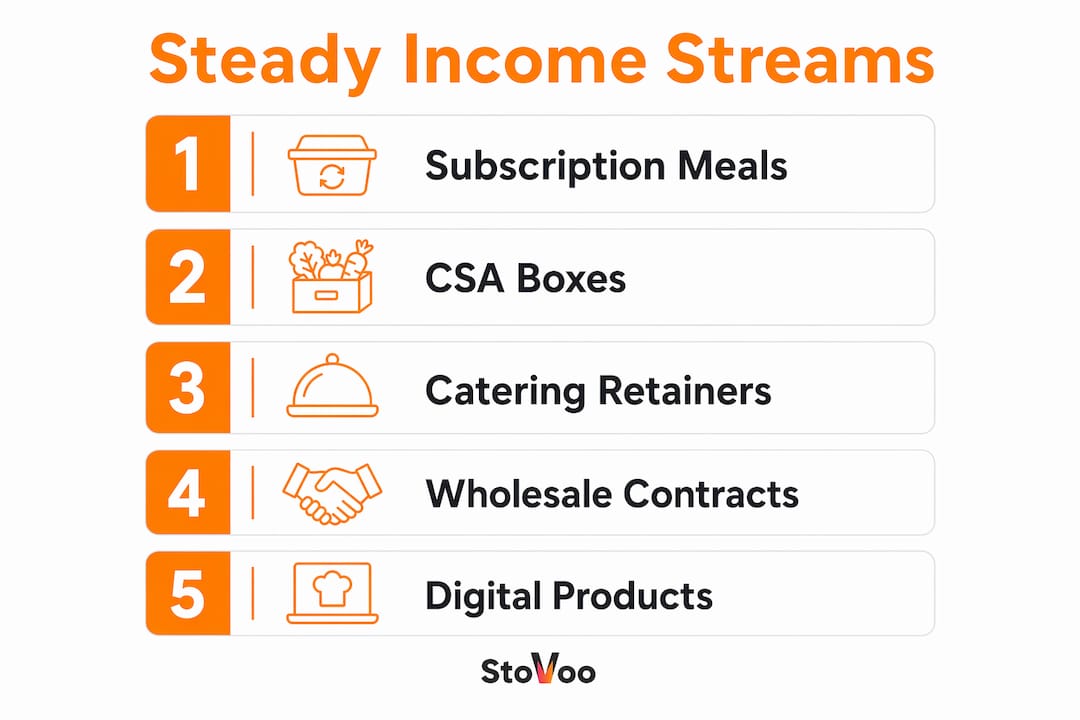
Subscription meal plans. Weekly or biweekly prepared-meal boxes delivered or picked up on a fixed schedule. High labor, but subscriptions smooth the feast-or-famine cycle and make fulfillment planning predictable. Best for meal preppers with a reliable kitchen and a local customer base. See the meal plan business models guide for fulfillment structures.
CSA boxes. Pre-sold seasonal shares paid upfront, giving you operating capital before you spend it. Michigan State University's farm-income research shows a mixed-market approach combining CSA and farmers-market channels is one of the clearest paths to significant annual sales
Catering retainers / corporate lunch programs. A signed recurring contract with a business or office. Margin is strong, volume is predictable, and you avoid the customer-acquisition grind. Requires written terms covering cancellation, substitution, and minimum order size.
Wholesale contracts. Lower per-unit margin, but high volume and zero direct-to-consumer logistics. Best pursued after you have proven demand at markets or through a DTC channel. Small-batch specialty brands typically add wholesale only once in-person demand is established.
Digital products and classes. Recipe eBooks, online courses, and live cook-along sessions generate income with minimal recurring labor once created. Low overhead, no fulfillment, and digital sales convert well for creators with an engaged audience. Pair with a digital downloads guide to set up quickly.
Diversifying across two or three of these models builds resilience. A subscription base covers fixed costs; wholesale or digital products add margin without proportional labor.

How to price recurring food offers so you actually pay yourself
Underpricing is the single most common failure mode for food side hustles. Creators count ingredients and forget labor entirely.
The formula:
Cost = ingredients + packaging + delivery/channel fees + overhead Retail price = Cost × 3 (minimum)
Then run the implied-hourly check: subtract all non-labor costs from your retail price, divide by hours worked, and compare to $25/hr. If you fall short, raise the price or cut the batch size.
| Component | Example Amount |
|---|---|
| Retail at 3x | $34.50 |
| Labor check ($25/hr) | $38 implied minimum |
In this example, $34.50 falls below the labor floor, so the price should be closer to $38–$40 or the recipe needs to be simplified.
Pro Tip: When running a first-box discount or a promotional bundle, apply the discount to the second box, not the first. That way your cost-of-goods math stays intact and you avoid training customers to expect a lower price permanently.
For renewal pricing, a 5–10% subscriber discount versus one-time purchase price is enough to drive loyalty without gutting margin. Never discount below your cost floor.
What U.S. legal basics do you need before you launch?
- Cottage food laws: Every state has its own rules on what you can sell from a home kitchen, where you can sell it, and how much. Many states cap annual cottage food revenue in the $25,000–$75,000 range; crossing that cap means moving to a licensed commercial kitchen. Check your state's Department of Agriculture website before your first sale.
- Permits and labeling: Selling at a farmers market or direct-to-consumer typically requires a business license and, in many states, a food handler's permit. Labels must list ingredients, allergens, net weight, and a statement that the product was made in a home kitchen (where required by state law).
- Sales tax: Recurring subscription receipts may be taxable depending on your state and product category. Consult your state's Department of Revenue or a local CPA before you set up automated billing.
- Insurance: General liability coverage protects you at in-person markets and events. For catering retainers or recurring corporate programs, add a commercial general liability policy and include cancellation and substitution terms in your written contract.
Pro Tip: Catering retainers carry more liability exposure than one-off orders because the client depends on you for an ongoing schedule. Get the contract and the insurance in place before the first delivery, not after.
For home-based operators, the guide to growing your home cooking business covers the compliance steps in practical detail.
What tech and operations do you need to run recurring revenue?
The operational flow for any recurring food model looks like this: capture lead → convert to a subscription or retainer plan → automated billing → fulfillment scheduling → customer communication → retention.
Doing that across WhatsApp threads and spreadsheets works for three customers. At thirty, it breaks.
| Feature needed | Why it matters |
|---|---|
| Recurring billing + payment retry | Reduces failed payments and involuntary churn |
| Subscription and order management | Batches orders for efficient prep and delivery |
| Customer profiles and contact ownership | You own the list, not a third-party marketplace |
| Delivery slot and pickup scheduling | Aligns fulfillment with your kitchen capacity |
| Automated email / SMS | Handles confirmations, reminders, and reactivation |
| Reporting (MRR, churn, AOV) | Makes growth decisions data-driven |
Stovoo is built specifically for this workflow. A food creator sets up a mobile-first shopfront, shares the link across social media and messaging apps, and starts accepting recurring meal-plan orders, catering bookings, and digital product sales from a single dashboard. Billing is automated, customer data stays with the creator, and order batching reduces prep chaos.
Which metrics tell you if your recurring model is working?
- MRR (monthly recurring revenue): Total active subscriptions × average subscription price. This is your baseline health number.
- Churn rate: Subscribers lost in a month ÷ total subscribers at the start of the month. Even a 5% monthly churn means losing more than half your base in a year.
- LTV (lifetime value): Average order value ÷ monthly churn rate. A $60/month subscriber with 3% monthly churn has an LTV of $2,000.- AOV (average order value): Total revenue ÷ number of orders. Raising AOV through bundles is often faster than acquiring new subscribers.
- Contribution margin per channel: Track labor, packaging, and delivery cost by channel (market, CSA, wholesale) using activity-based costing to see which channels actually profit.
Retention tactics that move these numbers:
- A structured welcome sequence (what to expect, how to pause, how to give feedback)
- Predictable delivery windows so customers can plan around you
- Members-only perks: early access to seasonal items or exclusive recipes
- An easy pause option (customers who can pause rarely cancel outright)
- A reactivation email sequence for lapsed subscribers at 30 and 60 days
Food business marketing tips covers the conversion tactics that turn one-time buyers into long-term subscribers.
How do you launch a recurring revenue pilot in 90 days?
- Weeks 1–2: Choose one hero product. Confirm cottage food eligibility and label requirements for your state.
- Weeks 3–4: Price it using the 3x formula and the $25/hr labor check. Set your go/no-go target: sell 10 units at full price before moving forward.
- Weeks 5–6: Test at a farmers market or through preorders. Markets are a live R&D environment for validating price points before scaling digitally. Capture every buyer's email.
- Weeks 7–8: Set up your shopfront and a simple subscription offer. Use ecommerce setup guidance to configure recurring billing. Go/no-go check: 5+ active subscribers and positive margin.
- Weeks 9–10: Run your first full subscription cycle. Batch orders, confirm delivery slots, and send a post-delivery feedback message.
- Weeks 11–12: Review MRR, churn, and contribution margin. If churn is under 10% and margin is positive, scale the subscriber count. If not, adjust pricing or product before adding volume.
Operational launch checklist: order batching rules documented, labeling templates ready, delivery/pickup windows confirmed, cancellation and substitution policy written, customer service response script drafted.
Key Takeaways
Recurring revenue in food requires the right model, a priced-correctly offer, legal compliance, and software that automates billing and preserves customer ownership from day one.
| Point | Details |
|---|---|
| Pricing floor | Set retail at 3x ingredient cost and verify the implied hourly rate clears $25/hr. |
| Cottage food compliance | Check your state's annual revenue cap ($25,000–$75,000 range) before your first recurring sale. |
| Churn math | A 5% monthly churn rate eliminates more than half your subscriber base within a year. |
| Channel margin | Use activity-based costing to measure contribution margin per channel before scaling any one of them. |
| Stovoo for operations | Stovoo automates billing, subscription management, and customer ownership in one dashboard built for food creators. |
Why most food creators stay stuck at the market table
The conventional wisdom says "build an audience first, monetize later." That advice costs food creators real money. Every week at a market without an email capture mechanism is a week of customer data lost forever. The creators who build reliable recurring income do the opposite: they treat the market as a subscription funnel, not a sales endpoint.
The second mistake is treating pricing as a marketing decision rather than a math problem. A lower price does not always mean more customers, but it almost always means less margin per hour worked. The $25/hr labor threshold is not arbitrary. It is the minimum that makes a food business worth running as a business rather than an expensive hobby.
The third lesson: automate customer ownership before you need it. Once you have 50 active subscribers managed through a spreadsheet, migrating them to a proper platform is painful. Setting up automated billing and a customer database on day one costs almost nothing and saves weeks of admin later.
Stovoo turns your recurring food offers into a real business
Running subscriptions, catering retainers, and digital product sales from three different apps is where food businesses stall. Stovoo consolidates all of it: automated recurring billing, subscription plan management, order batching, delivery scheduling, and a mobile-first shopfront you can share anywhere in minutes.
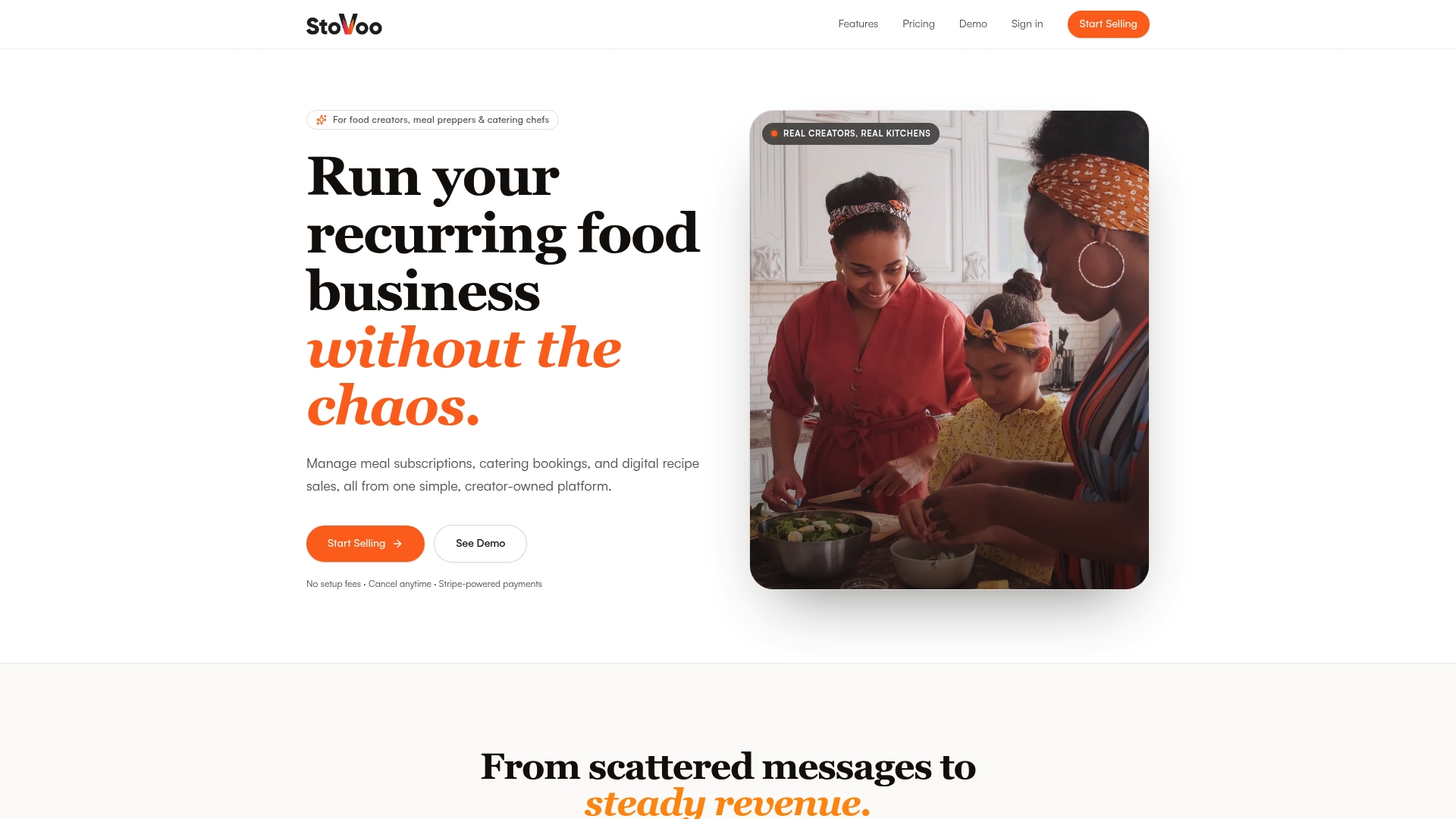
The platform is built specifically for food creators, meal preppers, and catering chefs who want to own their customer relationships instead of renting them from a marketplace. You set up your shopfront, share the link, and Stovoo handles the billing cycle, payment retries, and order confirmations automatically. See how a live vendor shopfront works in practice, then start selling on Stovoo to run your first subscription pilot without the admin chaos.
Useful sources
- Side Hustle School: Baking Side Hustle Guide — primary source for the 3x pricing rule, $25/hr labor threshold, and cottage food law starting point.
- MSU: Pathways to $100K in Farm Sales — supports CSA and mixed-market channel strategy with real revenue benchmarks.
- SteadStack: Farm Profit Playbook — covers activity-based costing and per-channel contribution margin analysis.
- NetSuite: Restaurant Revenue Streams — justifies revenue diversification as a resilience strategy.
- Cristioa: Small-Batch Food Brand — founder-level advice on the market-to-DTC-to-wholesale funnel and realistic scaling timelines.
- Stovoo Blog — operational guides on shopfronts, meal plans, digital downloads, and food business marketing.
FAQ
What is a steady income stream in food?
A steady income stream in food is recurring revenue that arrives on a predictable schedule, such as a weekly meal-plan subscription, a CSA box, a catering retainer, or a digital product sale, without requiring a fresh sales effort each cycle.
How do I price a food subscription correctly?
Multiply your total ingredient and packaging cost by at least 3 to get a retail floor, then check that the implied hourly rate after costs clears $25/hr. If it does not, raise the price or simplify the recipe.
What cottage food rules apply to recurring sales in the U.S.?
Rules vary by state, but many states cap annual cottage food revenue in the $25,000–$75,000 range and restrict which products and sales channels are allowed. Crossing the cap typically requires moving to a licensed commercial kitchen.
How does churn affect recurring food revenue?
A 5% monthly churn rate means losing more than half your subscriber base within a year. Keeping churn low through predictable delivery, easy pause options, and a strong onboarding sequence is the fastest way to grow MRR.
How does Stovoo help food creators build recurring revenue?
Stovoo provides automated billing, subscription management, order batching, and a mobile-first shopfront in one platform, so food creators can run meal plans, catering bookings, and digital product sales without spreadsheets or scattered messaging apps.