A chef is a trained professional who leads kitchen operations, develops menus, and takes ownership of the business side of food preparation — not simply someone who cooks. Merriam-Webster defines "chef" as "a skilled professional cook" and specifically "one who is in charge of a professional kitchen." The U.S. Bureau of Labor Statistics reinforces this: chefs and head cooks oversee food preparation, direct kitchen staff, plan menus, and order supplies. Leadership and operational accountability are what separate the title from a general cook.
Key Takeaways
A chef is a professional who leads kitchen operations and owns the business of food, not just the cooking of it.
| Point | Details |
|---|---|
| Chef vs. cook distinction | Chefs manage menus, staff, and costs; cooks execute recipes under direction. |
| Kitchen hierarchy | Titles range from commis (entry) to executive chef (senior), each with defined responsibilities. |
| Core duties | Menu development, food costing, inventory, staff management, sanitation, and vendor relations. |
| U.S. pay and outlook | Median annual wage is $61,980; employment projected to grow 6 percent over the next decade. |
| Training paths | Options include on-the-job experience, culinary certificates, degrees, ACF apprenticeships, and military training. |
Table of Contents
- What separates a chef from a cook?
- How a professional kitchen is organized
- What does a chef actually do every day?
- How to become a chef in the U.S.: paths, timelines, and pay
- Where the word "chef" actually comes from
- The business side of being a chef is the part most people underestimate
- Ready to run your chef business like a pro?
- Sources
- FAQ
What separates a chef from a cook?
The gap between a chef and a cook is not about talent. It is about scope of responsibility.
A chef designs those recipes, manages the people executing them, controls the costs, and answers for the quality of every plate that leaves the kitchen. The Culinary Institute of America frames it plainly: cooks execute, while chefs manage the kitchen as a business.
Here are the practical differentiators:
- Scope of responsibility: Chefs own the outcome. Cooks own their station.
- Leadership: Chefs hire, train, and schedule kitchen staff.
- Menu development: Chefs create dishes, price them, and adjust them seasonally.
- Food costing: Chefs track ingredient costs and set margins.
- Formal training or apprenticeship: Most chefs have structured culinary education or a recognized progression through kitchen ranks.
- Creativity vs. execution: Cooks follow direction; chefs set it.
A quick scenario: a line cook who has worked a grill station for three years is skilled, but they are still a cook. The moment they take over menu planning, manage two junior cooks, and negotiate with a produce vendor, the role has shifted into chef territory.
Dictionary notes that popular usage sometimes applies "chef" to any cook, but the industry draws a clear line at supervisory and creative responsibility.
Pro Tip: When evaluating a job title on a résumé or restaurant website, look for concrete signals of leadership: "managed a team of X," "developed seasonal menus," or "controlled food costs." A title without those responsibilities is likely a cook role with an inflated label.
How a professional kitchen is organized
The classic kitchen structure comes from the brigade system, formalized in 19th-century French haute cuisine and still the backbone of most U.S. restaurant kitchens today. Titles signal seniority, responsibility, and specialty.
| Title | Seniority Level | Core Responsibility |
|---|---|---|
| Executive Chef | Senior | Oversees all kitchen operations, often across multiple locations |
| Head Chef / Chef de Cuisine | Senior | Leads day-to-day kitchen operations at a single location |
| Sous Chef | Mid | Second-in-command; manages staff when the head chef is absent |
| Chef de Partie (Station Chef) | Mid | Owns a specific station (grill, sauté, pastry, etc.) |
| Commis | Junior | Entry-level cook assisting station chefs |
| Pastry Chef | Senior/Specialist | Leads all baked goods, desserts, and pastry production |
| Garde Manger | Mid/Specialist | Manages cold food preparation, salads, charcuterie |
| Chef-Owner | Senior | Combines culinary leadership with full business ownership |
A few things worth knowing about how these titles co-exist:
- In a small restaurant, one person often holds both the head chef and sous chef functions.
- Multi-site operations typically have an executive chef overseeing multiple head chefs, each running their own location.
- The honorific "Chef" is used broadly inside kitchens to encourage professionalism, even for station leaders who technically hold a cook title. Wikipedia notes this dual function: the word operates as both a job description and a mark of respect within the trade.
What does a chef actually do every day?
The cooking is only part of it. According to the BLS occupational profile, chefs and head cooks carry a wide range of operational duties that extend well beyond the stove.
Core responsibilities include:
- Menu development: Creating and updating dishes based on season, cost, and customer demand
- Food costing and pricing: Calculating ingredient costs and setting menu prices to maintain margins
- Inventory and purchasing: Ordering supplies, managing par levels, and reducing waste
- Staff management: Hiring, training, scheduling, and evaluating kitchen personnel
- Quality control: Setting plating standards and tasting food throughout service
- Sanitation and compliance: Maintaining health code standards and food safety protocols
- Vendor relations: Negotiating with suppliers and sourcing quality ingredients
The BLS reports that chefs and head cooks held about 143,100 jobs in the United States, with employment projected to grow 6 percent over the next decade, faster than the average for all occupations.
Executive chefs and chef-owners often spend the first half of their day on admin: reviewing invoices, adjusting the week's menu, meeting with vendors, and checking staff schedules. Hands-on cooking typically ramps up during prep and service. For catering operations, that admin load can be even heavier, since bookings, custom menus, and client communication all land on the chef's plate before a single ingredient is prepped.
How to become a chef in the U.S.: paths, timelines, and pay
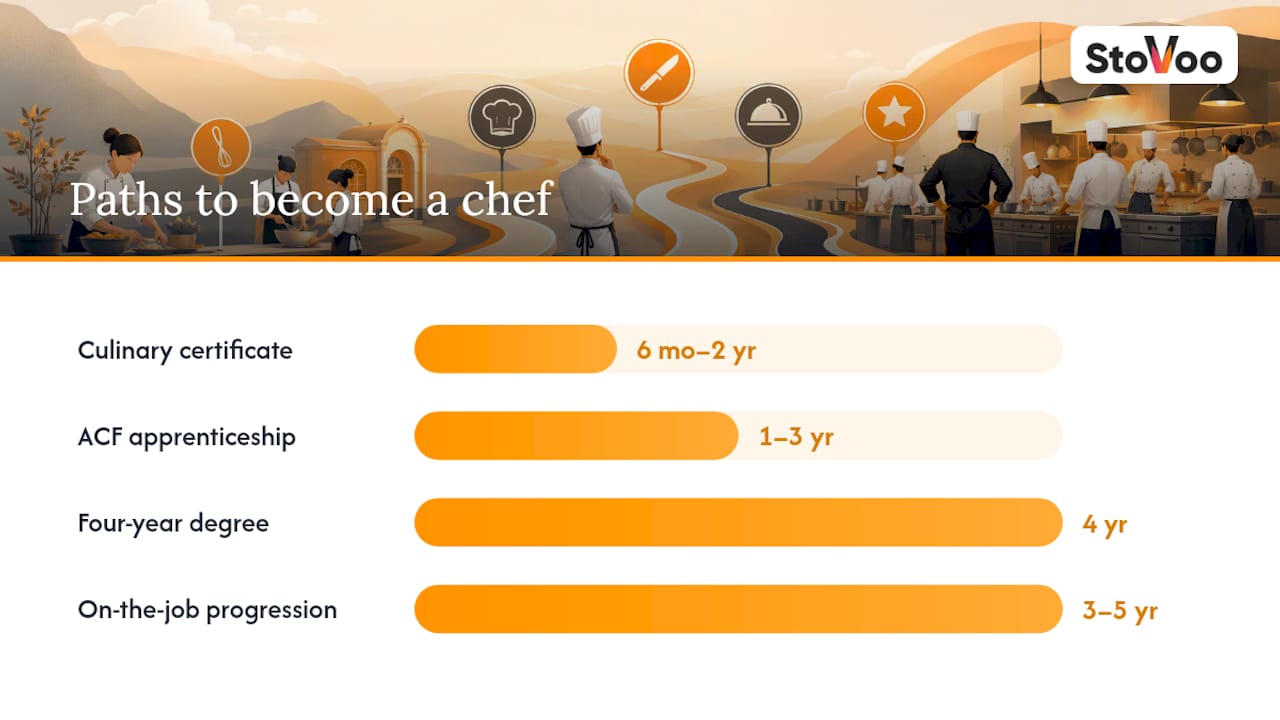
There is no single route into a chef role. The BLS and the CIA both recognize multiple valid pathways, and the right one depends on your timeline, budget, and goals.
Certifications matter for employability. ServSafe food handler and manager certifications are near-universal requirements in U.S. kitchens. The American Culinary Federation offers a tiered credential system, from Certified Culinarian to Certified Executive Chef, that signals verified competency to employers and clients alike.
The BLS reports a median annual wage of $61,980 for chefs and head cooks in the United States. The top 10 percent of earners in the field exceed $97,870 annually.
Working hours tend to run long, especially early in a career. Evenings, weekends, and holidays are standard. Chef-owners and executive chefs gain more schedule control over time, though the administrative workload often fills the hours that cooking used to occupy.
Pro Tip: Pairing a culinary certificate with an ACF apprenticeship gives you structured training and real kitchen progression at a fraction of a four-year degree's cost. Many employers value the hands-on track record more than the credential alone.
Where the word "chef" actually comes from
The word entered English from French, specifically from the phrase chef de cuisine, meaning "head of the kitchen." Wikipedia traces the root further back to the Latin caput, meaning "head." That etymology is not just trivia. It explains why the title has always carried a leadership connotation rather than a purely culinary one.
The term traveled into English during the 19th century alongside the rise of French haute cuisine, when formal kitchen brigades became the standard in elite European restaurants and hotels. As those practices crossed the Atlantic, so did the vocabulary. Over time, "chef" shifted from a borrowed French term into a recognized English professional title, carrying both the craft meaning (skilled cook) and the organizational meaning (person in charge).
The Cambridge English Dictionary captures this dual meaning well: "a skilled and trained cook who works in a hotel or restaurant, especially the most important cook." That "especially" is doing real work. It acknowledges that the word is sometimes used loosely while pointing toward its professional core.
The business side of being a chef is the part most people underestimate
The culinary world tends to romanticize the chef role. Television puts the drama of service on screen. What it rarely shows is the spreadsheet open at 7 AM, the vendor call at 8, and the staff review at 9, all before a single burner is lit.
The most important shift in understanding what a chef does is recognizing that the kitchen is a business, and the chef is its operator. Menu engineering, cost control, and staff systems are not secondary to the craft. They are what make the craft sustainable. The BLS data reflects this: executive chefs and chef-owners spend a substantial portion of their time on ordering, cost management, and administrative tasks rather than continuous hands-on cooking.
That operational reality is exactly why modern chef-owners increasingly rely on tools that centralize their business functions. Platforms like Stovoo give food entrepreneurs a single dashboard to manage meal subscriptions, catering bookings, digital recipe sales, and customer billing, freeing up the hours that would otherwise go to WhatsApp threads and manual invoicing. When automation handles catering operations, chefs can put that time back into menu development and team training, which is where their real value lives.
Gastronomy is also evolving fast. Current trends in the field are pushing chefs toward more direct-to-consumer models, digital menus, and subscription-based food services, all of which demand operational fluency alongside culinary skill. The chef title today means more than it did twenty years ago, and the business expectations have grown with it.
Ready to run your chef business like a pro?

If you are a chef, meal prepper, or catering professional ready to move beyond spreadsheets and scattered messages, Stovoo is built for exactly that. Set up your professional shopfront, manage recurring meal plan subscriptions, accept catering bookings, and sell digital recipes, all from one dashboard. No technical headaches. Just a cleaner way to run your food business and grow it steadily.
Start with Stovoo today
Sources
- Chefs and Head Cooks : Occupational Outlook Handbook: : U.S. Bureau of Labor Statistics
- CHEF Definition & Meaning - Merriam-Webster
- Chef
- Dictionary
- Cook vs. Chef: Training and Roles Explained | CIA
FAQ
What is the definition of a chef?
A chef is a skilled professional cook who leads a kitchen, according to Merriam-Webster. The role includes menu development, staff management, and operational oversight, not just food preparation.
Can any cook be called a chef?
Not in professional usage. Dictionary.com acknowledges that everyday language sometimes uses the terms interchangeably, but the industry reserves "chef" for those with supervisory and creative responsibility over a kitchen.
What qualifies you as a chef?
Qualification comes from a combination of training and responsibility. Most U.S. kitchens expect a chef to have formal culinary education or a recognized apprenticeship, plus demonstrated leadership over staff, menus, and kitchen operations, as outlined by the BLS.
What is the difference between a head chef and an executive chef?
A head chef (or chef de cuisine) runs a single kitchen location day-to-day. An executive chef typically oversees multiple locations or the entire culinary direction of a larger operation, spending more time on strategy and administration than on hands-on cooking.
How long does it take to become a chef in the U.S.?
It depends on the path. A culinary certificate takes 6 months to 2 years; an ACF apprenticeship runs 1–3 years; a four-year culinary degree takes 4 years. On-the-job progression from cook to chef typically takes 3–5 years with consistent advancement.