
The fastest way to build a pipeline of corporate catering leads is to combine a targeted intake form with direct outreach to office managers and executive assistants, then back it with a 24 to 48 hour quote turnaround. Three sources produce the highest-quality leads: buyer roles like office managers, HR staff, and executive assistants who repeatedly show up as the highest-value prospects in catering lead generation; existing corporate clients ready for repeat orders; and high-intent Google searches from people who already know they need catering.
Here's what to do right now:
- Add a catering-specific intake form with fields for headcount, date, and budget range
- Reach out to three past corporate clients this week with a reactivation offer
- Check whether your Google Business listing shows a dedicated catering page
A platform like Stovoo can centralize these inquiries and automate billing, so you're not chasing quote requests across email, text, and spreadsheets.
Key Takeaways
Corporate catering leads convert fastest when intake captures headcount, buyer role, and budget upfront, and when quotes go out within 24 to 48 hours.
| Point | Details |
|---|---|
| Target the right roles | Office managers, executive assistants, and HR staff are consistently the highest-value corporate catering prospects. |
| Score leads fast | Use headcount, buyer role, and repeat-customer status to sort hot leads from low-priority ones in seconds. |
| Reply within 24 to 48 hours | A fast, complete proposal wins more corporate contracts than a lower price with a slow response. |
| Reactivate past clients | A short, personalized offer to a past corporate account often closes faster than any cold outreach effort. |
| Centralize your enquiries | A single dashboard for intake, billing, and reordering prevents leads from getting lost across scattered messages. |
Table of Contents
- Where to Find Corporate Catering Leads That Actually Book
- How Do You Qualify and Prioritize Catering Leads?
- What Outreach Sequence Actually Converts Corporate Leads?
- Build an Inquiry Checklist That Speeds Up Quoting
- Tracking and Follow-Up That Predicts Repeat Business
- How Stovoo Helps You Capture and Convert Corporate Leads
- What Pricing Structure Wins Corporate Catering Contracts?
- What Does a Successful Corporate Catering Conversion Look Like?
- Handling the Objections That Stall Corporate Catering Deals
- What Should a Corporate Catering Inquiry Actually Include?
- Start Booking Corporate Accounts With Stovoo
- What the Data Actually Says About Corporate Catering Leads
- Sources
- FAQ
Where to Find Corporate Catering Leads That Actually Book
Not every lead source deserves equal attention. Some convert at high rates with almost no chasing, while others need months of nurturing before anyone signs a contract. Ranked by ease of conversion and repeat potential, here's where corporate catering business actually comes from.
- Google catering searches and dedicated landing pages. Someone searching "corporate catering near me" or "office lunch catering" has already decided to buy. A page built specifically for corporate catering, separate from your general menu page, converts this traffic far better than a generic homepage.
- Existing customers and past corporate accounts. A company that ordered catering for one all hands meeting will likely need it again for the next one. Reactivating a dormant account usually beats cold outreach on both speed and close rate, since the buyer already trusts your food and your process.
- Local outbound to office managers, facilities staff, HR, and executive assistants. These roles control the catering budget at most mid-size companies, even when they don't hold the final signature. A short, specific email to a named office manager outperforms a mass blast to "info@" every time.
- Verified prospect lists and B2B data services. Prospect-list providers compile verified contacts organized by buyer persona, which cuts down the hours you'd otherwise spend hunting for the right office manager's email on LinkedIn.
- Partnerships and referral channels. Event planners, coworking spaces, HR benefits vendors, and venue coordinators all refer catering business regularly. A simple referral arrangement, even an informal one, can produce steadier volume than paid ads.
Weight your time toward the first two. They cost less to pursue and close faster than cold prospecting ever will.
How Do You Qualify and Prioritize Catering Leads?
Not every inquiry deserves the same response speed. A lead for a 200 person quarterly meeting matters more than a request for six sandwich boxes, and your intake process should sort them accordingly.
Pull these fields from every inquiry before you spend time on a quote:
- Event date and flexibility
- Headcount (exact or estimated range)
- Delivery address and whether it fits your current radius
- Buyer role (office manager, EA, HR, facilities, or unknown)
- Budget range or per-person spend hint
- Service style needed (drop-off, staffed buffet, plated)
A simple point system works better than instinct alone. Give two points for headcount over 50, two points for a named buyer role like office manager or EA, and three points for repeat-customer status. A lead scoring six or more points is hot and gets a same-day reply. Anything scoring two or under, especially requests with no firm date or headcount, can wait.
Red flags worth deprioritizing immediately: no event date, a delivery address well outside your service area, or a budget range so low it can't cover your minimums.
Pro Tip: Ask for headcount as a range, not an exact number. Corporate buyers rarely know final attendance three weeks out, and forcing a precise figure kills form completion rates.
What Outreach Sequence Actually Converts Corporate Leads?
Speed wins more corporate catering deals than menu creativity does. A buyer comparing three caterers will often book whichever one replies first with a real answer, not just a "thanks, we'll get back to you."
Build your sequence around this order:
- Instant auto-confirmation. The moment someone submits an inquiry, they get an automated email confirming receipt and setting expectations for response time.
- Qualification follow-up. Within a few hours, ask any missing questions: exact headcount, dietary restrictions, delivery versus on-site service.
- Sample menu and price range. Send this before a full proposal. It lets the buyer self-select out early if the budget doesn't match, saving you a wasted quote.
- Formal proposal within 24 to 48 hours. Caterers who commit to a one business day reply window consistently outperform those who take a week to respond.
- Structured follow-up. A short check-in three days after the proposal, then again a week later if there's no response.
Channel notes matter here too. Cold outreach to office managers works best as short, specific emails, not templated blasts. Paid search should point to a catering-specific landing page, never your general homepage. Reactivation campaigns to past clients convert fastest when personalized with the exact event they booked last time.
Corporate buyers care about three things above menu quality: reliability, invoicing or purchase order support, and clear dietary labeling. Procurement-friendly features like PO support and automatic billing directly influence whether a corporate buyer signs with you or moves to a competitor.
Pro Tip: Mention your invoicing and PO process in the very first proposal email. Corporate buyers often rule out vendors who can't handle standard procurement paperwork, and most caterers never say this upfront.
Build an Inquiry Checklist That Speeds Up Quoting
A vague inquiry means back-and-forth emails before you can even build a quote. A tight intake form eliminates most of that friction.
Include these fields on every catering inquiry form or email template:
- Event date and backup date if flexible
- Exact or estimated headcount
- Start time and how long service should run
- Delivery or on-site setup needed
- Dietary restrictions or allergy flags
- Rough budget or per-person spend
Two templates cover most situations. A quick confirmation reply: "Thanks for your inquiry. We've received your request for [date] and will send pricing within 24 hours." A request-for-quote form prompt: "Tell us your event date, headcount, and any dietary needs, and we'll send a custom proposal within one business day."
Place the form above the fold on your catering landing page, not buried in a general contact page. Stovoo's catering booking checklist walks through the exact fields that reduce quoting delays for small catering teams.
Tracking and Follow-Up That Predicts Repeat Business
A lead you don't track is a lead you'll forget to follow up on, and forgotten follow-up is where most catering revenue quietly disappears.
Track these fields at minimum for every inquiry:
- Buyer role and company name
- Lead score (using the point system from earlier)
- Event date, headcount, and quoted amount
- Follow-up date and outcome
Set up three automations if your tools support it: an instant auto-confirmation, a reminder nudge if a proposal goes unanswered for three days, and a reactivation campaign triggered 60 to 90 days after a corporate client's last order. Reactivating a past corporate customer with a short, personalized offer tends to close faster and cheaper than chasing new cold leads.
Watch three KPIs monthly: conversion rate by buyer role (EAs often convert differently than facilities staff), average order value, and repeat order frequency per account. These three numbers tell you where to spend your outreach hours next month.
How Stovoo Helps You Capture and Convert Corporate Leads
Running catering inquiries through email, text, and a spreadsheet works until volume picks up, then it breaks fast. Stovoo's centralized dashboard pulls every enquiry into one place, so nothing gets lost between a Monday email and a Friday text message.
What matters most for corporate catering teams:
- Centralized enquiries so nothing sits unread in a separate inbox
- Automated billing that handles recurring corporate orders without manual invoicing
- A mobile shopfront link you can send directly to an office manager or EA
- Recurring order support for accounts that book weekly or monthly meals
Culater Catering, a Lagos-based caterer, uses Stovoo's shopfront and booking tools to manage recurring meal and catering orders without juggling separate messaging apps for every client.
Map the intake fields from your qualification checklist, headcount, date, buyer role, budget, directly into Stovoo's enquiry fields, and your scoring system carries over without extra setup work.
What Pricing Structure Wins Corporate Catering Contracts?
Corporate buyers rarely choose the cheapest quote outright. They choose the one that's easiest to approve internally, and pricing structure affects that more than most caterers realize.
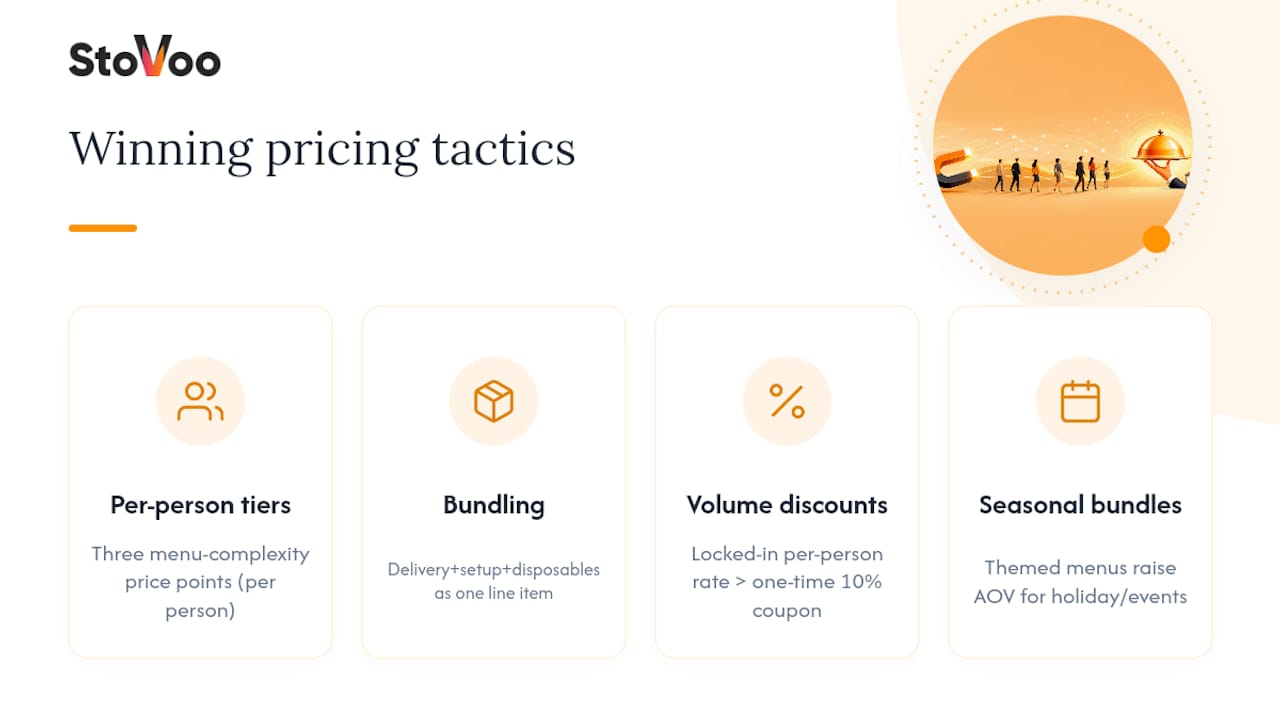
Per-person pricing tiers work better than flat quotes for recurring business. A tier structure, say three price points based on menu complexity, lets an office manager pick a budget-appropriate option without emailing back for a revised quote. Bundling delivery, setup, and disposable serviceware into one line item also speeds up approval, since many corporate buyers need a single number to submit for internal sign-off rather than an itemized breakdown.
Volume discounts on recurring orders matter more than one-time discounts. A company booking weekly lunch catering values a locked-in per-person rate over a one-off 10% coupon, because it makes budgeting predictable for their finance team.
Consider a simple three-tier structure: a standard drop-off tier, a staffed buffet tier, and a premium plated tier, each with a clear per-person price range. This mirrors how boutique caterers commonly structure offerings for corporate bookings in the 50 to 150 guest range, giving buyers an easy mental model to compare against competitors.
Seasonal or thematic menu bundles can also boost average order value, particularly around holidays or quarterly company events. Partner content like Wild Foodz's seasonal event menu roundup offers useful inspiration for building themed packages that corporate planners actually request.
What Does a Successful Corporate Catering Conversion Look Like?
A typical winning pattern starts with a single, small inquiry that expands over time, not a huge contract signed on the first call.
Picture an office manager who submits a form for a 15 person team lunch. The caterer replies within a few hours with a sample menu and a price range before sending a full proposal, and delivers a clean, on time drop-off. That single interaction, done well, often turns into a recurring monthly order once the office manager sees the process is reliable.
The pattern repeats at scale. A company that starts with one department's lunch order frequently expands to company-wide events once other managers hear about the smooth experience. This is why the reactivation approach matters so much: a past client who had a good first experience is dramatically easier to re-book than a brand-new cold lead, since the trust and menu preferences are already established.
The common thread across conversions that stick: fast response time, a simple ordering process, and consistent quality on the first order. Caterers who treat that first small booking as a trial run for a bigger recurring account, rather than a one-off transaction, tend to build the steadiest corporate revenue. A shopfront link that makes reordering as simple as clicking a saved menu, the kind Stovoo vendors like Chef E's Kitchen set up for repeat corporate orders, removes the friction that otherwise causes a happy client to quietly drift to a competitor next quarter.
Handling the Objections That Stall Corporate Catering Deals
Corporate buyers raise the same handful of objections again and again. Knowing the response in advance keeps a stalled inquiry from going cold.
"Your price is higher than another quote we got." Point to what's included: delivery, setup, disposable serviceware, and a guaranteed response window. A lower quote that lacks these often costs more once add-ons appear.
"We need to run this through procurement." Offer PO support and formal invoicing upfront rather than waiting for the buyer to ask. This single fix removes one of the most common reasons corporate deals stall mid-process.
"We're not sure about dietary restrictions yet." Send a menu with dietary labels built in (vegetarian, gluten-free, nut-free) so the buyer can forward it internally without needing a follow-up call.
"We need to confirm headcount closer to the date." Accept a range now and lock the final number a few days out, rather than insisting on an exact count today. Rigid headcount requirements lose bookings that would otherwise close easily.
"We haven't worked with you before." Offer a smaller trial order, like a single department lunch, before pitching the full company-wide contract. This mirrors the pattern that turns one-off orders into repeat accounts.
What Should a Corporate Catering Inquiry Actually Include?
A vague inquiry costs you time on both ends. The more specific the initial request, the faster you can turn it into an accurate quote and a signed booking.
Every solid inquiry should specify the event date and any flexibility around it, along with an exact or estimated headcount. Timing matters just as much: the start time and expected service duration determine staffing and delivery logistics. Whether the client needs simple drop-off or full on-site setup changes your pricing and preparation entirely, so this should be clear from the first message.
Dietary needs deserve their own line, not an afterthought buried in a "notes" field, since allergies and restrictions affect menu planning directly. Budget hints, even a rough per-person range, help you skip proposals that were never going to fit the client's numbers anyway.
Local caterers commonly recommend at least a week of notice for standard office meals, with longer lead times required for larger, staffed events. Setting this expectation early, right on your inquiry form, prevents last-minute requests from creating unnecessary pressure on your kitchen.
Start Booking Corporate Accounts With Stovoo
Most caterers lose corporate deals to slow replies, not weak menus. Stovoo gives you one dashboard for enquiries, automated billing, and a shopfront link you can send straight to an office manager, so a 15 person lunch order today can turn into a recurring monthly account without extra admin work. Vendors like Chef Ts Culinary and Chef Kingsley's Kitchen already use Stovoo's shopfront tools to manage exactly this kind of recurring corporate business. Set up your Stovoo shopfront and start converting inquiries into repeat accounts this week.
What the Data Actually Says About Corporate Catering Leads
The conventional advice tells caterers to chase more leads. The research says something different: chase the right leads faster, and repeat business does more work than new acquisition ever will. Most catering operations treat every inquiry with the same urgency, which means a $150 sandwich order gets the same response time as a 200 person quarterly meeting. That's backwards.
Where the standard advice really falls short is on speed. Plenty of guides tell caterers to "build relationships" with office managers, which is true but vague to the point of uselessness. The sharper insight is that reactivating a client who already trusts your food beats almost any cold outreach tactic, and it costs a fraction of the effort.
If you take one thing from this: fix your response time before you fix your menu. A buyer choosing between three caterers usually books whoever answers first with a real number attached. Everything else, the plating, the branding, the sample menus, matters far less than most catering teams assume.
— freeman
Sources
- Catering Lead Generation for Restaurants | FlashCater
- CateringData | Grow Your Catering Business with Prospect Lists
FAQ
How Far in Advance Should Corporate Catering Be Booked?
Most caterers recommend at least a week of notice for standard office meals, though larger staffed events typically need longer lead times for planning and staffing.
Who Are the Best Corporate Catering Leads to Target?
Office managers, executive assistants, HR staff, and facilities coordinators consistently rank as the highest-value prospects because they control or influence the catering budget directly.
How Fast Should You Respond to a Catering Inquiry?
Send an automated confirmation immediately, then a full proposal within 24 to 48 hours; caterers who commit to a same-business-day reply window close more deals.
What Should a Catering Intake Form Include?
Capture the event date, headcount, delivery or on-site needs, dietary restrictions, and a rough budget range so you can quote accurately without extra back-and-forth emails.
Do Corporate Clients Care About Invoicing Options?
Yes. Corporate buyers often value clear billing and purchase order support as much as menu quality, since it directly affects whether their procurement process approves the vendor.