

TL;DR:
- Catering management involves planning, organizing, and coordinating all steps from order intake to post-event follow-up to ensure quality and consistency. Effective management minimizes risks and errors associated with multiple handoffs, logistics, staffing, and quality checks. Building standardized systems and continuous process improvements help catering businesses deliver reliable, high-quality service at every event.
Catering management is one of those disciplines where the real complexity hides behind the finished plate. Most food professionals understand that running a catering operation involves more than cooking, but few appreciate just how many moving parts must align perfectly for every single event. Catering management is the planning, organizing, and coordinating of all steps needed to produce food and deliver it as a complete service for an event or order. When those steps aren't systematized, small errors multiply fast, and the customer experience suffers every time.
Table of Contents
- What is catering management?
- Key elements of catering management
- Quality assurance and customer satisfaction in catering
- Managing capacity and high-volume catering
- The overlooked keys to successful catering management
- Next steps: Streamline your catering business
- Frequently asked questions
Key Takeaways
| Point | Details |
|---|---|
| Multi-stage process | Catering management involves systematic planning, coordination, and follow-up across intake, preparation, quality, and delivery. |
| Quality control essentials | Standardization and quality checks prevent errors and ensure consistent customer satisfaction. |
| Logistics and kitchen interplay | Efficient logistics and kitchen management are vital for handling timing and temperature risks unique to catering. |
| Capacity and contingency planning | Recognizing operational limits and preparing contingencies is key for reliably serving large events. |
| SOPs drive consistency | Standard operating procedures and preventive analysis help maintain quality and efficiency, regardless of staff or event. |
What is catering management?
Catering management is a discipline that spans the entire lifecycle of a food service engagement, from the first client inquiry to the final follow-up after delivery. It's not just about what happens in the kitchen. It's about how every stage connects, communicates, and delivers a consistent experience.
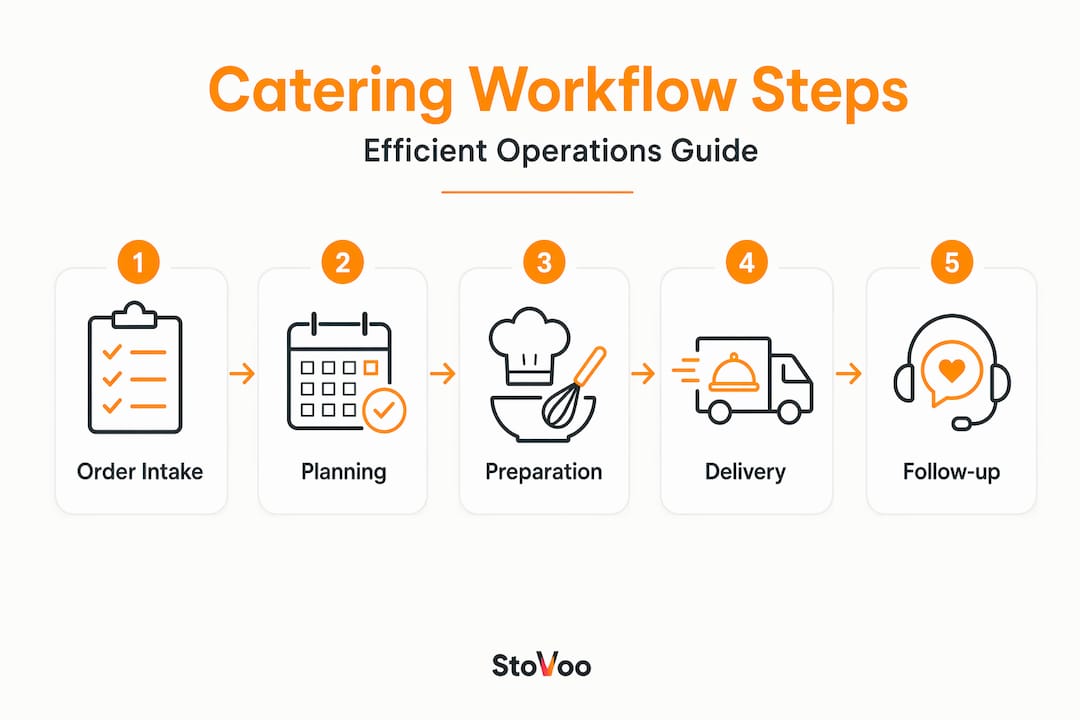
The core catering operations guide defines it clearly: catering management is the planning, organizing, and coordinating of all steps needed to produce food and deliver it as a complete service. That means intake, planning, preparation, quality checks, delivery, and post-event follow-up all fall under this umbrella.
Each stage matters because failure at any one point cascades forward. A missed detail at intake becomes a wrong order at delivery. A skipped quality check becomes a temperature violation in the field. The entire system is only as strong as its weakest link.
Here's how catering operations compare to standard restaurant operations:
| Factor | Restaurant operations | Catering operations |
|---|---|---|
| Production location | On-site kitchen | Separate production kitchen |
| Service timing | Real-time, continuous | Scheduled, event-based |
| Client interaction | Walk-in or reservation | Contracted, detailed intake |
| Quality checkpoint | At point of service | Pre-transport and on-site |
| Staffing model | Fixed team per shift | Variable, event-specific |
| Logistics complexity | Low | High (transport, setup, breakdown) |
The table above reveals something important: catering operations introduce multiple handoff points that restaurants simply don't deal with. Each handoff is a risk. Effective catering management is fundamentally about controlling those risks.
The key stages every catering manager should treat as non-negotiable include:
- Intake: Capturing client requirements with precision, including guest counts, dietary needs, and event timing
- Planning: Translating intake details into a production and logistics plan
- Preparation: Executing the kitchen work against a documented timeline
- Quality check: Verifying food accuracy, temperature, and presentation before transport
- Delivery and setup: Transporting food safely and setting up on-site to spec
- Follow-up: Reviewing the event, gathering client feedback, and updating records
Following solid catering business tips for each of these stages helps you build repeatable processes that protect both your reputation and your bottom line.
"The biggest difference between good and great catering is whether the process runs the team, or the team runs the process."
Businesses that treat planning in catering management as a structured discipline rather than an informal checklist consistently outperform those that rely on memory and habit. And when catering planning steps are documented and followed, you spend less time firefighting and more time growing.
Key elements of catering management
Once you understand the stages, the next step is mastering the elements that sit inside those stages. These are the functional pillars that keep your operation running smoothly under pressure.
Operational flow is the backbone. Every task from intake to follow-up should have a defined owner, a deadline, and a handoff protocol. Without this, information falls through the cracks and staff make assumptions that lead to errors.
Kitchen management in catering is specialized because, as catering kitchen management research confirms, catering production is typically separated from the point of service, creating heightened risk around timing and temperature control. This separation means you can't just taste the soup right before it's served. You need documented holding temperatures, transport protocols, and time windows built into your prep schedule.
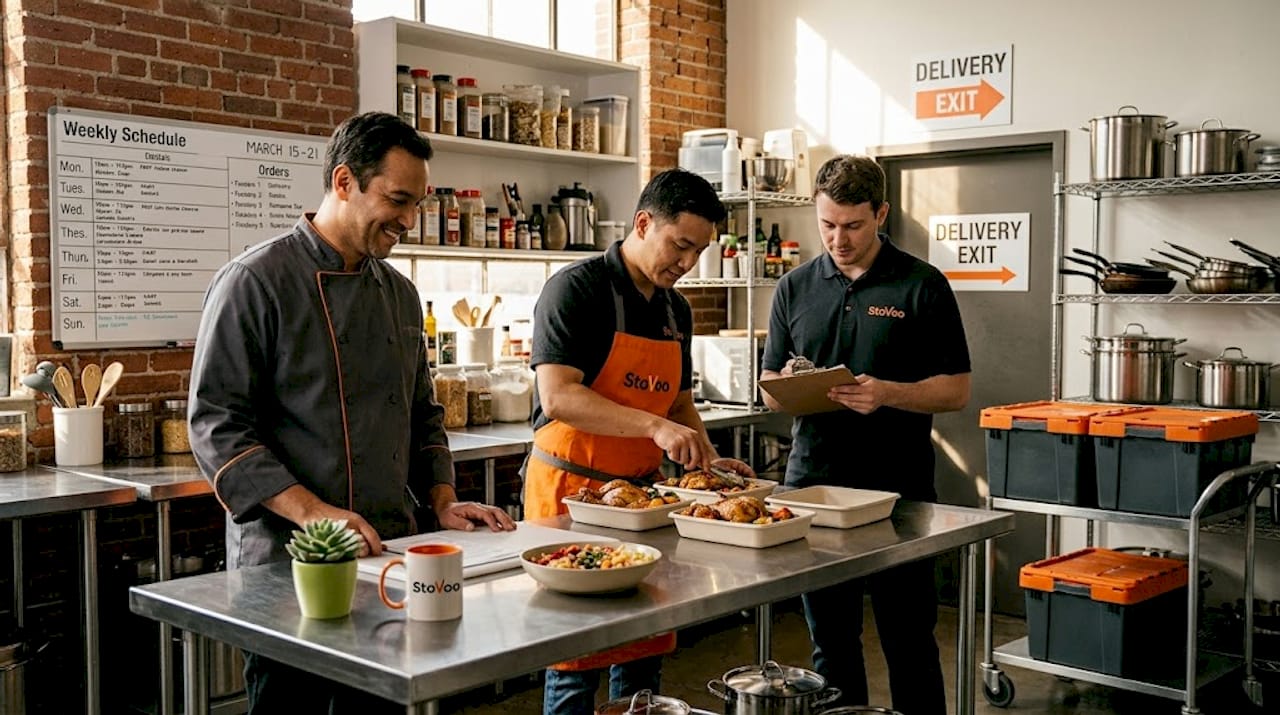
Logistics covers everything from vehicle loading plans to site setup diagrams. Managing logistics and staffing for high-volume catering events requires contingencies to maintain quality during peak demand. That means backup drivers, extra equipment, and clear communication between your kitchen and on-site teams.
Staffing is where many catering operations struggle most. Unlike restaurants with consistent shift patterns, catering demands surge and contract based on your event calendar. Smart staffing strategies for catering managers include:
- Build a tiered team: a core permanent staff supplemented by a reliable pool of trained temporary workers
- Create role-specific briefing sheets so temporary staff can perform to standard without extensive training time
- Assign a senior team member as a quality lead for every event, responsible for the final check before departure
- Cross-train kitchen and service staff so you have flexibility when someone calls in sick
- Schedule a debrief within 24 hours of every event to capture what worked and what needs adjustment
Using catering logistics planning tools that centralize your booking details, staffing assignments, and delivery schedules makes it far easier to manage these moving parts without losing critical information.
Here's a practical look at how timing errors create compounding problems:
| Failure point | Immediate impact | Downstream consequence |
|---|---|---|
| Late ingredient delivery | Prep runs behind schedule | Food not ready at transport window |
| Incorrect hold temperature | Food safety risk | Potential health incident or waste |
| Missing staff briefing | On-site confusion | Slow service, client frustration |
| No quality check step | Errors reach the client | Refund demands, reputation damage |
| No post-event follow-up | Lost feedback | Same mistakes repeat at next event |
Pro Tip: Set temperature checks as a mandatory step in your pre-transport checklist. Assign one person to own this step, not the whole team, because shared responsibility often means no one actually does it. Using quality control practices that are person-specific and time-stamped creates accountability and a paper trail if issues arise.
Quality assurance and customer satisfaction in catering
Quality in catering isn't a feeling. It's a documented standard that your entire team can measure against consistently. When quality is left to individual judgment, you get inconsistent outcomes across events, and clients notice.
Defining quality catering operations confirms that customer-focused catering management ties operational execution to consistent service standards and process control to balance customer satisfaction with production costs. This is a critical insight: quality and cost aren't opposites. A well-controlled process reduces waste, rework, and refunds while keeping clients happy.
The core practices that build quality assurance into your catering operation include:
- Documented recipes and plating standards: Every dish should have a spec sheet with portion size, presentation requirements, and allergen information
- Pre-event checklists: Covering equipment, food quantities, packaging, and client-specific requirements
- Staff training logs: Recording who has been trained on which procedures and when
- Client confirmation calls: Conducted 48 hours before every event to verify details and catch last-minute changes
- Post-event quality reviews: Comparing what was planned against what was delivered and identifying gaps
One of the most effective quality improvement approaches in the industry is applying a quality improvement methodology that identifies the root cause of errors rather than just treating symptoms. For example, if food consistently arrives cold, the fix isn't just to reheat on-site. The root cause might be insufficient insulated transport containers or a pickup window that's too early relative to the event start time.
Statistic callout: Operations that implement documented service standards and process controls report significantly fewer client complaints and repeat errors compared to those that rely on informal practices alone.
Pro Tip: Use a preventive failure analysis before major events. Walk through each stage mentally and ask, "What could go wrong here, and what's our response?" Document the answers. This simple exercise, which takes about 20 minutes per event, catches the vast majority of foreseeable errors before they happen. Pair this with preventing delivery errors checklists to close the gap between planning and execution.
Service execution in catering depends on your team knowing not just what to do, but why it matters. When staff understand that a missed allergen note isn't just an inconvenience but a potential health crisis, their attention to detail improves dramatically. And when catering customer experience is treated as a strategic priority rather than an afterthought, repeat business and referrals follow naturally.
Managing capacity and high-volume catering
High-volume events are where catering operations either prove themselves or fall apart. The fundamentals are the same, but the margin for error shrinks dramatically when you're serving 500 guests instead of 50.
Capacity planning is a core part of catering management: leaders are expected to recognize operational limits, including lead times and order volume windows, and use systems that protect quality when demand spikes. The practical implication is that every catering business needs to know its maximum viable output before accepting bookings, not after.
Here's a step-by-step framework for managing capacity effectively:
- Establish your baseline capacity: Calculate the maximum number of guests you can serve at a single event without quality degradation, based on your current kitchen, staff, and equipment
- Define your lead time requirements: Know how many days of advance notice you need for events of different sizes, and communicate this clearly to clients during intake
- Build order volume windows: Establish maximum bookings per weekend or per week, and hold those limits even when pressure mounts to take on more
- Create a tiered event classification system: Small events (under 50 guests), medium events (50 to 200 guests), and large events (200 plus guests) each require different resource allocations
- Pre-assign resources per tier: When a booking comes in, immediately slot it into a tier and trigger the corresponding staffing, equipment, and production plan
- Schedule buffer time between large events: Never book two large events on back-to-back days without adequate recovery time for your team and kitchen
"The caterers who consistently deliver excellent large events aren't the ones who work harder. They're the ones who plan earlier, standardize more, and say no to bookings that exceed their verified capacity."
As high-volume catering research shows, effective catering management includes logistics and staffing planning plus contingencies to maintain quality during peak demand. That word "contingencies" is doing a lot of work here. The best catering managers don't just plan what should happen. They plan what to do when things don't go as expected.
Pro Tip: For every large event, designate a contingency budget of 10 to 15 percent of total production costs. This covers last-minute ingredient replacements, additional staff call-ins, or equipment rentals that become necessary on short notice. Teams that handle high-volume catering with this buffer built in are far more resilient than those who plan to exact margins.
The overlooked keys to successful catering management
After working through the technical strategies, there's a layer of operational wisdom that most industry guides skip over entirely. It comes down to this: most catering managers know the right steps, but far fewer actually build the systems that make those steps happen consistently.
Standardization is often undervalued. It feels bureaucratic until you see what happens without it. A team that runs three events a week on memory and verbal handoffs will eventually have a catastrophic mix-up. A team that runs those same events on documented procedures will catch problems before they become crises.
Because catering spans multiple stages and handoffs, standardized intake and verification plus a quality-check step are essential to prevent accuracy failures before delivery. This isn't a nice-to-have. It's the structural safeguard that protects your operation from the edge cases that will, eventually, show up.
Real-world mishaps in catering often trace back to one of two failure modes. Either the intake wasn't thorough enough and a client detail was missed, or the quality check was skipped because the team was rushed. Both are preventable with the right systems in place.
The caterers who build lasting businesses treat every near-miss as a system improvement opportunity. When something almost goes wrong, they don't just breathe a sigh of relief. They ask why it almost happened, update their checklist or procedure, and brief the team. Over time, this continuous improvement mindset builds an operation that clients trust completely.
The lessons from catering operations that matter most aren't learned in cooking school. They're learned from the event where the wrong venue address was in the system, from the booking where a dairy allergy wasn't flagged, from the peak weekend where two large events overlapped and the kitchen ran out of prep time. Every catering professional has these stories. The differentiator is whether those stories change how you operate going forward.
Pro Tip: Build intake verification into every single order as a non-negotiable step. Create a brief structured call or written confirmation that recaps the client's key requirements: guest count, dietary restrictions, delivery time, setup requirements, and any special requests. Send it to the client and ask for a written confirmation. This single step eliminates the majority of accuracy failures in catering.
Next steps: Streamline your catering business
Running a well-managed catering operation requires more than good food and hard work. It demands organized systems, clear communication, and the right tools to keep everything in one place.
Stovoo is built specifically for food entrepreneurs like you. Whether you're managing weekly catering bookings, recurring meal plans, or digital recipe sales, Stovoo gives you a centralized dashboard to handle it all without the chaos of scattered spreadsheets and messaging apps. Explore how Amara catering solutions and Ami catering plans are already helping food professionals manage client relationships, streamline bookings, and build steady recurring income. Ready to take your operation to the next level? Start selling on Stovoo today and see how much smoother your catering business can run.
Frequently asked questions
What does catering management cover?
It covers planning, organizing, and coordinating every step from order intake through delivery and follow-up to ensure consistent service at every event.
Why are quality checks crucial in catering?
Quality checks prevent inaccuracies at delivery because catering spans multiple handoffs, and errors that aren't caught internally will always reach the client.
How does catering management differ from restaurant operations?
Catering separates production from service, creating unique risks around timing, temperature control, and logistics that standard restaurant environments don't typically face.
How do catering managers handle large events?
They use capacity planning, logistics, and contingencies to protect quality standards even when order volumes spike during peak demand periods.
What is the role of SOPs in catering management?
SOPs, or standard operating procedures, systematize tasks and standards so that service quality stays consistent across different staff members and events, reducing the risk of human error.