
The fastest route to predictable catering bookings combines four things: local business outreach, search-driven capture (local SEO plus targeted PPC), repeat-customer reactivation, and venue or planner referrals. Do this in the next hour: claim and fully complete your Google Business Profile with catering-specific categories like corporate catering or box lunch delivery.
What to expect from a healthy mix:
- Speed: marketplaces and PPC produce inquiries within days; SEO and referrals take months to compound.
- Cost: ranges from free (profile optimization, past-customer outreach) to ongoing ad spend for PPC.
- Buyer role: office managers and executive assistants dominate corporate leads; couples and planners drive weddings.
Key Takeaways
Catering businesses that combine at least four distinct lead sources and reply within two hours consistently close more bookings than those relying on a single channel.
| Point | Details |
|---|---|
| Diversify your sources | Mix local outreach, search, referrals, and repeat customers so no single channel controls your pipeline. |
| Qualify before you quote | Score leads on headcount, date, budget, and buyer role to prioritize the ones most likely to book. |
| Reply within two hours | Faster follow-up during business hours meaningfully improves close rates on new inquiries. |
| Track cost per source | Calculate revenue against spend for each channel monthly to see which ones actually earn their keep. |
| Centralize with Stovoo | A single dashboard captures inquiries from every source, sends pricing instantly, and moves leads to booked orders. |
Table of Contents
- Where Catering Lead Sources Actually Come From
- How to Score and Prioritize Incoming Leads
- What to Send First and When to Follow Up
- Which Tools Actually Manage This Volume?
- How Fast Each Source Pays Off, and What It Costs
- A Quick Look at Centralized Lead Capture in Practice
- Handling Lead Data the Right Way
- Why Relying on One Source Eventually Backfires
- Tracking What Each Lead Source Actually Returns
- What Most Operators Get Wrong About Sourcing Leads
- One Dashboard for Every Catering Inquiry
- Further Reading and Tools
- Sources
- FAQ
Where Catering Lead Sources Actually Come From
Most catering businesses over-invest in one channel and wonder why bookings stall the moment that channel slows down. FlashCater tracks five recurring sources for restaurant and catering leads: local business outreach, Google searches for catering, existing dine-in and takeout customers, past catering clients, and word-of-mouth referrals. Building all five, rather than leaning on one, produces the volume you can actually forecast against.
Local business outreach puts you in front of office managers directly, usually through cold email or a drop-in sample tray. It is slow to start but cheap, and it builds the kind of relationship that reorders every quarter.
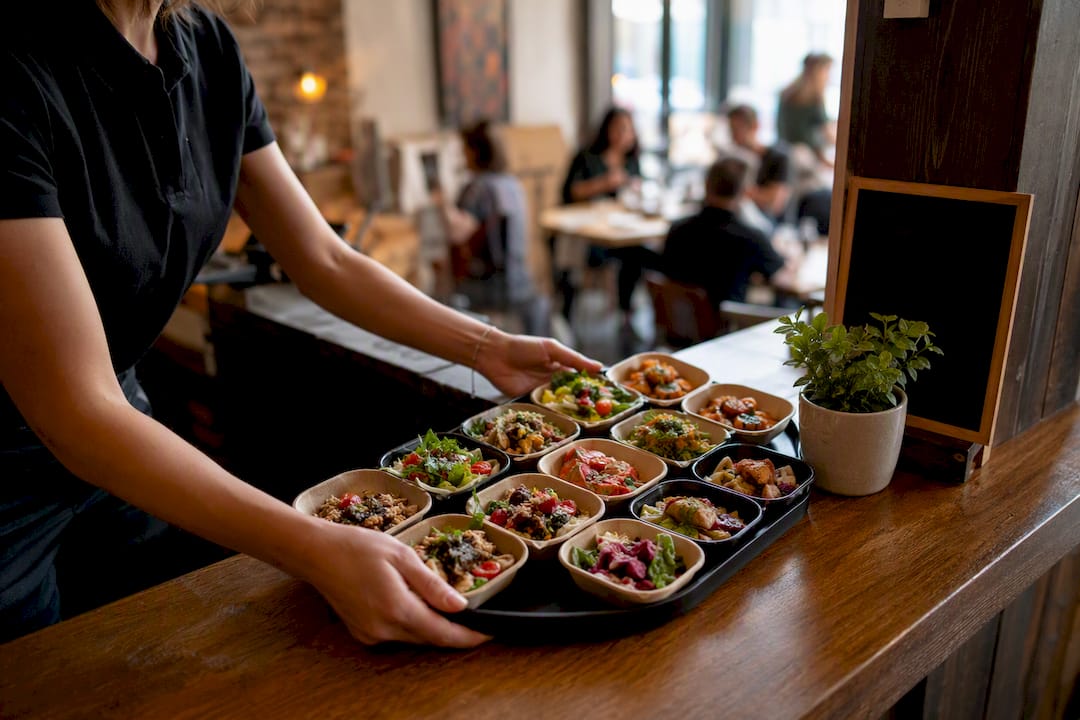
Corporate leads come from HR departments, executive assistants, and office managers booking recurring lunches or event catering. LeadsuiteNow points to LinkedIn outreach to these exact roles as one of the more reliable paths, with reply rates in the 8 to 15% range for well-targeted sequences.
Weddings, events, and venue referrals arrive through planners and venue coordinators who keep a short preferred-vendor list. Getting on that list takes a tasting and a relationship, not an ad.
Local search (SEO) captures people typing "catering near me" at the exact moment they need you. A complete, accurate Google Business Profile is the single highest-leverage free asset here, according to CUFinder.
Paid search (PPC) buys you visibility on event-specific terms like "wedding catering" or "corporate event menus." Podium notes that well-managed campaigns on these terms can meaningfully increase high-intent inquiries, often within days of launch.
Social media, particularly Instagram and TikTok, sells the visual experience of your food but rarely closes a deal on its own. Treat it as a top-of-funnel trust-builder that feeds your other channels.
Referrals and repeat customers are your cheapest, highest-margin source. A single satisfied client who reorders for three events a year is worth more than a dozen one-off marketplace orders.
Directories and marketplaces deliver instant orders but take a commission on every one.
Pro Tip: Ask every past client for a specific vendor introduction, not a generic testimonial. "Would you introduce me to your venue coordinator?" produces warm leads. "Leave us a review" produces stars nobody chases down.
How to Score and Prioritize Incoming Leads
Not every inquiry deserves the same reply speed or effort. Run each lead through a quick checklist before you draft a proposal:
- Headcount — does the order clear your minimum?
- Event date — is it far enough out to plan, or urgent enough to prioritize today?
- Budget signal — did they mention a number, or ask "what's your cheapest option"?
- Buyer role — office manager or executive assistant with booking authority converts faster than someone "just gathering quotes."
- Delivery location — inside your service radius, or an add-on delivery fee?
- Repeat potential — one-off event or a recurring weekly account?
A simple 0 to 10 score works well: give 3 points for headcount above your minimum, 3 points for a date within your booking window, 2 points for a confirmed decision-maker, and 2 points for repeat potential. Anything scoring 7 or above gets a callback within the hour, not a form email. Your minimum order value and margin should drive this scoring, not just lead volume. LeadsuiteNow and other operators cite response speed as a bigger swing factor in close rates than almost anything else on this list.
What to Send First and When to Follow Up
Every capture form should ask for exactly enough information to qualify a lead without scaring them off. For corporate inquiries: company name, headcount, date, and budget range. For weddings: event date, guest count, venue, and service style. Four fields, no more. Long forms kill conversions before you ever see the lead.
The moment a lead lands, send three things: a short menu PDF, per-person pricing with your minimum order clearly stated, and a one-line next step ("Reply with your date and I'll hold a spot"). A template that works well for corporate leads: "Thanks for reaching out. Attached is our lunch menu with pricing starting at $X per person, 10-person minimum. What date are you looking at?"
| Step | Timing | Channel | Action |
|---|---|---|---|
| Auto-reply | Instant | Email/SMS | Confirm receipt, set expectation for callback |
| Quick quote | Within 2 hours | Send menu PDF, pricing, minimum order | |
| Personal follow-up | Day 1-2 | Phone or LinkedIn | Answer questions, confirm date availability |
| Close | Day 3-5 | Email or call | Send formal proposal, request deposit |
Response speed decides most of the outcome here. Replies beyond two hours during business hours noticeably reduce close rates, while a same-hour reply keeps you in the running against every competitor the buyer also emailed.
Which Tools Actually Manage This Volume?
You don't need ten different apps, but you do need each of these categories covered:
- Google Business Profile and local SEO tools capture "near me" searches for free but take weeks to build authority.
- A landing page with a built-in booking form or checkout turns visits into holds without a phone call.
- A CRM or contact list keeps every lead's status visible instead of buried in a text thread.
- A chat widget catches the visitor who almost bounces before filling out a form.
- Directories and marketplaces add volume fast but cost you commission on every order.
- Email nurture automation keeps warm leads engaged for the months a wedding decision takes.
Pro Tip: Connect your lead capture form directly to your booking or checkout flow. Every extra click between "interested" and "confirmed" costs you leads, especially with corporate buyers comparing three caterers in one afternoon.
How Fast Each Source Pays Off, and What It Costs
Marketplaces and PPC deliver inquiries almost immediately, often within a day of launch. Local outreach and sample deliveries typically produce booked events in one to three weeks. SEO and venue partnerships take one to three months to build meaningful volume, and organic search rankings for competitive terms can take three to six months or longer to mature.
Cost shapes vary by channel:
- PPC: ad spend plus setup time, no long-term contract.
- Directories: listing or commission fees per order.
- Cold outreach: mostly your time, or the cost of a list-building tool.
- Tastings and samples: food and delivery cost per prospect, usually your highest per-lead expense.
For corporate accounts, outreach and venue referrals tend to produce the fastest return because the buyer already has budget authority. For weddings, referrals and a strong Google Business Profile usually outperform paid ads, since couples research extensively before ever requesting a quote.
A Quick Look at Centralized Lead Capture in Practice
Picture an inquiry landing through a shopfront: the system auto-sends a menu PDF and per-person pricing within seconds, then flags the lead for a callback. That single workflow, built on a platform like Stovoo, moves a cold inquiry to a booked order without five separate tools.
- Turn on instant auto-reply and a pricing PDF from day one.
- Keep your capture form to four fields max.
Pro Tip: Set your minimum order value directly in your booking flow so unqualified inquiries filter themselves out before they hit your inbox.
Handling Lead Data the Right Way
Every form you put online collects personal information, and that carries real obligations. If you're capturing names, phone numbers, and email addresses from prospects in the United States, you're generally subject to state-level privacy and marketing rules rather than one federal standard, and the specifics depend on where your prospects live.
The most immediate compliance point for catering businesses is text and email marketing consent. The Telephone Consumer Protection Act (TCPA) requires prior consent before sending marketing texts, and the CAN-SPAM Act sets rules for commercial email, including a working unsubscribe link and accurate sender information. If your capture form checks a box for "text me updates," that consent needs to be explicit and logged, not assumed because someone submitted an inquiry.
Storage matters too. A spreadsheet of prospect phone numbers sitting on a shared drive is a liability if it's ever exposed. Whatever system holds your leads, whether a CRM, a booking platform, or a simple form tool, should have basic access controls and a clear policy for how long you retain data after a prospect goes cold.
If you sell to corporate clients, some companies will ask about your data handling before they'll even share a decision-maker's contact information, particularly larger accounts with their own vendor compliance checklists. Having a one-paragraph privacy statement on your booking page, even a simple one, removes friction for these buyers and shows you take their information seriously. Skipping this step doesn't just risk a fine, it can quietly cost you the accounts most worth winning.
Why Relying on One Source Eventually Backfires
A caterer who built their entire pipeline on one wedding marketplace learns the hard lesson the day that marketplace changes its algorithm, raises commission rates, or simply sends fewer leads that month. Diversification isn't a nice-to-have strategy; it's how you avoid a revenue cliff.
The practical fix is to treat each lead source as a separate, trackable channel and set a rough target mix. Your exact split will depend on whether you lean toward weddings or corporate accounts, but the principle holds regardless: no single channel should represent more than half your pipeline.
Marketplaces deserve a specific caution here. They deliver volume fast, but every order that comes through one is a rented customer, not an owned one. The fix is simple and often skipped: capture the buyer's direct contact information at delivery, even something as small as a note asking them to save your number for their next event. That single habit converts a marketplace order into a direct relationship you control going forward, rather than one you have to pay commission on every single time.
Seasonal swings compound the risk of over-reliance. Corporate catering often dips in late December and picks up sharply in January with new-year meetings, while wedding inquiries cluster heavily from January through March as couples plan for spring and summer dates. A caterer who only sources weddings will feel a real gap in the fall and early winter unless corporate or holiday-party leads fill it. Mapping your lead sources against these seasonal patterns, rather than assuming demand stays flat, is what keeps revenue steady across the calendar year.
Tracking What Each Lead Source Actually Returns
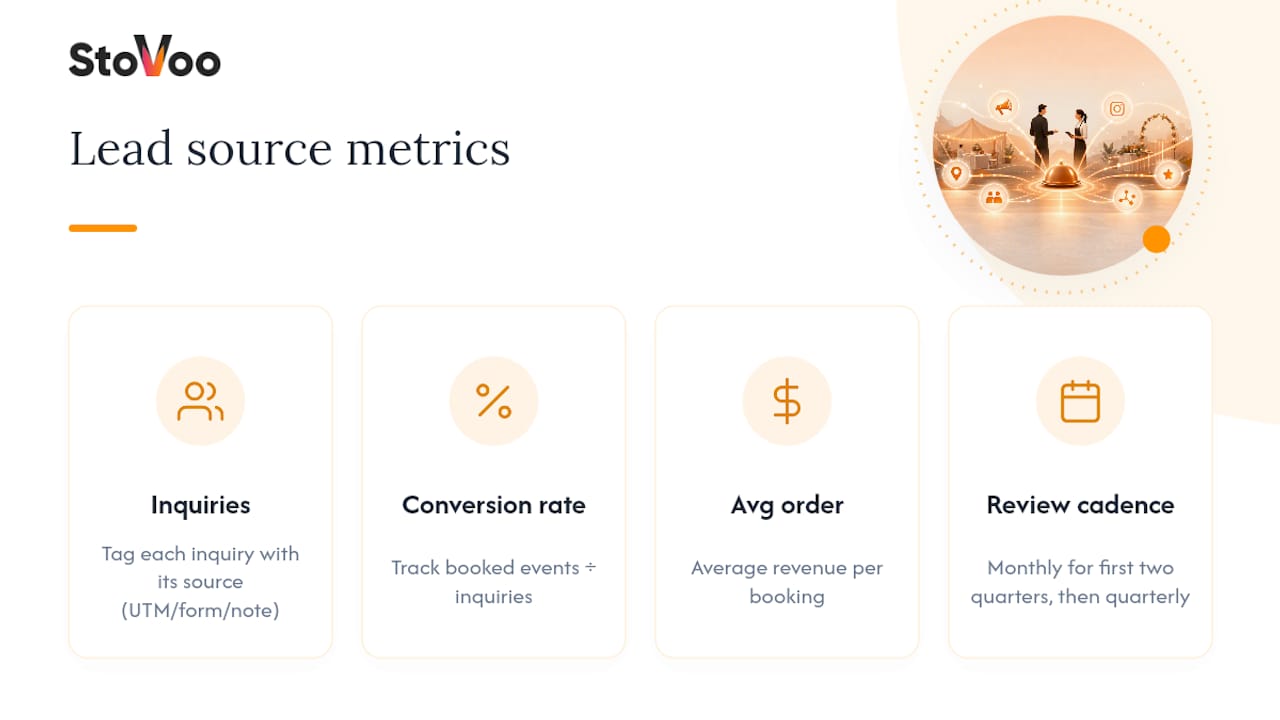
You can't fix what you don't measure, and catering leads are easy to lose track of across five different channels. Start by tagging every inquiry with its source the moment it arrives, whether that's a UTM parameter on a paid ad, a "how did you hear about us" field on your form, or a manual note when someone calls after seeing your van at an event.
From there, the calculation is straightforward: total revenue from a source divided by total cost of running that source over the same period. If a $400 PPC campaign in a given month produced two booked events worth $3,000 combined, that channel just returned roughly 7.5 times its spend. Compare that against your referral channel, which likely costs you almost nothing beyond the occasional thank-you gift, and the return-per-dollar looks completely different even if the total revenue is smaller.
Track three numbers per source at minimum: number of inquiries, conversion rate to booked events, and average order value. A source that generates plenty of inquiries but low conversion is often a targeting problem, not a volume problem, worth fixing before you spend more on it. A source with fewer inquiries but a high conversion rate and strong order value, like venue referrals, often deserves more investment than its lead count alone suggests.
Review this monthly for the first two quarters of any new channel, then quarterly once you have a baseline. Seasonal patterns will skew short-term numbers, so judge a channel's real performance across a full year before deciding to cut it.
What Most Operators Get Wrong About Sourcing Leads
The most common mistake isn't picking the wrong channel. It's picking one channel and riding it until it stops working, then scrambling. A close second is treating every inquiry the same instead of qualifying fast. Fix both: diversify your sources on purpose, and reply to hot leads within the hour, not the day.
One Dashboard for Every Catering Inquiry
Running five lead sources through five different inboxes, a shared spreadsheet, and a WhatsApp thread is how good leads slip through the cracks. Stovoo gives caterers a single dashboard where every inquiry, whether it came from a Google search, a referral, or your Instagram bio link, lands in one place, gets an instant automated reply with your menu and pricing, and moves straight into a booking flow without you copying information between tools.
You keep full ownership of every customer relationship the platform helps you capture; nothing about your contact list or order history belongs to a third party. If you're tired of chasing leads across scattered messages, set up your Stovoo shopfront and start routing every inquiry, from every source, into one workflow you actually control.
Further Reading and Tools
- Catering Booking Checklist: a practical rundown for turning inquiries into confirmed events.
- Catering Client Acquisition Methods: a deeper dive into outreach tactics covered here.
- Google Maps Lead Generation for Food Businesses: the outreach workflow and open-rate benchmarks referenced above.
Sources
Common sources include local outreach to office managers, wedding venue referrals, Google and PPC searches, social media, past customers, and marketplaces or directories.
- Catering Lead Generation for Restaurants | FlashCater
- 10 Ways to Generate Leads for Catering Businesses
- Catering Company Lead Generation: B2B and Event Strategies for USA 2026 | LeadsuiteNow
- Lead Generation for Catering: Book More Events
- Google Maps Lead Generation for Food Businesses: How to Find Catering & Events Clients | LeadScraper Pro
FAQ
How do I get leads for my catering business?
Combine local business outreach, a complete Google Business Profile, referrals from past clients, and targeted PPC on event-specific terms. Most successful caterers run at least three of these simultaneously rather than depending on one.
What are the 7 P's of catering?
Definitions vary across marketing sources, but the concept generally adapts the classic marketing mix (product, price, place, promotion, people, process, physical evidence) to catering, covering menu, pricing, delivery logistics, marketing, staff, service workflow, and presentation.
What is the most profitable food to cater?
Profitability depends more on your labor cost and portion control than the specific dish, though buffet-style menus with shelf-stable sides and simple plated proteins tend to carry stronger margins than labor-intensive, made-to-order items.
How quickly should I respond to a catering inquiry?
Aim to respond within two hours during business hours. Slower replies noticeably reduce your chance of closing the booking, especially when a buyer is comparing multiple caterers at once.