
TL;DR:
- Most catering failures stem from operational flaws rather than a lack of customers, requiring precise logistics and workflow design. Implementing systems for event-specific prep, profit tracking, and operational engineering enables scalable growth and sustained profitability. Building repeatable processes and leveraging data-driven insights are essential for long-term success in catering businesses.
Most catering businesses don't fail because they lack customers. They fail because the operational model is fundamentally different from a restaurant, and too many owners try to run events the same way they'd run a dining room. Catering demands precise logistics, event-driven prep cycles, and margin discipline that most dine-in playbooks simply don't address. Whether you're handling five events a month or pushing toward fifty, the strategies that separate thriving catering businesses from struggling ones come down to workflow design, data-driven profitability tracking, and systems that hold up under pressure.
Table of Contents
- Design your workflow for operational constraints
- Track profitability at the event level
- Pull the profitability levers that matter most
- Systemize preparation to stay ahead on event day
- What most catering guides miss: The untold importance of engineering systems
- Ready to simplify and scale your catering operation?
- Frequently asked questions
Key Takeaways
| Point | Details |
|---|---|
| Workflow design matters | Specialized catering workflows ensure food safety and productivity far more than copying restaurant routines. |
| Event-level profitability | Review every event separately to spot patterns, winners, and losses—business averages hide risk. |
| Boost margin with proven levers | Menu engineering, supplier negotiation, logistics, and waste control consistently drive profits upward. |
| Prep systems minimize chaos | Robust preparation reduces last-minute errors and enables stress-free event execution and growth. |
Design your workflow for operational constraints
With the importance of a specialized approach established, let's start by designing your workflow around the unique realities of catering.
Catering isn't a restaurant you take on the road. It's a logistics operation with food at the center. The moment you treat it like a dine-in service, you start losing money in ways that are hard to trace. Temperature control, transit time, and event-driven scheduling are structural constraints, not afterthoughts. Every workflow decision you make should account for them first.
The most effective catering operations build operational capacity around production and logistics constraints rather than copying dine-in workflows. That means separating your kitchen team from your packaging and transport team. When one group handles cooking and another handles portioning, labeling, and loading, accuracy goes up and errors go down. It's a simple structural change that pays off immediately.
Here's what a solid catering workflow foundation looks like in practice:
- Temperature control as a design principle: TCS (Time/Temperature Control for Safety) foods must stay out of the danger zone (40°F to 140°F). Build your prep schedule backward from event delivery time, not forward from kitchen availability.
- Event-driven scheduling: Each event gets its own prep timeline. Batch cooking for Tuesday's corporate lunch shouldn't bleed into Wednesday's wedding prep.
- Kitchen and packaging separation: Designate physical zones or time blocks for cooking versus portioning. This reduces cross-contamination risk and speeds up output.
- Standardized portion sizes: Pre-portioned bags and labeled containers cut last-minute guesswork and reduce food waste on-site.
- Equipment matched to transit needs: Insulated carriers, chafing dishes, and hot/cold transport boxes aren't optional upgrades. They're core infrastructure.
"The biggest operational mistake catering businesses make is treating the kitchen as the only constraint. Transit time and temperature management are just as critical to the final product as the cooking itself."
Pro Tip: Create a master event checklist template that covers prep milestones, packaging checkpoints, and equipment load-out. Run every event through the same checklist and update it after each one. Within three months, you'll have a reliable standard operating procedure built from real experience.
Standardizing batch prep is one of the fastest ways to reduce labor costs and last-minute scramble. If your menu features items that can be prepped 24 to 48 hours ahead, build that into your production calendar. Portion bags, pre-measured spice kits, and labeled containers all reduce the cognitive load on event day and minimize costly mistakes.
Track profitability at the event level
With systems that support smooth operations, the next move is ensuring your events are actually making money, not just covering costs.
Business-wide profit averages are misleading. A catering business can look healthy on paper while quietly bleeding money on specific event types. The fix is event-level profitability tracking, which means analyzing gross margin, food cost percentage, and labor cost for every single event you run.
Here's a step-by-step breakdown of how to calculate profit margin per event:
- Calculate total event revenue: Include all charges, service fees, and add-ons.
- Subtract food cost: Total ingredient cost for that event. Target: 28% to 35% of revenue.
- Subtract direct labor cost: Hours worked by kitchen and service staff multiplied by their hourly rate.
- Subtract direct event expenses: Rentals, transport, packaging, and disposables.
- Calculate gross profit: Revenue minus all direct costs above.
- Calculate gross margin percentage: Gross profit divided by revenue, multiplied by 100.
Here's what a typical event profitability breakdown might look like:
| Event type | Revenue | Food cost | Labor cost | Other costs | Gross profit | Gross margin |
|---|---|---|---|---|---|---|
| Corporate lunch (50 pax) | $2,500 | $750 (30%) | $400 (16%) | $150 (6%) | $1,200 | 48% |
| Wedding reception (120 pax) | $9,600 | $3,200 (33%) | $1,800 (19%) | $480 (5%) | $4,120 | 43% |
| Custom private dinner (20 pax) | $1,800 | $720 (40%) | $540 (30%) | $120 (7%) | $420 | 23% |
That custom private dinner tells a clear story. High food cost, high labor relative to revenue, and a margin that barely justifies the effort. Without event-level data, you'd never know it was dragging your averages down.
Common red flags to watch for in your event data:
- Underpriced events: If food cost alone exceeds 35%, you're likely undercharging.
- Custom menu creep: One-off dishes require extra prep time, specialty ingredients, and higher error rates. They cost more than they appear to.
- Excessive labor: Events requiring more than 20% of revenue in labor are worth re-examining for staffing efficiency or pricing adjustments.
Pro Tip: After every event, spend 15 minutes filling out a simple profit recap sheet. Track revenue, food cost, labor hours, and any unexpected expenses. After 10 events, you'll have enough data to see patterns that will genuinely change how you price and plan.
Pull the profitability levers that matter most
Once you know your winners and losers, it's time to systematically boost the metrics that matter most.
Not all improvements are created equal. Some changes take months to show results. Others can shift your margin within a few events. Profitability improvements in catering commonly come from a focused set of levers: menu engineering, supplier and procurement control, delivery density and logistics, labor right-sizing, and waste and yield improvements.
Here's how each lever stacks up in terms of impact and effort:
| Lever | Typical margin impact | Implementation effort | Time to results |
|---|---|---|---|
| Menu engineering | 3% to 6% improvement | Medium | 1 to 2 months |
| Supplier negotiation | 2% to 4% improvement | Medium | 1 to 3 months |
| Delivery density optimization | 1% to 3% improvement | Low to medium | Immediate |
| Labor right-sizing | 2% to 5% improvement | High | 2 to 4 months |
| Waste and yield improvement | 1% to 3% improvement | Low | Immediate |
Combined, small disciplined changes across these five areas can realistically improve your overall margin by 4% to 9%. On a $200,000 annual revenue base, that's an additional $8,000 to $18,000 in profit without adding a single new client.
Menu engineering means designing your menu around items with the best margin, not just the ones clients ask for most. Analyze which dishes cost the least to produce relative to what you charge. Promote those items in your proposals and packages. Quietly retire or reprice the dishes that consistently eat into your margin.
Supplier negotiation is underutilized by most small catering businesses. If you're placing regular orders, you have more leverage than you think. Ask for volume pricing, consolidated delivery schedules, and seasonal substitutions that maintain quality at lower cost. Even a 5% reduction in ingredient cost can meaningfully shift your food cost percentage.
Delivery density refers to how efficiently you route and schedule deliveries. Running two events in the same area on the same day costs far less per event than two separate trips across town. When possible, cluster events geographically or adjust scheduling to reduce transport overhead.
Labor right-sizing means matching staffing levels to actual event needs rather than overstaffing out of habit or anxiety. Use your event-level data to build staffing models based on guest count, service style, and menu complexity. Over time, you'll develop reliable staffing ratios that prevent both under-staffing and costly over-staffing.
Waste and yield improvement starts with better purchasing. Order based on confirmed headcount plus a realistic buffer, not a generous cushion that becomes expensive leftovers. Track yield on high-cost proteins and produce items to identify where shrinkage is hurting you.
Systemize preparation to stay ahead on event day
Maximizing profits with proven levers is easier to sustain when your operation runs like clockwork, especially under pressure. Here's how top operators prepare.
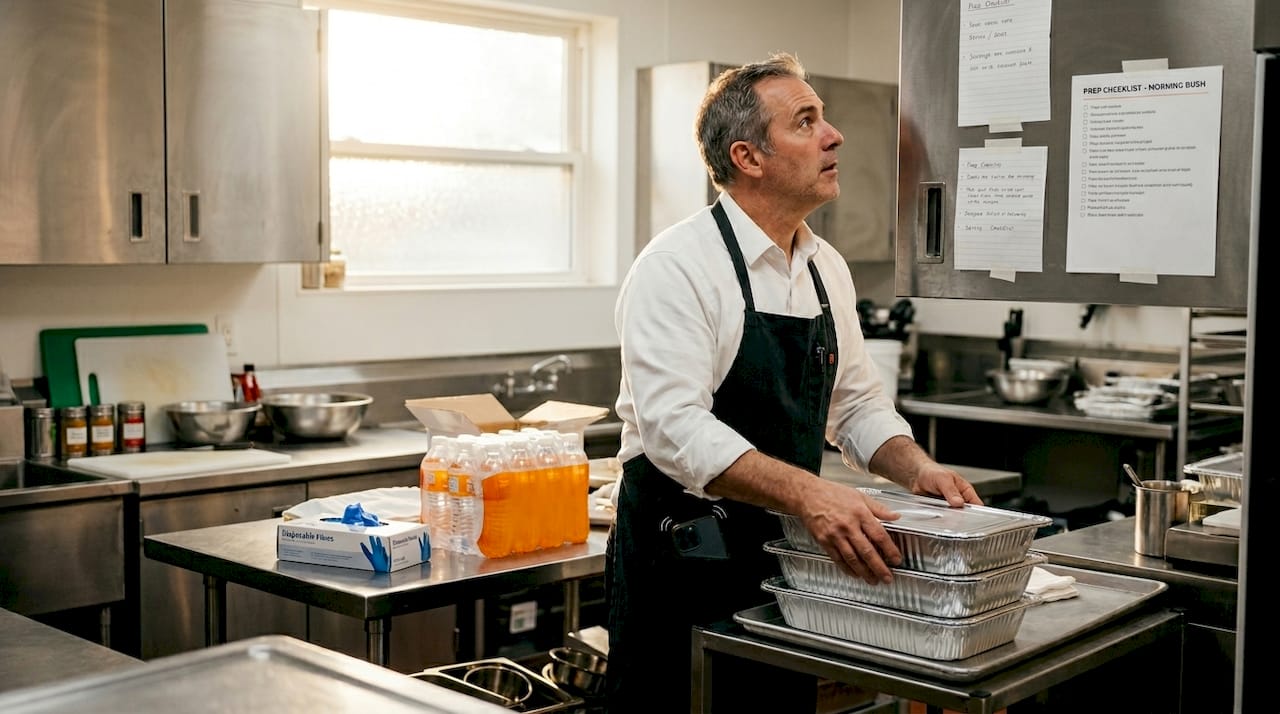
The most instructive example in the catering industry comes from operators who've scaled to high event volume by building preparation systems and precision that prevent scramble on event day. The lesson isn't that they work harder. It's that they've engineered their prep so thoroughly that event day becomes execution, not problem-solving.
Here's a concrete prep system you can build starting this week:
- Build event-specific prep sheets: For each event, list every dish, the quantity needed, the prep steps, and the timeline. This document becomes the single source of truth for your kitchen team.
- Set up batch stations: Organize your kitchen by task category, not by dish. Proteins in one zone, vegetables in another, sauces and dressings in a third. This reduces movement and speeds up output.
- Pre-portion into labeled bags or containers: Every component that can be pre-portioned should be. Label with the event name, date, and contents. This eliminates confusion during pack-out.
- Use time-stamped labels for TCS foods: Any item that requires temperature control should have a prep time and a use-by time clearly labeled. This protects food safety and reduces liability.
- Conduct a pre-event load-out check: 60 minutes before departure, run through your equipment checklist, confirm all food containers are sealed and labeled, and verify transport temperatures.
"Plan the first 95% so you can deliver the last 5% under pressure."
That mindset is what separates operators doing 10 events a year from those doing 100. The chaos that derails most catering businesses on event day isn't random. It's the predictable result of under-engineered prep. Every checklist you build, every portion bag you label, every batch station you set up is a direct investment in your capacity to scale.
Pro Tip: After your next three events, note every moment where you had to improvise or problem-solve on the fly. Those moments are your system gaps. Fix them one at a time and you'll watch your event-day stress drop significantly within a month.
Robust prep systems also reduce costs in ways that aren't immediately obvious. Fewer mistakes mean less food waste. Faster pack-out means less overtime labor. Consistent portion sizes mean more accurate food cost forecasting. The operational and financial benefits compound quickly.
What most catering guides miss: The untold importance of engineering systems
Here's a perspective that most catering content won't give you: the advice to "market more" or "build a better menu" is not wrong, but it's almost always premature. The catering businesses that achieve real, sustainable growth almost universally credit their breakthrough to a single shift: they stopped running on instinct and started engineering their operational capacity in catering.
Marketing brings in clients. A great menu wins repeat business. But neither of those things protects your margin when you're running six events in a week and your prep team is improvising. The operators who scale from $100,000 to $500,000 in annual revenue aren't doing it by posting more on Instagram. They're doing it by building systems that make every event repeatable, measurable, and improvable.
There's a common story among catering founders who hit a wall around 30 to 40 events per year. Revenue looks good. The phone keeps ringing. But profit is flat or declining, and the owner is exhausted. The culprit is almost always the same: the business grew on hustle, and hustle doesn't scale. What scales is a documented workflow, an event-level profit model, and a prep system that doesn't depend on any single person's memory or energy.
The uncomfortable truth is that intuition gets you to your first $50,000. Systems get you to your first $500,000. The catering owners who resist building operational infrastructure because it feels bureaucratic or time-consuming are the same ones who plateau and burn out. The ones who invest in it, even imperfectly at first, are the ones who keep growing.
Don't wait until you're overwhelmed to build your systems. Build them now, while you have the bandwidth to think clearly. Start with one checklist, one prep sheet, one event-level profit tracker. Then iterate. The compounding effect of small, disciplined improvements is the real secret to a profitable catering business.
Ready to simplify and scale your catering operation?
If the strategies in this article resonate with you, the next step is finding tools that make them practical to implement without adding more admin to your plate. Tracking event profitability, managing bookings, and staying on top of prep systems all become significantly easier when you have the right platform behind you.
Run your catering business without chaos with Stovoo, a platform built specifically for food entrepreneurs who want to manage catering bookings, track recurring orders, and own their customer relationships without juggling spreadsheets and WhatsApp threads. Stovoo gives you a professional mobile-first shopfront, automated billing, and a centralized dashboard so you can focus on the food and the events, not the admin. It's the operational backbone your catering business deserves.
Frequently asked questions
What is the single most effective way to boost catering profits?
Focusing on menu engineering and supplier negotiation usually has the biggest and fastest impact on profit margin, often improving overall margin by 3% to 6% within the first two months.
How should I handle food safety for off-premise events?
Treat temperature control and transit logistics as core engineering constraints, and always use TCS-compliant equipment to maintain safe food temperatures throughout transport and service.
How do I know if an event is really profitable?
Track every event individually for gross profit, food cost percentage, and labor cost to compare actual results versus your targets, as event-level tracking reveals which event types drive margin and which quietly drain it.
What's the most common prep mistake owners make?
Most owners under-invest in event-specific prep systems, which leads to last-minute chaos, higher error rates, and unnecessary labor costs, all of which building preparation systems directly prevents.